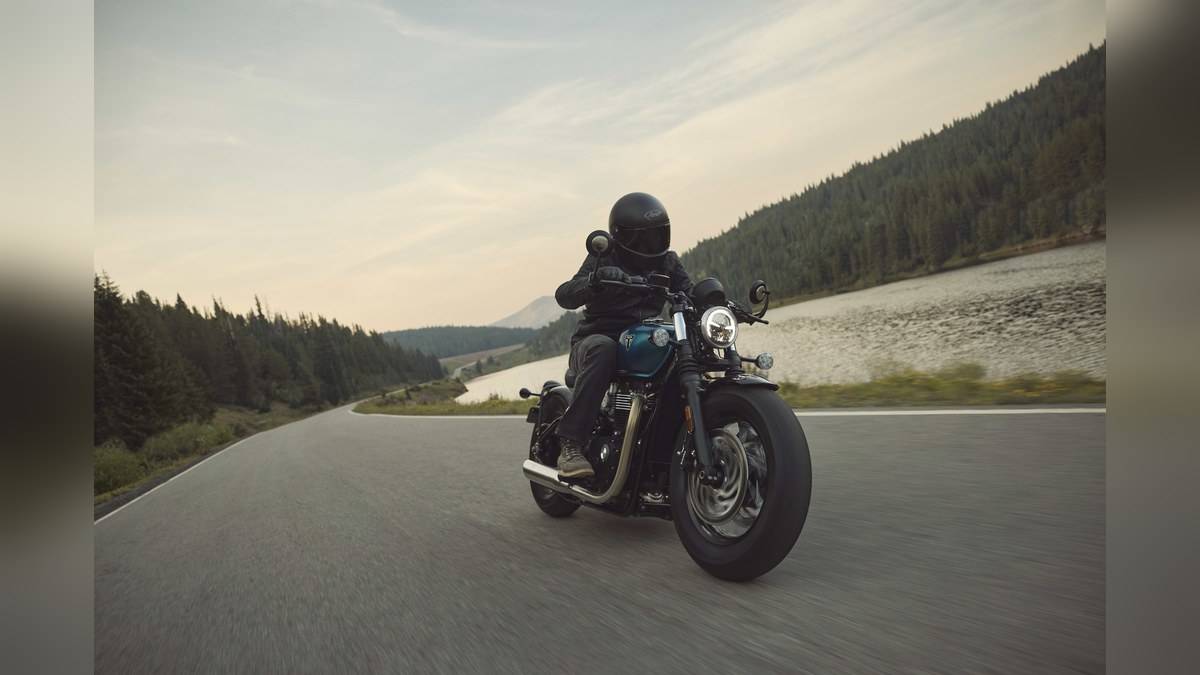
NEW DELHI: The Triumph Bonneville Bobber has an official seat height of 690 mm, alongside a listed wet weight of 250 kg. Those figures describe different aspects of accessibility. The low saddle helps explain the Bobber's stance, but it cannot by itself establish how easily every rider can move or balance the motorcycle.
| Item | Official listing |
|---|---|
| Seat height | 690 mm |
| Wet weight | 250 kg |
| Rear suspension | KYB monoshock with linkage and preload adjustment |
| Front suspension | 47 mm Showa cartridge forks |
| Engine | 1,200 cc parallel twin |
| Fuel capacity | 14 litres |
| Wheel diameter | 16 inches front and rear |
Ground reach is only part of the fit
Seat height measures a vertical dimension. A rider's actual path to the ground also depends on the saddle shape, the space around the motorcycle and how the legs fall beside it. That is why a numerical comparison can begin a fit assessment but cannot finish one. A low figure does not provide a universal guarantee of flat-footed contact.
The Bobber makes this distinction particularly relevant because its floating saddle is central to the design. Triumph describes a wider, more sculpted seat and a concealed adjustment mechanism. Appearance and fit are linked here: moving a rider's position can affect reach to the bars and foot controls, even when the motorcycle continues to look much the same from the side.
Any seat-position change needs the applicable handbook procedure and correct securing of the mechanism. The public product page does not supply a complete adjustment method or a verified set of alternative seat heights. There is consequently no basis for inventing a range around the published figure or promising that an adjustment will suit a particular body shape.
A low saddle does not remove the weight
Pushing a motorcycle backwards into a parking slot is a different task from placing a foot down at a signal. The Bobber's wet mass remains part of that task even when the saddle allows an easy reach. A careful assessment distinguishes between supporting the motorcycle upright, turning it within limited space and moving it on a slope.
This matters in an Indian home-parking context, where the final approach can be more awkward than the road journey. The official measurements cannot predict the result for a particular house, but they do show why describing the Bobber simply as easy because it is low would be incomplete.
Control reach should be considered separately too. Being able to place a foot on the ground does not establish that the handlebars fall comfortably to hand or that the rider can operate every control without stretching. The Bobber's distinctive layout makes a seated check of the whole riding position more informative than judging the saddle in isolation.
The hard-tail appearance hides working suspension
Triumph uses a steel swing cage and a concealed, linkage-operated rear monoshock to preserve the stripped-back outline. The specification identifies a KYB unit with preload adjustment. The motorcycle therefore has working rear suspension despite the visual suggestion of an older rigid-frame custom. This is a concrete mechanical distinction, rather than merely a styling description.
It also changes how photographs should be read. An uncluttered space beneath the floating saddle does not prove an absence of suspension. The mechanism is packaged elsewhere within the chassis. For readers unfamiliar with the design, following that load path is more useful than assuming that every visible styling cue corresponds directly to a traditional mechanical arrangement.
Preload adjustment should not be translated into an unlimited ability to alter the riding position. The seat mechanism and rear suspension perform different jobs. Without the relevant limits and procedures, combining them into a claimed lower saddle measurement would be misleading. The verified height in this report remains the figure in Triumph's official specification.
The rest of the package shapes its identity
The Bobber pairs its compact vertical stance with a large-capacity twin and matching wheel diameters. These describe its custom-roadster identity without establishing a turning circle or handling score. None of those results can be calculated reliably from the saddle measurement and styling alone.
Its fuel tank capacity is useful as an ownership reference, yet it cannot establish a dependable distance between fills. Consumption varies with conditions, and no independently measured range is offered here. Keeping capacity separate from range is the same discipline as keeping saddle height separate from handling: a confirmed dimension should not become an unsupported performance claim.
How to describe accessibility accurately
For the Bobber, an accurate fit description needs to connect the low seat, floating-saddle arrangement, reach to the controls and the mass being handled. Each contributes something different. A rider may value the visual stance and ground reach while still needing to assess parking manoeuvres carefully. That is a model-specific explanation of accessibility without pretending that a single dimension settles it.
The confirmed figure is a useful reference precisely because its limits are clear. It describes the Bonneville Bobber as listed by Triumph India, with the hidden rear suspension and overall package shown above. Personal fit remains something to establish on the actual motorcycle, with the seat correctly secured and the riding position checked as a whole.
Related coverage: Triumph Speed T4 price report, Scrambler 400 X and Speed 400 comparison, Scrambler 400 XC price explainer.
Official source: Triumph India Bonneville Bobber product page.