
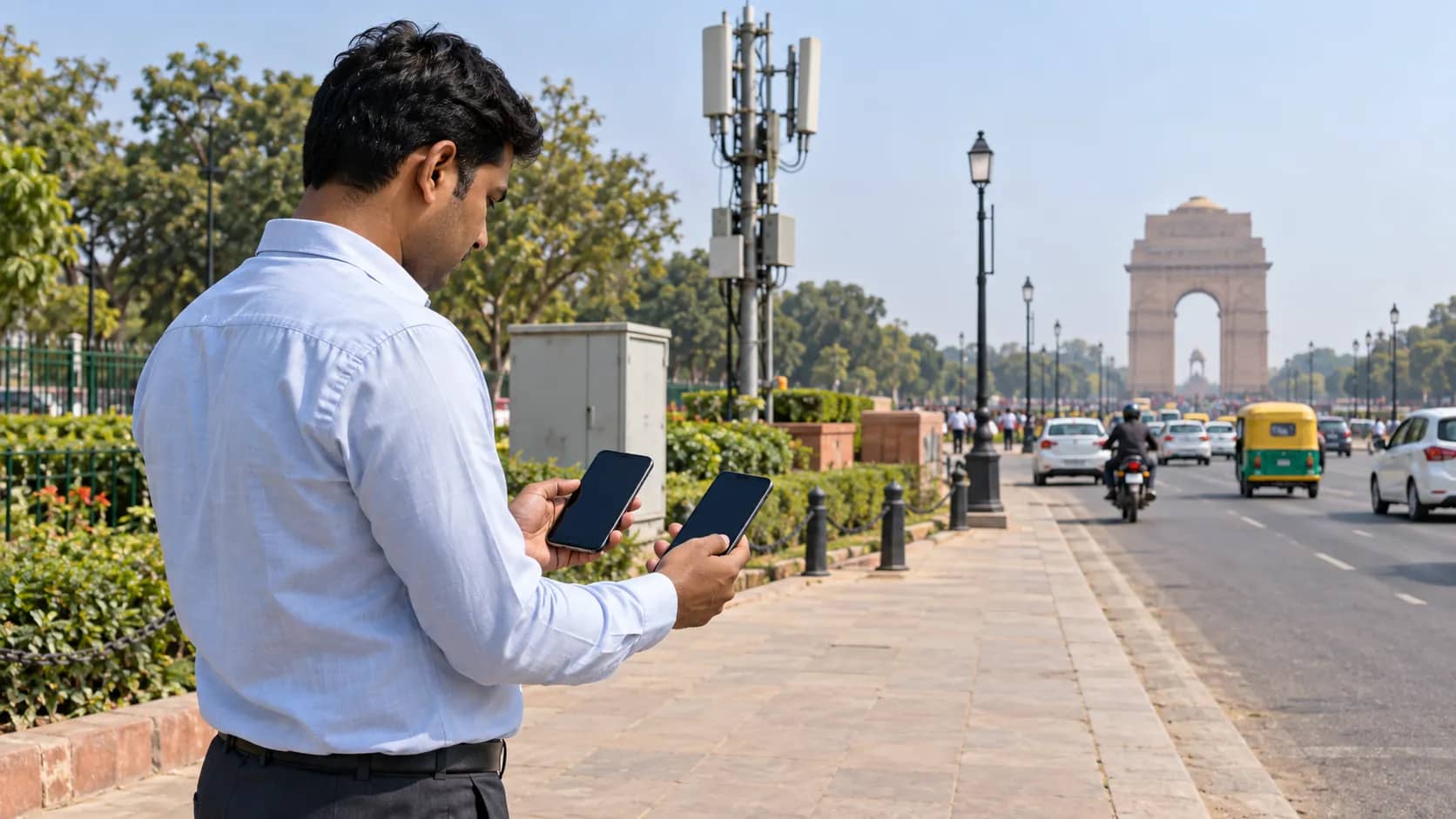
The Telecom Regulatory Authority of India has published Delhi mobile-network test results showing different performance across downloads, uploads and voice calls. The findings, released on 12 October 2026, cover field tests conducted from 10 to 14 August on routes described by the regulator as New Delhi and Central Delhi.
The exercise covered 322.9 km of city driving, 11 stationary hotspots and a 2.2 km walk test, with inter-operator calling tested at one location. TRAI says the observations represent the tested route and the day and time of measurement. They cannot establish the speeds available across Delhi in October.
Testing was supervised by TRAI's Delhi regional office. The methodology uses operator SIM cards in multiple test handsets, with live voice and data sessions monitored through software. The official release and detailed annexure provide the measurements and route maps.
Downloads and uploads produce different results
Average measured download throughput was 156.52 Mbps for Airtel, 4.34 Mbps for MTNL, 287.91 Mbps for RJIL and 39.57 Mbps for VIL. RJIL and VIL are the abbreviations used in the report for the operators familiar to consumers as Jio and Vi.
Uploads showed a different order. The measured averages were 23.94 Mbps for Airtel, 1.17 Mbps for MTNL, 23.31 Mbps for RJIL and 25.41 Mbps for VIL. Downloads and uploads measure data travelling in different directions, so the download result alone does not describe performance when sending a file.
The annexure places these tests in automatic network-selection mode across 5G, 4G, 3G and 2G. It labels Airtel, RJIL and VIL as operating up to 5G, and MTNL up to 3G. The results should therefore be read with that difference in network capability, rather than as a comparison conducted entirely on one technology.
Call drops and silence need separate counts
In the overall calling test, Airtel recorded no dropped calls among 868 successfully established calls. MTNL recorded 123 drops among 794 established calls, RJIL two among 872, and VIL one among 877. Those denominators describe the test sample; Airtel's zero here is not a guarantee of uninterrupted calls elsewhere.
The separate call-silence test used 5G/4G automatic selection and a different set of established calls. Airtel had three calls with silence lasting longer than three seconds, producing three silence instances among 844 established calls. RJIL had 40 affected calls producing 46 instances among 835 calls.
VIL recorded nine affected calls and 11 silence instances among 845 established calls. MTNL was marked not applicable in this table. An instance is an occurrence of silence, and a single call can contain more than one. Reporting RJIL's 46 instances as 46 affected calls would misstate the annexure.
Signal samples provide another view of the route. Airtel recorded 1,594 poor-signal samples out of 97,412; MTNL 59,106 out of 91,219; RJIL 1,610 out of 95,084; and VIL 983 out of 97,747. These counts refer to measurements taken during voice testing, not numbers of affected people or the proportion of Delhi's area without service.
The annexure separately records limited-service or no-coverage samples: zero for Airtel, 1,896 for MTNL, 18 for RJIL and zero for VIL. It lists these separately from poor-signal samples, so readers should keep the two categories distinct when examining the coverage maps.
Where the tests apply
The driving route included India Gate, Khan Market, Janpath, Kashmere Gate, Daryaganj and Civil Lines, as well as areas such as Lajpat Nagar, Hauz Khas and Sarojini Nagar. Stationary testing included Agrasen Ki Baoli, Old Delhi Railway Station, Red Fort and Sadar Bazar. These are examples from the route list, not a survey of every Delhi neighbourhood.
The walk test on 14 August covered Bhagirath Palace Electronic Market, examining a crowded pedestrian setting. Someone comparing the findings with their commute can use the official maps to identify tested stretches. A nearby route measurement does not establish the connection quality inside a particular home or office.
Indoor connectivity has a separate assessment context. Dalimss News previously covered TRAI's building digital-connectivity rating platform. For readers comparing a mobile connection's benefits as well as its network, the earlier guide to Airtel's free-roaming terms addresses a different question: the conditions attached to a plan.
TRAI says it has shared the drive-test findings with the respective service providers for necessary action. The release gives no deadline for remedial work and does not say that identified problems have already been fixed. The published results provide a dated, route-specific record against which later measurements can be assessed.