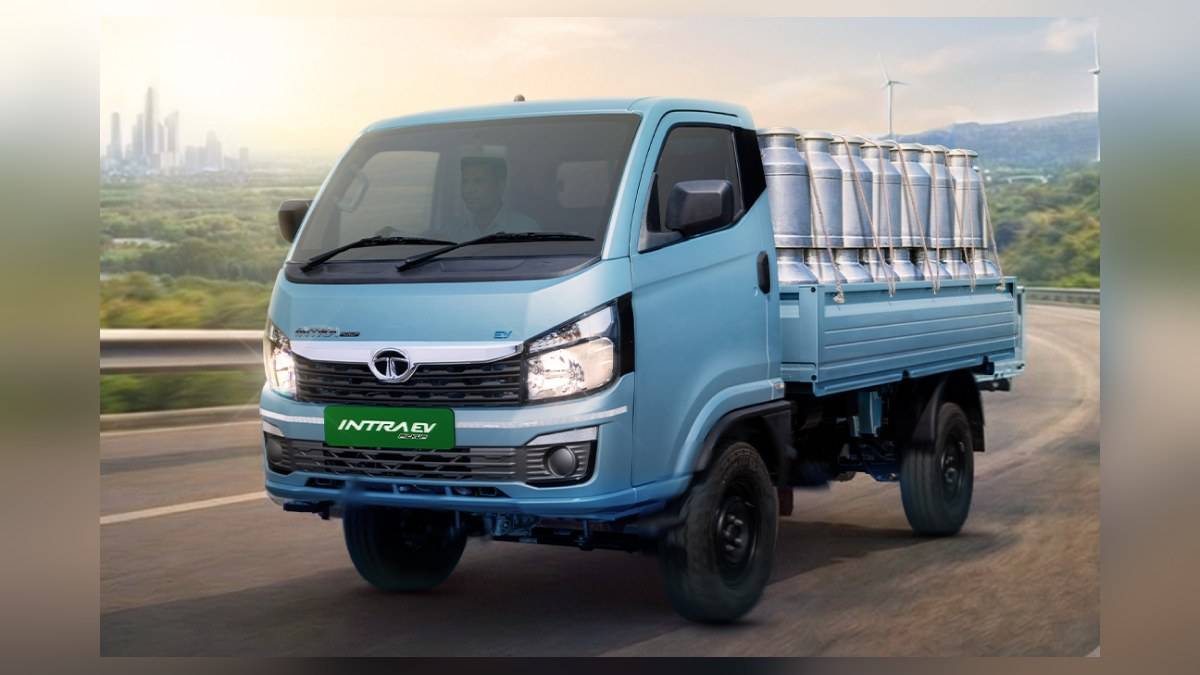
NEW DELHI: Tata Motors quotes about 55 minutes for the Intra EV Pickup to charge from 10% to 80% using a CCS2 charger. That is the fast-charging window in its official launch release and on the brochure cover. It is not a full-charge time, and it should not be used as the duration of an overnight AC charging session.
| Intra EV charging and range | Official statement |
|---|---|
| Fast-charge headline | 10% to 80% in about 55 minutes |
| DC connector | CCS2 |
| Battery | 28.2 kWh LFP |
| Certified range | 211 km |
| Brochure real-world range | 125 to 140 km, conditions apply |
| AC charging, 3.3 kW charger | 10.8 to 11 hours |
| AC charging, 6.6 kW charger | 4.8 to 5 hours |
Read the battery window with the time
The charging claim has a defined starting point and a defined finishing point. Removing those percentages changes its meaning. An Intra EV arriving with a different state of charge cannot automatically be assigned the same stopping time, and the quoted figure does not describe how long the final part of a full charge takes.
Tata's brochure also expresses DC charging as a range of 50 to 60 minutes for the same battery window. That is consistent with the approximate figure on its cover. The sensible reading is a manufacturer estimate for the stated charging method, rather than a promise that every visit will finish at an identical minute.
The brochure's AC entries are separate. It lists durations alongside the respective charger ratings, but does not clearly label a battery percentage window for those entries. They should therefore be reproduced as published, without assuming that they refer to the fast-charge window or claiming a directly comparable charging-speed ratio.
Put the stop into a working delivery schedule
For an Intra EV collecting milk cans before a distribution run, the operational question is when charging can happen without interrupting the collection window. A CCS2 stop might sit between delivery duties, while depot charging might fit a longer parked period. Those are different schedules, even though both replenish the same vehicle.
This is a planning example, not a finding from a road test. The depot would need to establish charger access, vehicle arrival charge and the time taken to reach the charger. Queueing, positioning and connecting the vehicle also belong in the timetable. The advertised charging interval by itself does not account for the whole stop.
That distinction matters particularly when a route has a fixed dispatch time. A dispatcher should work backwards from departure and record what charging equipment is actually available. An assumed charger rating in a spreadsheet is not a substitute for an installed, compatible and usable facility at the place where the pickup parks.
Certified range is not the brochure's working-range estimate
Tata publishes both a certified range and a separate real-world range band. The brochure attributes the certification figure to ARAI and states that actual range varies with load, driving style, terrain and weather. Those qualifications should remain attached to the range entry whenever it is copied into a fleet proposal.
The consequence for an Intra EV route sheet is straightforward: do not combine the certification headline with the fast-charge headline to guarantee a day's delivery distance. They describe different aspects of the vehicle. An operator needs a record of its own outward journey, delivery circuit and return requirement before setting a charging routine.
The pickup's rated payload is 1,750 kg. That makes the load carried during a route assessment an essential part of the record. An assessment conducted with a lightly loaded vehicle cannot, by itself, establish the energy requirement of the business's heaviest regular assignment.
Tata also describes three-level regenerative braking. That is another reason to record the actual duty cycle: an urban collection circuit and an uninterrupted road journey involve different patterns of acceleration and slowing. The presence of regeneration does not justify adding an assumed distance allowance to the published range.
Equipment and duty cycle belong together
The launch release lists a 72 kW motor and 230 Nm peak torque, along with electric power-assisted steering and Fleet Edge connectivity. Those details help describe the Intra EV as a working pickup. They do not establish a guaranteed electricity bill, charging tariff or saving against a diesel vehicle, so none is assumed here.
Related commercial EV reading includes the Tata Aeris introductory prices span Rs 5.29 lakh to Rs 9.74 lakh and Tata.ev prices: Tiago.ev from Rs 6.99 lakh, Nexon.ev offers up to Rs 1.41 lakh. Each vehicle needs its own figures. Our EV battery rental explained: BaaS prices for Punch.ev, Syros EV, Creta, BE 6 covers another commercial-vehicle reference point.
For the Intra EV, the useful distinction is between a specified DC top-up and a longer AC session. Preserve that distinction in the dispatch plan, use the matching equipment entry, and validate the routine against actual work.
Official sources: Tata Motors Intra EV launch release and Intra EV product brochure, rechecked on 8 November 2026.