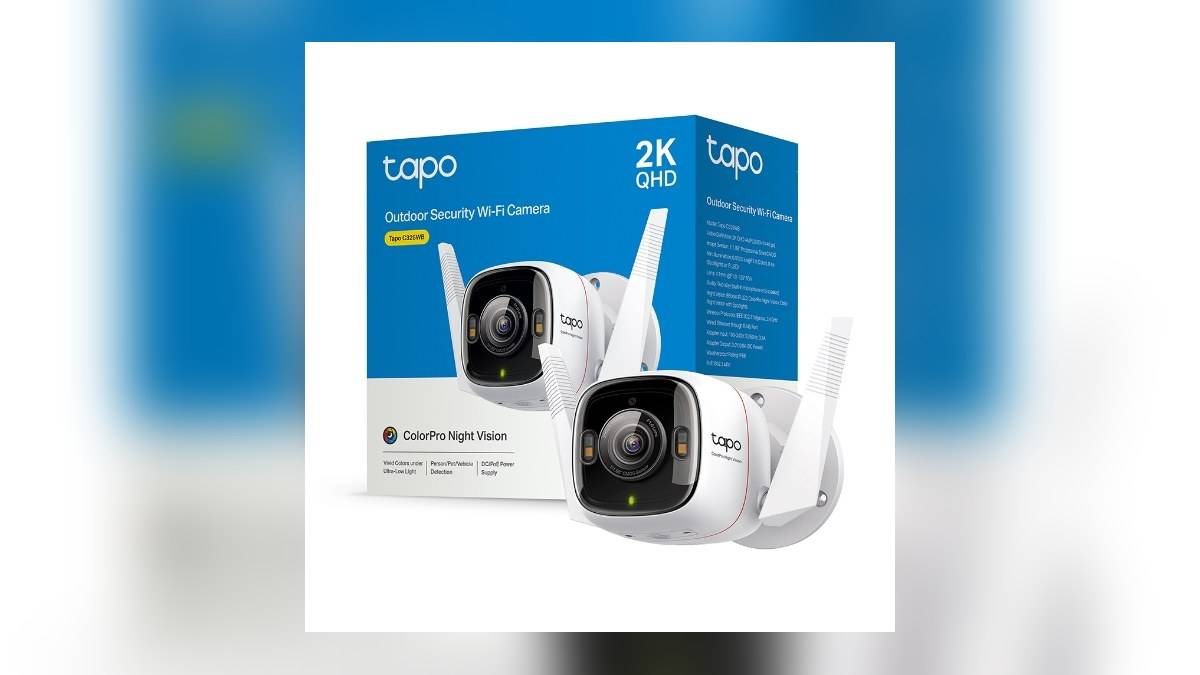
NEW DELHI: Tapo C325WB specifications change with the hardware version: the official V1 sheet lists 2688 x 1520-pixel video, while V2 lists 2560 x 1440 pixels and adds 802.3 af/at Power over Ethernet. Anyone planning an outdoor camera cable run should establish the version before deciding where its power supply will sit.
| Official specification | C325WB V1 | C325WB V2 |
|---|---|---|
| Maximum video resolution | 2688 x 1520 pixels | 2560 x 1440 pixels |
| Sensor format | 1/1.79 inch | 1/1.88 inch |
| Lens aperture | F1.0 | F1.0 |
| Power source listed | 9V DC adapter | 9V DC adapter or 802.3 af/at PoE |
| Network socket | 10/100 Mbps Ethernet | 10/100 Mbps Ethernet |
The version changes the installation plan
Both version sheets list a horizontal field of view of 106 degrees and a vertical field of view of 56 degrees. Check those axes when framing a gate rather than relying solely on a headline diagonal angle.
The distinction is easy to miss because both cameras carry the C325WB name and use ColorPro branding. The versioned pages describe different hardware configurations. These are not camera-app quality settings, and selecting a different video mode cannot add a power feature that the specification does not list.
Consider a home with an Ethernet cable already reaching a gate pillar but no convenient socket near the camera. V2's documented PoE support makes that cable relevant to the power plan. For V1, the published power specification lists the DC adapter. Do not infer PoE merely because an Ethernet connector is present.
This is a documentation comparison, not an announcement of a new Indian launch or a claim that every local seller holds V2. TP-Link India's product page and Tapo's version-specific global pages should be read together. Match the label on the actual unit to its support documents before asking an installer to finish the wiring.
Resolution does not settle night-time performance
V1's published maximum frame contains more pixels than V2's. That is a useful recording specification, but it does not establish which camera will reveal a moving face more clearly at a particular entrance after dark. The sensor and lens specifications also change, and a pixel count alone cannot replace a test at the installation site.
Tapo's V1 overview pairs its low-light positioning with a large sensor and wide aperture. The V2 overview retains ColorPro positioning and describes operation without distracting lights. Both are manufacturer descriptions of the imaging approach. They should not be turned into a promise that every dim driveway will produce equally bright or equally detailed colour footage.
For an entrance shaded by a porch, inspect footage when the porch light is on and when it is off. Include a person walking through the view rather than judging a still picture of an empty gate. That is an editorial testing suggestion, not a measured result for either version.
The network choices have clear boundaries
The versioned specification sheets list Wi-Fi and Ethernet networking for both units, with wireless connectivity on 2.4 GHz. The Ethernet socket is rated at 10/100 Mbps. Neither fact should be confused with the PoE difference: a wired data path and the method used to power the camera are separate entries in the specification.
In a household discussing a faster router at the same time as new CCTV, keep that distinction visible in the installation notes. Record whether the camera will use wireless or wired data and, separately, what will power it. This avoids an ambiguous instruction such as simply asking for a wired camera connection.
Both version sheets also list RTSP and ONVIF. Those entries are relevant when checking whether a separate recorder can use the camera's feed, but the entries alone do not establish compatibility with a particular recorder configuration. Check the recorder's requirements against the camera documentation before assuming the whole system will work together.
Plan recording and placement as well as cabling
Local storage is specified as a microSD card up to 512 GB on both versions, with Tapo Care offered separately as a subscription service. Capacity is not a guaranteed recording duration. Keep the storage decision distinct from the resolution comparison, especially if the purpose is to retrieve an incident after the camera itself becomes inaccessible.
Both sheets list IP66 weather resistance. The V2 overview also says the camera is intended for outdoor use and recommends mounting at 2 to 3 metres. Follow the installation documents for the exact hardware, including the supplied weather-sealing components. A weather rating should not become a reason to improvise the surrounding cable connections.
Related reading: our Tapo C520WS connector-sealing guide, Tapo C110 resolution explanation and Deco X20 Ethernet planning guide address other parts of a connected home.
Official sources: TP-Link India product page, V1 specifications, V2 specifications, and the V2 overview.