Samsung announced four winners of Solve for Tomorrow 2026 on 16 October, awarding a combined Rs 2 crore in incubation grants. QuantHunt from Raebareli, morphism from Raipur, InnoBotix from New Delhi and Somatrace from Hyderabad will receive support from FITT at IIT Delhi to develop their prototypes further, according to the official announcement.
The projects tackle different problems. QuantHunt is developing an AI cybersecurity tool for encryption weaknesses and emerging quantum-computing risks. Morphism is working on AI-assisted interpretation of facial expressions and behavioural signals to help autistic people understand emotions.
InnoBotix’s Sentinel combines cameras, radar and seismic data in a solar-powered device intended to warn of wildlife approaching settlements. Somatrace is developing a wearable that measures spinal angles and training loads for precision-sport athletes. These are the teams’ intended applications; the announcement does not publish independent performance tests or establish that the tools are ready for widespread use.
How the grant reaches each team
The 2026 competition rules set out a Rs 50 lakh grant for each winner, conditional on forming a private limited company and entering incubation. The six-month period starts with the grant agreement. Winning the competition therefore begins a further development process, with funding tied to progress.
The annexure specifies three instalments: 50% when the agreement is executed, 25% on achieving milestones and the remaining 25% after completion and submission of reports and a utilisation certificate. Technical and financial progress reports are required. The final payment follows approval.
FITT must verify the company documents before onboarding. Where winners are minors, parents or legal guardians can be the company’s promoters or directors and execute the agreement, while the young innovators are recognised as beneficiaries. The rules permit online or offline incubation according to teams’ geographical preferences.
Teams that choose not to enter incubation must tell FITT in writing within 60 days of the finale and will not qualify for the grant. The framework includes technical guidance and milestone reviews. An extension of up to six months needs a revised milestone plan and committee approval under the annexure.
From a student pitch to further testing
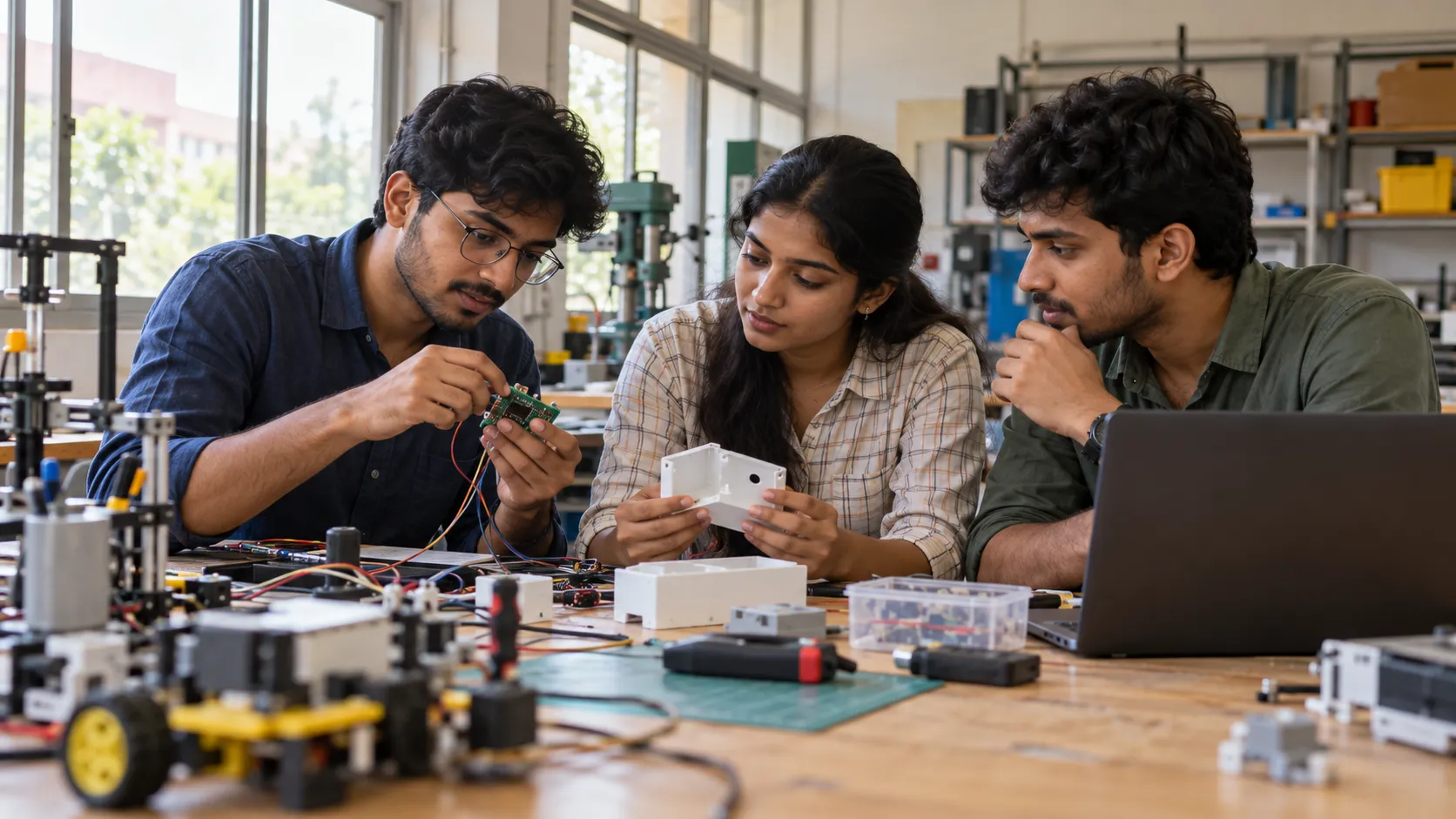
The preparation involved more than submitting an idea. Samsung’s 10 September account of the finalist stage describes a hands-on prototyping programme for 40 semi-finalist teams with FITT-IIT Delhi. At the bootcamp, teams worked with mentors on their solutions and on understanding the people expected to use them.
Participants also visited Samsung’s design operation in Delhi, research centres in Noida, Delhi and Bengaluru, and its Gurugram head office. A national pitch event then used 20 evaluators from Samsung’s research and regional operations to select five finalists in each of the four themes.
That September shortlist comprised 36 participants in 20 teams from 18 cities across 12 states. It included Varanasi’s itzFOD, whose proposed offline application explains documents in spoken language, and New Delhi’s Equinox, which proposed a voice-first study companion for visually impaired learners. Those projects illustrate the wider education and accessibility work in the finalist group; neither is among the four winners announced on Friday. The September announcement also earmarked Rs 1 lakh for each finalist team to improve its prototype, a separate stage of support before the larger incubation grants. That placed development funding alongside the training and evaluation process.
FITT’s published prototyping facilities offer a concrete picture of the infrastructure available within the incubator. Its NIDHI Centre of Excellence lists electronics and mechanical laboratories, simulation software and support on intellectual property and technical questions. The equipment inventory includes oscilloscopes, circuit-testing tools and a 3D printer.
The same page distinguishes between no-charge access for incubated startups and facilities carrying usage charges. It does not allocate equipment to these four winners or confirm that they have started using it. For hardware projects, the practical next question is which tests and facilities their development plans will require.
Readers following student entrepreneurship can also read Dalimss News on IIT-BHU’s Traction programme and its emphasis on refining early products. Our earlier IndigoTex report follows a separate IIT Delhi-linked venture’s path from research towards commercial production.