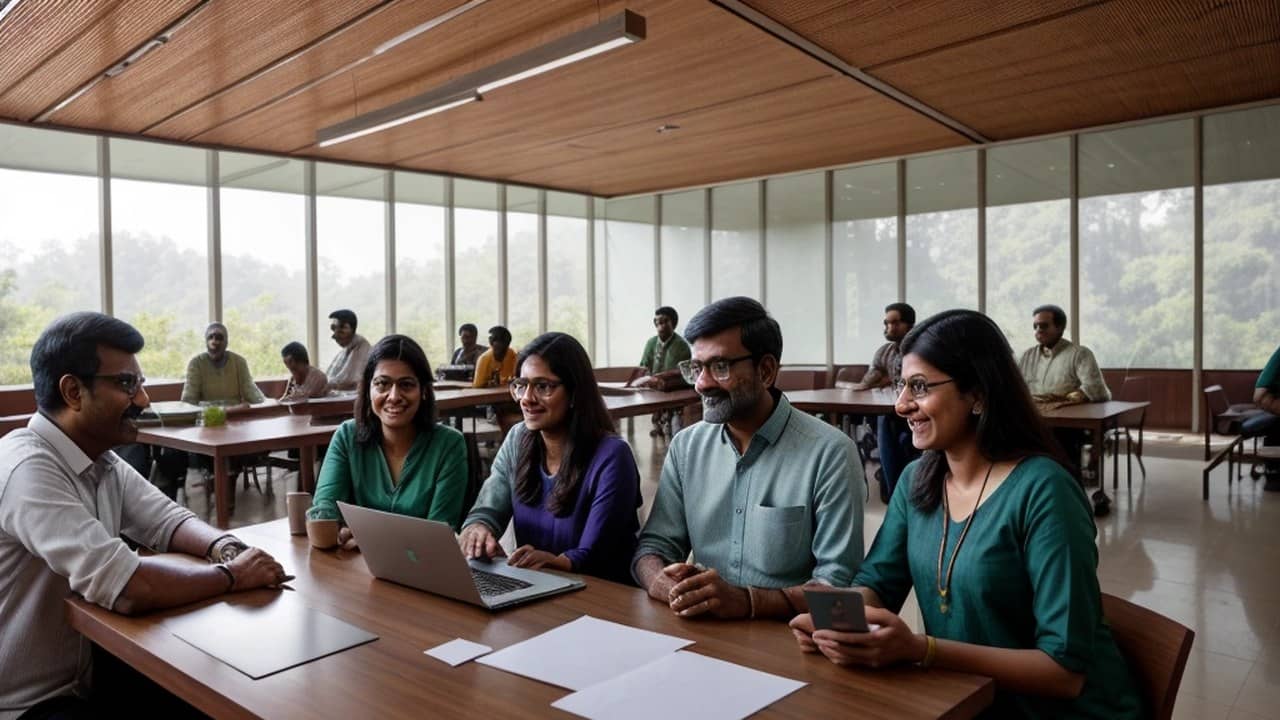
A three-day entrepreneurship programme at IIT (BHU), Traction 2026, ended on Sunday with participants presenting the minimum viable products they had refined over the course of the event. The institute's Centre for Innovation, Incubation and Entrepreneurship ran the programme from 2 to 4 October at the E-Hall of the Ideation Innovation and Incubation Foundation (I3F) on the campus.
The full title of the event, rendered in English, was "Traction 2026: Your Idea, Your Venture, Your Journey". It was organised with I3F, the Joint Incubation Centre and the E-Cell of IIT (BHU), and was open to students, faculty members, aspiring founders, innovators, researchers and early-stage startups.
According to the institute, the aim was to take participants beyond the idea stage. The sessions were built around the order in which a venture actually comes together: identifying and validating a problem, customer discovery, defining a minimum viable product, building the product, working out business and go-to-market strategy, and getting ready to raise funds.
The format leaned on doing rather than listening. Over the three days, the programme combined workshops, conversations with founders, mentor clinics, practical exercises and dedicated build sprints, in which participants worked directly on their own ventures between sessions.
Much of that feedback came from the institute's own alumni. The institute said those taking part included Rajeev Gupta, a serial entrepreneur; Amitava Saha, founder of FirstCry and Xpressbees; Dr Anand Jaiswal of the TERI School of Advanced Studies; and Dhiraj Daga, chief technology officer of Indra Astra.
Others listed were Saurabh Yadav, director of Rocksensor India; Akasmat Pradhan, chief executive of Magna Hire; Prakhar Yadav and Pranav Yadav, who lead Specker.ai; Sridhar Parthasarathy, a partner at BlueHill; Rohan Paliwal, a senior associate at Stakeboat; Sudhanshu Srivastava, an investor with venture funds; and Saurabh Singh, a partner at Trifecta Capital. The mix covered founders who have built consumer and logistics companies as well as people who sit on the other side of the table and decide which startups get funded.
The alumni spoke about their own routes into business and about the parts of company building that rarely show up in a classroom. The institute said the discussions covered commercialising technology, acquiring customers, funding and scaling up, along with the practical problems founders run into along the way.
The programme closed with each participant group reviewing its progress, refining its minimum viable product and presenting what it had achieved. The institute has not published the number of participants, the list of teams or any awards, and no funding announcements were made public from the event.
For those new to the vocabulary, a minimum viable product is the simplest working version of an idea that can be put in front of real users to see whether they want it. Customer discovery is the stage before that, where founders go out and talk to the people they hope to serve. Both steps are meant to stop teams from spending months on something no one needs.
Campus research in Varanasi has been moving closer to these questions of application. Earlier this month, Dalimss reported on a BHU scientist's role in shaping a new Ganga microplastic monitoring protocol, and in September on BHU's agreement with VCA Healthcare for scientific testing of herbal formulations. Programmes like Traction sit at the far end of that chain, where work from a lab or a hostel room has to turn into something people will pay for.
The city's younger founders and professionals have also been the subject of Dalimss's own 20 Under 40 Varanasi 2026 list. That list was about people already established in their fields; Traction was aimed at the stage before, when an idea has not yet met its first customer.
Students and early founders who missed this edition can follow the incubation and entrepreneurship channels of IIT (BHU), including the Centre for Innovation, Incubation and Entrepreneurship and I3F, through which the institute runs its startup support. The institute has not yet announced dates for its next programme of this kind, and anyone hoping to take part in a future edition will need to watch those channels for the call.