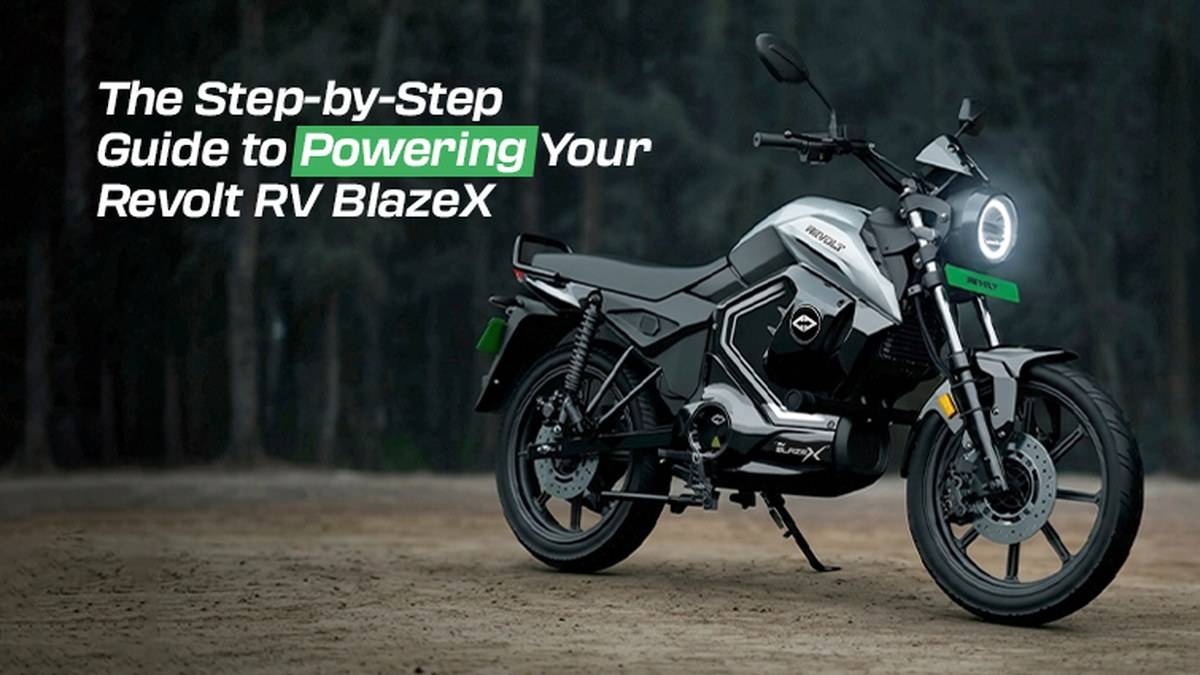
NEW DELHI: The Revolt RV BlazeX takes a claimed 3 hours 30 minutes to charge from empty to 80% with its standard charger, while the fast-charging figure for the same window is 80 minutes. Revolt's charging guide lists 4 hours 45 minutes for a full standard charge. Those are different charging jobs, and owners should keep the starting level, finishing level and charger type together when planning a stop.
| RV BlazeX charging fact | Official figure or provision |
|---|---|
| Battery capacity | 3.24 kWh, removable |
| Standard charging, 0% to 80% | 3 hours 30 minutes |
| Standard charging, 0% to 100% | 4 hours 45 minutes |
| Fast charging, 0% to 80% | 80 minutes |
| Standard charger rating | 10 A, offboard |
| Fast charging rating | 27 A |
| Claimed range | 150 km IDC |
Choose the charging location first
The BlazeX gives an apartment resident a useful choice: leave the battery in the motorcycle and connect the charger, or remove the pack and take it indoors. The second route matters when the allotted parking bay has no socket. It also changes the task from extending power to the motorcycle to finding a suitable place for the battery and charger.
Revolt's model page describes home charging with a portable charger and confirms that the battery can be removed. Its specification sheet separately identifies the charger as offboard. In practical terms, the charging equipment is a separate item to manage, even when the battery remains inside the motorcycle.
Follow the connection sequence
For direct charging, Revolt instructs owners to switch off the ignition, use a standard 15 A socket, connect the charger to the motorcycle first and then connect and switch on the wall supply. Charging status can be checked on the dashboard or through MyRevolt.
For battery removal, its guide says to open the upper compartment with the key, switch the internal miniature circuit breaker off, disconnect the battery cable and lift the pack using its handle. Put it on a cool, flat surface and connect the charger before the wall supply. The company also says to keep that breaker off when reinstalling the pack.
The last part of a full charge needs its own time
Do not read the standard 80% figure as the time needed to fill the battery. Revolt publishes a separate full-charge duration, while the fast-charging row in its guide leaves the full-charge field blank. There is therefore no verified fast full-charge time to substitute into a daily timetable.
The specification comparison supports the same standard and fast charging windows. It also distinguishes the charger ratings. That matters when discussing a demonstration: a quick top-up shown using the fast setup does not establish what the regular equipment will do at home. Match the quoted duration to the equipment actually being used.
For a shared household motorcycle, write down which charger is normally kept with the bike and who is responsible for reconnecting the battery. That simple arrangement makes the removable-pack option easier to use when riders leave at different times.
Storage and the display support the routine
Revolt lists a front storage box and an underseat charger box for this motorcycle. Keeping those functions separate is useful when organising a workday: personal items need their own space, while the charger needs to be available if the next charging location requires it. A removable pack alone does not eliminate the need to carry compatible charging equipment.
The bike has a 6-inch LCD cluster, reverse mode and MyRevolt connectivity. The model page lists battery status, live tracking, geofencing and service support among its connected functions. Those features serve different purposes. Looking up the motorcycle's location is separate from checking whether it has enough charge for the next journey.
Range and charging answer different questions
The published IDC range is a test claim, rather than a commitment that every charge will cover the same distance. Revolt's recent comparison explains that load, speed, traffic and road conditions affect results. Owners should therefore use their own repeated journeys to establish a charging routine instead of turning the headline range into a fixed interval between plug-ins.
The BlazeX's commuter hardware includes a chain-driven motor, telescopic front suspension, twin rear shocks and disc brakes with CBS. Its removable battery is the ownership feature that most directly changes charging arrangements. A rider with ground-floor power and a rider carrying the pack upstairs can own the same motorcycle while having quite different evening routines.
Related reading: our Hyundai IONIQ 5 price: Rs 55,70,600 for the 84 kWh RWD version covers the purchase-price question. Our guides to Kia EV6 price: Rs 65,97,937 starting MSRP and Kia Syros EV price list: Rs 13,49,900 to Rs 19,99,900 explain other models' published charging windows.
Official sources: BlazeX charging instructions, model page and specifications.