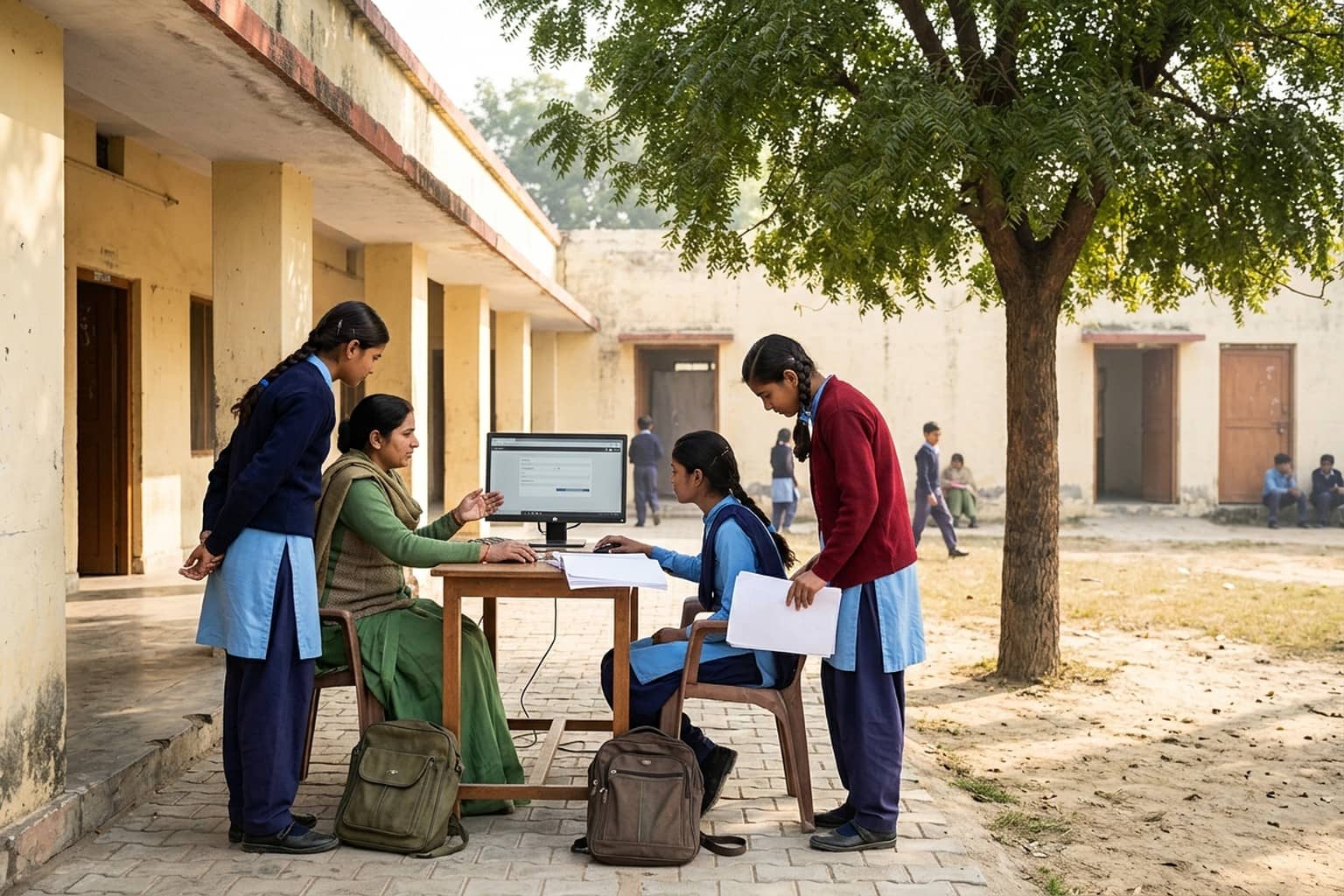

A student who wins a merit seat at a college on the government's quality list can borrow the full cost of the course from a bank without pledging property or finding a guarantor. That is the core of PM-Vidyalaxmi, and with first-semester fees falling due, Haryana's school board is now pushing the message to the 2026 Class 12 batch.
In Haryana, the Board of School Education sent a letter dated 18 September 2026 to all government and private schools, forwarding a communication from the Department of Higher Education in the Union Ministry of Education and asking schools to reach every student who passed Class 12 this year. This guide sets out what the scheme offers, who qualifies and how to apply, using the official scheme documents.
What PM-Vidyalaxmi is
PM-Vidyalaxmi is a Central Sector scheme approved by the Union Cabinet on 6 November 2024. Its core promise is an education loan with no collateral and no guarantor for students who get admission on merit to a designated Quality Higher Education Institution, or QHEI.
According to the government's PM-Vidyalaxmi backgrounder published on 29 July 2026, 1,425 institutions are now covered, public and private. When the Cabinet cleared the scheme it began with 860 institutions, so the list has grown as fresh NIRF rankings have come in.
There is no fixed upper limit on the loan. The amount depends on the course fee and other costs charged by the institution, such as hostel and mess charges, refundable and non-refundable fees, the cost of a reasonable laptop and reasonable living expenses during the course. Students from every income group can apply for the loan itself.
Which colleges count
The QHEI list is built from the National Institutional Ranking Framework. It includes institutions ranked in the top 100 in the overall, category-specific or domain-specific NIRF lists, institutions run by state and Union Territory governments that are ranked in the top 200, and all remaining higher education institutions governed by the Government of India.
Some institutions are left out by design. Indian campuses of foreign universities, foreign campuses of Indian universities and foreign institutions are not covered. The list is revised using the latest NIRF ranking, so a college that is on it this year may not be on it next year, and the other way round.
How you got the seat matters as much as the college. The scheme is for merit-based admission through competitive examinations. Management quota and NRI quota admissions do not get the benefit.
The three money benefits
The first is the collateral-free, guarantor-free loan from a participating bank. Scheduled banks, Regional Rural Banks and cooperative banks taking part in the scheme can lend under it.
The second is a government credit guarantee. For loans up to Rs 7.5 lakh, the Government of India covers 75 per cent of the outstanding default. This support goes to the bank, not the student, but it is meant to make banks more willing to lend without security.
The third is interest subvention during the moratorium, which is the course period plus one year. A student whose annual family income is up to Rs 8 lakh can get 3 per cent interest subvention on a loan of up to Rs 10 lakh. If the loan is larger, the subvention is paid only on the first Rs 10 lakh of principal disbursed.
This 3 per cent support is capped at one lakh fresh students a year, and the Cabinet note says preference goes to students from government institutions in technical or professional courses. The Cabinet set aside Rs 3,600 crore for 2024-25 to 2030-31, and expects about 7 lakh fresh students to benefit over that period.
How it fits with PM-USP
PM-Vidyalaxmi sits alongside an older scheme, the PM-USP Central Sector Interest Subsidy, or CSIS. Under CSIS, students in technical or professional courses at approved NAAC-accredited institutions or NBA-accredited courses, with annual family income up to Rs 4.5 lakh, get full interest subvention during the moratorium on loans up to Rs 10 lakh. CSIS has no cap on the number of students.
The two work as a ladder. Lower-income students in professional courses get full interest support under CSIS. Students with family income up to Rs 8 lakh at a QHEI, in any degree or diploma course, can get the 3 per cent support under PM-Vidyalaxmi.
There is an important exclusion. A student who already receives any other Central or State Government scholarship, another interest subvention scheme or fee reimbursement is not eligible for interest subvention under CSIS or PM-Vidyalaxmi. Families who have applied for a scholarship should read our guide to National Scholarship Portal deadlines for 2026-27 and weigh the two before choosing.
Rates, repayment and conditions
The backgrounder says interest on loans under the scheme is capped at the lending bank's Externally Benchmarked Lending Rate (EBLR) plus 0.5 per cent, and that this rate will be lower than what the bank charges on its other education loans. Banks may give up to 1 per cent more concession if the student keeps paying interest during the study and moratorium period.
Repayment can stretch to 15 years after the moratorium. Interest paid on the loan is eligible for the income tax deduction under Section 80E.
The benefits come with conditions. Students have to register through Aadhaar, stay enrolled and keep up satisfactory academic performance from the second year onwards. Dropping out midway or being expelled for disciplinary or academic reasons ends the benefit. Interest subvention and credit guarantee can be used only once, for an undergraduate, postgraduate or integrated course.
How to apply
All applications go through the unified portal at pmvidyalaxmi.co.in. A student fills one common loan application, picks banks on the portal, tracks the status of the application and later applies for interest subvention, all in the same place. Grievances can also be raised there.
Once a loan is sanctioned and disbursed, an eligible student applies for interest subvention based on family income. The subsidy is credited to the PM Vidyalaxmi Digital Rupee App, a CBDC wallet, and then moved to the education loan account.
Have the admission letter and the college's fee structure at hand before starting, since the loan amount is worked out from course and related costs, and keep an income certificate ready if you plan to claim subvention. Check that your college and campus appear on the current QHEI list. If it is not listed, the collateral-free product under this scheme will not apply, though the student can still approach banks for an ordinary education loan.
The scheme is one of several central supports for students this year. School students in Class 8 have a separate route through the National Means-cum-Merit Scholarship, open till 31 October. For college entrants, PM-Vidyalaxmi is the one built around the loan itself, and the rules above come straight from the government's scheme documents, not from any lender.