
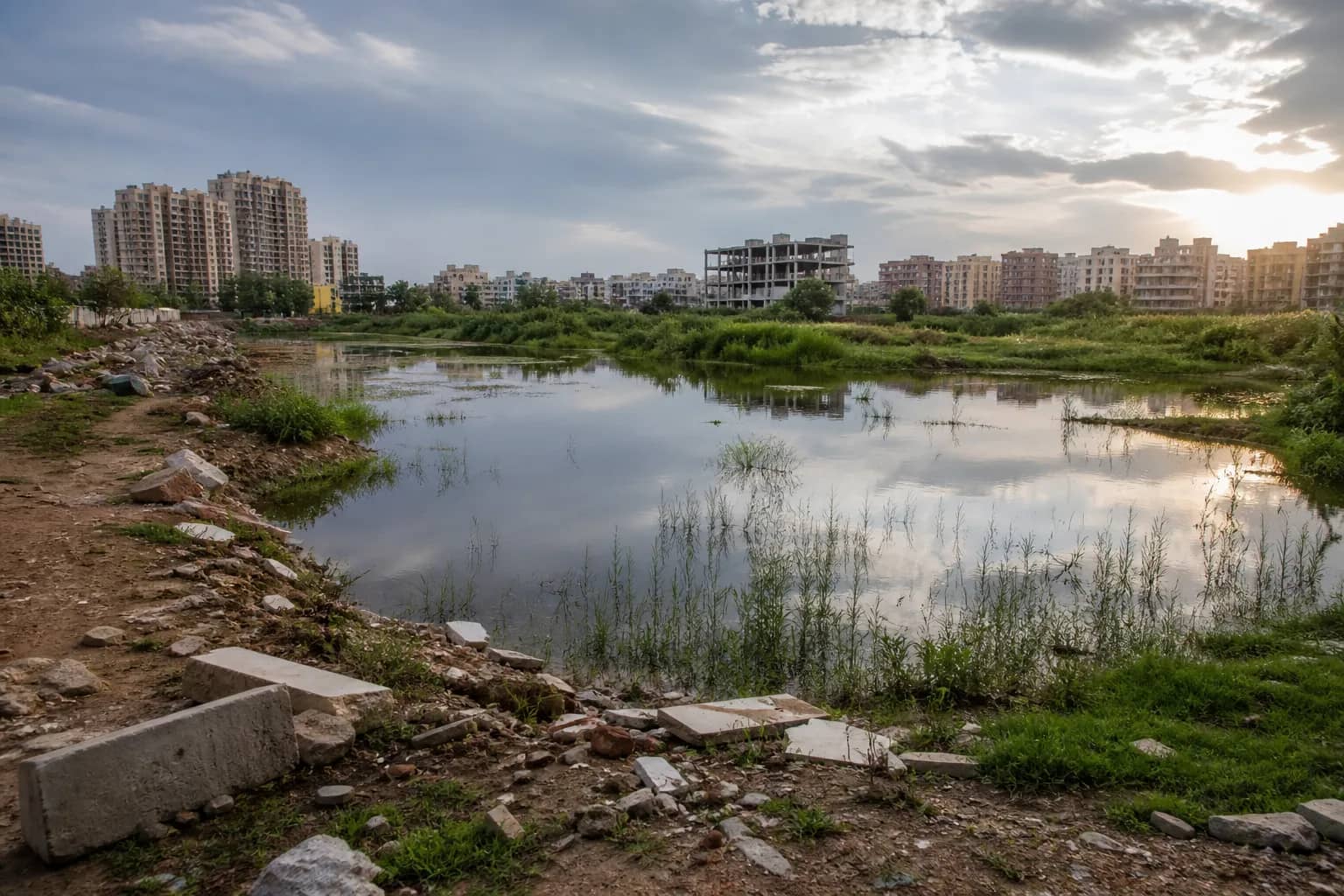
GURUGRAM: The National Green Tribunal has ordered Haryana and Gurugram authorities to remove encroachments from the Jharsa pond in Sector 47 and restore the recorded water body, after a survey found structures ranging from seven jhuggis to a temple, masonry platform, road and footpath on parts of the site.
The order was pronounced on 24 August by the tribunal's Principal Bench comprising judicial member Justice Arun Kumar Tyagi and expert member Dr A Senthil Vel. It brings a three-year residents' effort to a decisive administrative stage: agencies that previously exchanged reports must now act in accordance with law and prepare the nearly three-acre pond for restoration.
Survey mapped several kinds of occupation
The joint inspection recorded seven jhuggis occupying about 275 square yards on a government water-retention bund, a temple of about 39 square yards and a masonry platform of roughly five square yards. It also identified a road and footpath crossing or covering land entered in the revenue record as a natural water body. The tribunal said the identified encroachments arose after a Punjab and Haryana High Court status quo order dated 25 May 2015 and were therefore not protected by that order.
The case was initiated by Sector 47 resident and RWA office-bearer Virendra Tyagi, who first approached the district administration and Chief Minister in April 2023 over the pond's condition. His petition described construction debris, grazing, dumping and shrinking open water. The tribunal's direction now requires the Municipal Corporation of Gurugram, GMDA, HSVP, the pollution control board, the state water authority and the district administration to coordinate rather than treat the site as someone else's jurisdiction.
Removal is only the first half of the order. The bench also directed restoration and rejuvenation in line with Supreme Court and NGT decisions and Central Pollution Control Board guidance. That means the exercise cannot end with demolition debris left beside a dry depression. The agencies will need a contour survey, clean inlets and outlets, protection from sewage, a plan for desilting and a boundary that preserves the pond without sealing it off from its natural catchment.
Restoration must keep the monsoon connection
Jharsa pond sits in a city that has just endured another week of severe waterlogging. Restoring a water body is therefore not ornamental landscaping. A functioning pond can hold runoff, slow peak flow and support groundwater recharge, but only if the drains feeding it remain open and the bed is not converted into a manicured bowl disconnected from surrounding rainwater.
The order also creates a rehabilitation question for people living in the seven informal structures identified by the survey. Encroachment removal must follow legal notice and due process. Clear documentation of each structure, its date and the authority responsible will reduce the risk of selective action while allowing the recorded pond area to be recovered.
Residents should now be able to track a public restoration schedule: demarcation, notices, removal, debris clearance, hydrological work and post-monsoon monitoring. Gurugram has no shortage of plans that stop after a site visit. The tribunal has supplied a legal direction; the agencies must turn it into a pond that can hold water again.