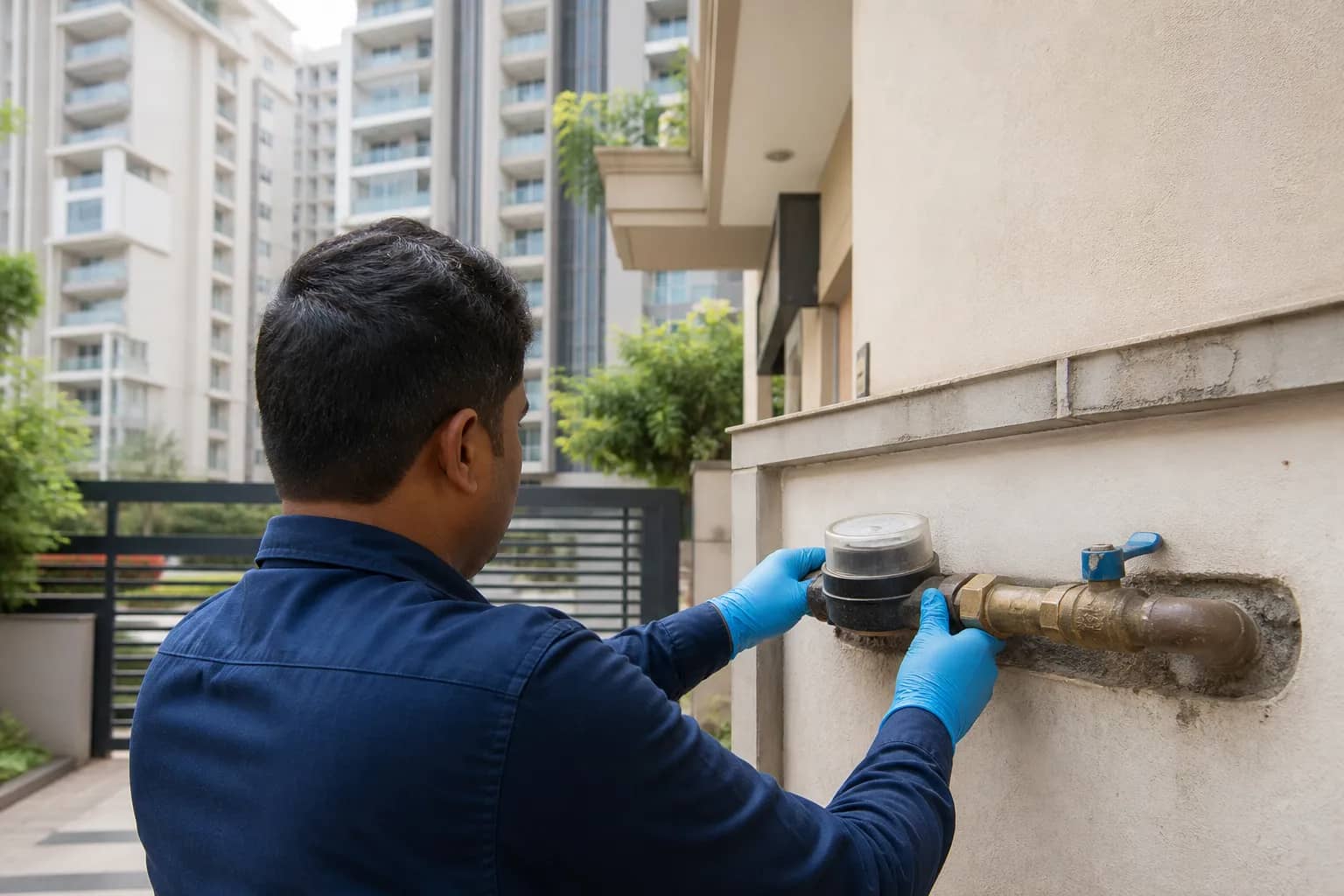
GURUGRAM: Nearly two out of every three active water connections recorded by the Municipal Corporation of Gurugram do not have a meter, leaving the civic body with a large blind spot in measuring consumption, detecting losses and linking bills to actual use.
Municipal data puts the total number of active consumers at about 1.9 lakh. Of these, 63,169 connections, or 32.5 per cent, are metered. The remaining roughly 1.3 lakh connections, representing 67.5 per cent of the network, are unmetered.
The scale has grown sharply with Gurugram. The corporation had around 30,000 water consumers in 2013; it now manages more than six times that number. Housing expansion, the transfer of colonies and a wider municipal footprint have added connections faster than the city has installed and maintained a uniform measurement system.
Without a functioning meter, billing usually depends on a flat assessment or another proxy rather than actual litres consumed. That weakens the incentive to conserve water and makes it difficult to distinguish normal household demand from a leak, an illegal draw or unusually heavy use. It also reduces the quality of data available for planning summer supply.
Recovery has improved, but gaps remain
The corporation's recovery record has varied considerably. In 2022-23, it collected about Rs 35.4 crore against demand of Rs 67.6 crore, a recovery of 52.3 per cent. The following year, recovery was around Rs 39.7 crore against Rs 90.3 crore, or 43.9 per cent.
The rate improved to 74.6 per cent in 2024-25 and 70.5 per cent in 2025-26. During the current financial year, collections of about Rs 28.1 crore have exceeded the current demand figure of Rs 19.9 crore because the total includes arrears from earlier bills. Stronger arrear collection is useful, but it does not solve the underlying measurement gap.
Smart meters and mapping planned
MCG plans to install 465 ultrasonic smart meters at selected points and is mapping tubewells, boosting stations and related water assets through a geographic information system. Bulk meters can reveal how much water enters a zone and, when matched with household readings, how much is billed. The difference can point to leakage or unauthorised use.
The small number of proposed smart meters compared with 1.3 lakh unmetered connections shows that the first step is likely to be network monitoring rather than an immediate household-wide conversion. A credible rollout will need installation targets, calibration and repair arrangements, consumer grievance handling and transparent rules for moving from flat charges to measured bills.
Metering alone cannot create more water, but it can make shortages easier to diagnose and distribution harder to game. In a city where tanker dependence and uneven pressure recur every summer, reliable consumption data is not a back-office luxury. It is the starting point for fair billing and for knowing where Gurugram's treated water is actually going.