
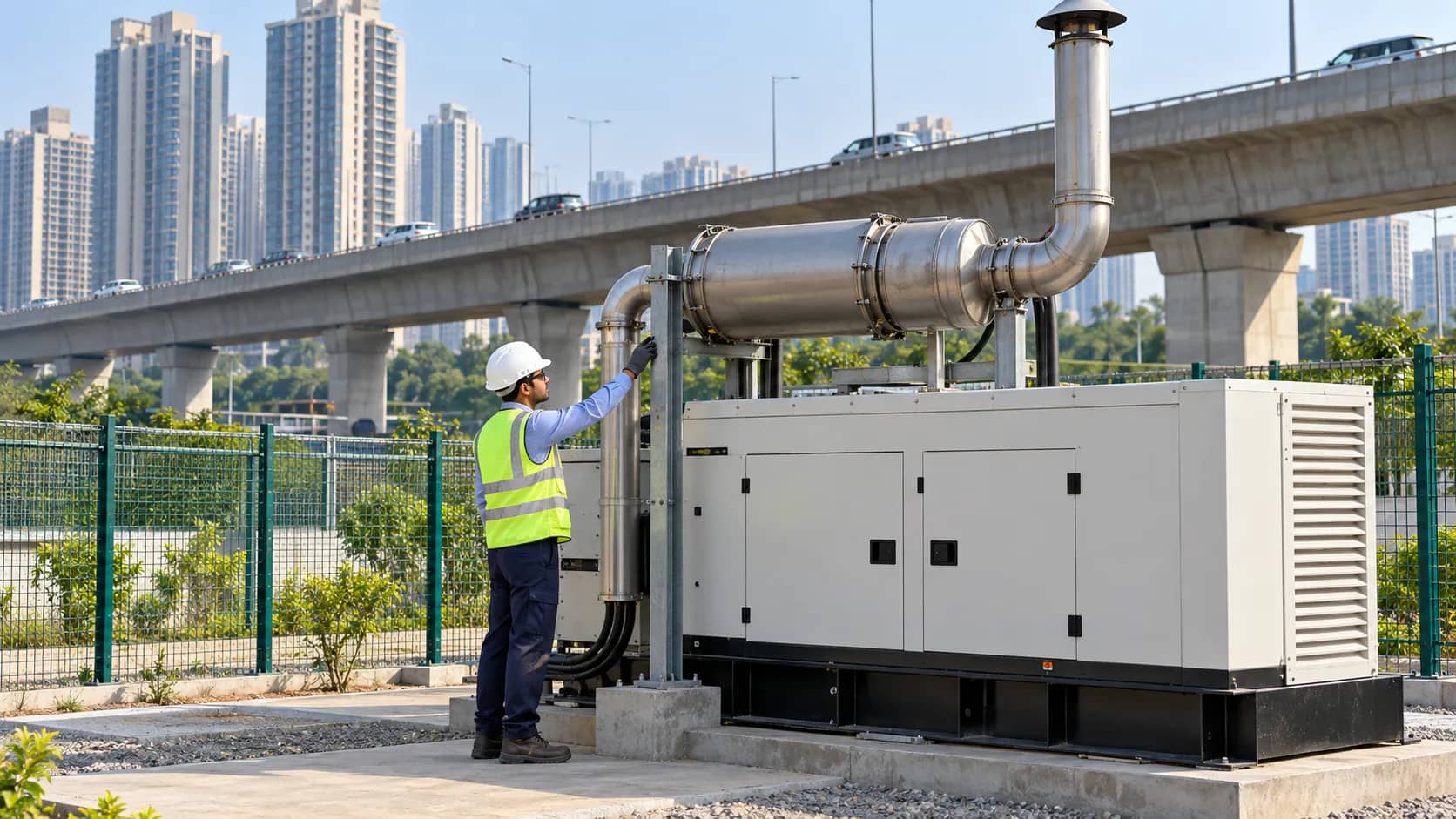
GURUGRAM: The National Highways Authority of India plans to fit emission-control devices to 25 diesel generator sets on the Dwarka Expressway stretch between Basai and the Kherki Dhaula cloverleaf. The generators serve expressway lighting and other associated operations.
The 9 October announcement covers the 8.7 km Package IV. Installation will include testing, commissioning and maintenance support. NHAI also requires GPS-tagged photographs of the installations for verification.
The authority says the work is intended to bring these generators into compliance with the Commission for Air Quality Management's requirements, particularly ahead of winter. It has not announced a completion date, contract value or measured reduction in emissions.
What the expressway work covers
The equipment is described as Retrofit Emission Control Devices, or RECDs. These are additions to existing generator systems. The announcement concerns highway infrastructure; it does not announce a retrofit programme for generators in neighbouring housing societies or a change in motorists' entry rules.
That distinction matters for residents following works along the corridor. NHAI's announcement should be read alongside the specific responsibilities of other agencies, rather than as a common timetable for every project in the area. Dalimss News has separately reported on the Sector 99-102 service-road proposal and the stormwater-drain plan near the Dwarka Expressway sectors.
Package IV is part of the Haryana section described in the Prime Minister's Office's March 2024 project briefing. That briefing put the Haryana section at 19 km and divided it into a 10.2 km section from the Delhi-Haryana border to Basai Rail-over-Bridge, and the 8.7 km Basai-to-Kherki Daula section.
The earlier project note described an eight-lane corridor intended to ease traffic on NH-48 between Delhi and Gurugram, with links towards the airport and the Gurugram bypass. Those details help locate the present work: the generator announcement is about the operating equipment on one defined package of a much larger road connection.
Why certification matters
The pollution-control equipment has its own certification requirements. A 10 February 2026 notice from the Andaman and Nicobar Pollution Control Committee, relaying Central Pollution Control Board information, explains that certified RECD manufacturers are listed for particular generator capacity ranges. The notice concerns diesel generator engines up to 800 kW.
It also says the CPCB list is revised periodically as manufacturers and device capacities gain approval. For a procurement or maintenance team, that makes the matching of equipment and generator capacity part of the job. A device being described as an emission-control product is not, by itself, evidence that it is certified for every engine.
The notice advises generator owners, project proponents and suppliers to consult the updated list when planning purchases, installations or compliance work. Its practical value here is the distinction between fitting equipment and establishing compliance. The certificate, capacity range and installation record need to relate to the actual generator involved.
A longer-running NCR requirement
Controls on backup generators predate this expressway announcement. In its September 2023 explanation of Direction 76, CAQM said large-scale generator use contributed to the region's air-quality problem. It described a framework covering industrial premises, offices, commercial establishments and residential buildings, with generators treated as backup against regular power failures.
That explanation also recorded practical concerns about certified devices being available for different capacities and older engines, access to piped gas, and the time needed for installation. It is historical background, rather than a substitute for checking the latest applicable direction before operating a generator.
CAQM's current official document catalogue lists a further revised GRAP schedule dated 29 September 2026. Readers checking restrictions should use that current schedule and subsequent implementation orders. A new equipment announcement alone does not establish which GRAP stage is in force on a particular day.
An installation photograph can show where a device has been fitted. Testing and maintenance records would help establish whether it continues to work as intended. NHAI's inclusion of commissioning and maintenance makes those separate checks worth following as the project proceeds.
Dalimss News did not receive payment or any other consideration for this article. It is independent editorial coverage.