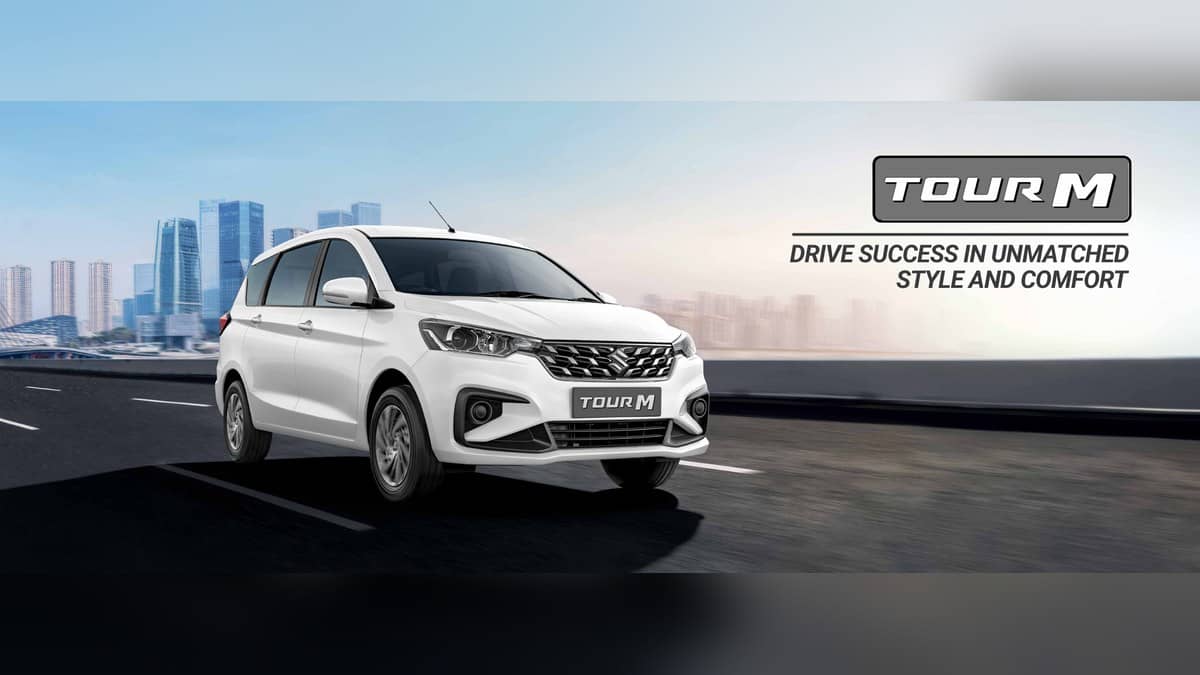
NEW DELHI: Maruti Suzuki Tour M has seven seats in both petrol and CNG form, but its two fuel versions do not share the same hybrid equipment. The official brochure lists Smart Hybrid functions for petrol and leaves those entries blank for CNG. That distinction matters more to an operator reading the specification sheet than the shared engine capacity or familiar Ertiga shape.
| Official specification | Tour M petrol | Tour M CNG |
|---|---|---|
| Seats | 7 | 7 |
| Engine capacity | 1,462 cc | 1,462 cc |
| Transmission | 5-speed manual | 5-speed manual |
| Certified efficiency | 21.10 km/l | 26.54 km/kg |
| Idle start-stop, regeneration, torque assist | Listed | Not listed |
| Maximum speed limit | 80 km/h | 80 km/h |
There is also a source-reading trap: the website FAQ gives a different engine-capacity number from the technical table and brochure. This report uses the matching 1,462 cc technical entries. Keeping that conflict visible is preferable to silently blending the FAQ wording with the brochure equipment list when preparing a fleet specification sheet.
The petrol badge carries specific hardware
The manufacturer's technical leaflet identifies the petrol engine as K15C Smart Hybrid and the CNG engine as K15C. Its equipment rows assign idle start-stop, brake energy regeneration and torque assist to the petrol column. An operator should therefore resist treating every reference to Tour M technology on a general feature page as a promise about both versions.
This is a useful distinction when preparing a vehicle handover checklist. Match the fuel description on the order paperwork with the relevant brochure column, then ask for the fitted equipment to be demonstrated. A sales description that simply says hybrid is less useful than an explanation of which functions the particular vehicle actually provides.
The CNG version is a different operating proposition within the same passenger carrier. A comparison should account for the fuel used on the intended route and the equipment fitted to that version, rather than assuming that adding a gas system preserves every petrol feature. The brochure itself supplies the reason to keep those questions separate.
Seven seats need a luggage plan
For the physical package, Maruti's product specification gives a length of 4,435 mm, width of 1,735 mm, height of 1,690 mm and wheelbase of 2,740 mm. These describe the vehicle's exterior and axle spacing. They do not describe the space available for bags behind an occupied rear row.
A useful inspection starts with the seats arranged as they will be during work. Put representative luggage into the remaining space and check access to the rear row before judging the cabin from an empty display vehicle. A hotel transfer carrying suitcases asks a different question of this cabin from an employee shuttle carrying mostly small bags.
That is particularly relevant to Tour M because its central promise is passenger capacity in an Ertiga-derived package. A photograph with folded seats may demonstrate flexibility, but it cannot establish luggage accommodation with every seat in use. The practical test should preserve the passenger arrangement instead of creating space the working trip will not have.
Read efficiency in the correct unit
The official product page quotes petrol consumption performance in kilometres per litre and CNG performance in kilometres per kilogram. The larger CNG number is not, on its own, a percentage saving on a fuel bill. Those figures measure distance against different quantities of fuel, so they need separate treatment in an operating worksheet.
For an operator's own budget, use the fuel price actually paid and measured consumption from the intended duty. Keep filling time and detours visible alongside fuel spending. Otherwise a calculation can look precise while leaving out the part of the shift that determines how many trips the vehicle can complete. This is a planning method, not a manufacturer earnings forecast.
Who it is for
The configuration is relevant to taxi operators who need a passenger carrier with a manual gearbox and want to compare petrol with factory CNG. The official leaflet specifies taxi use and the speed limiting function. Those conditions should sit alongside seating and fuel choice when a business decides whether the vehicle fits a proposed service.
The speed limit is also a scheduling input. Build the duty around realistic travel, loading and stopping time rather than around a passenger-car performance expectation. A vehicle can meet the seating requirement and still be poorly matched to a timetable that assumes a different kind of operation.
For related fleet reading, see the Tour H3 price list, the Tour H1 price list and our Ertiga and XL6 service campaign explainer. These cover separate vehicles or ownership questions; their equipment descriptions should not be transferred to Tour M.
Official sources: Maruti Suzuki Tour M and its technical brochure, checked on 5 November 2026.