Kanyashree Prakalpa is West Bengal's education support scheme for unmarried girls. The official South 24 Parganas and Hooghly district pages list K1 as an annual scholarship of Rs 1,000 and K2 as a one-time grant of Rs 25,000. The application route runs through the student's educational institution. A girl should first ask her school or college which component applies to her age and enrolment, then obtain the current form and an acknowledgement.
| Component | Amount | Basic age band |
|---|---|---|
| K1 annual scholarship | Rs 1,000 a year | 13 to 18 years |
| K2 one-time grant | Rs 25,000 once | 18 to 19 years |
The amounts do not mean every student receives both payments automatically. K1 and K2 have separate age and educational conditions. The institution must check the student's particulars and process the appropriate application. Receiving an earlier scholarship should therefore be followed by a specific enquiry about the next application stage, especially when the student approaches her eighteenth birthday.
Kanyashree eligibility: who can apply for K1 and K2?
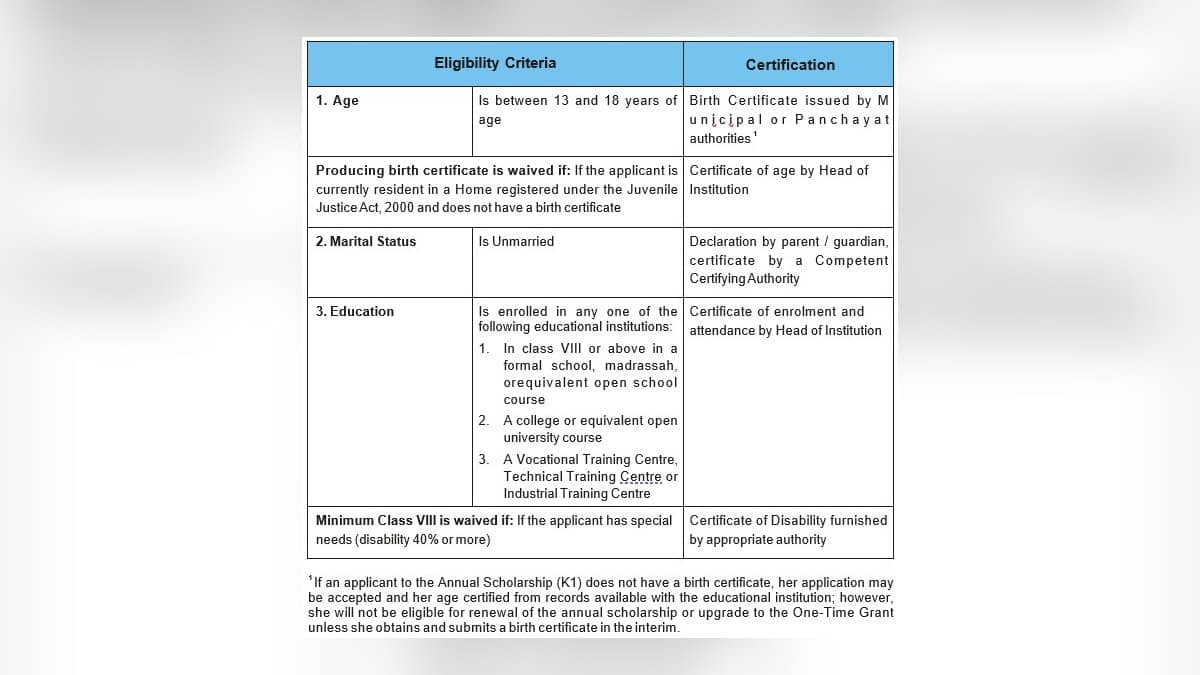
The South 24 Parganas scheme guidance describes K1 for unmarried girls aged 13 to 18 studying in Class 8 or above in a government recognised educational institution. Its K2 description provides a one-time grant for unmarried students in the 18 to 19 age band. Ask the institution to calculate the applicable age cutoff from the birth record rather than relying on the academic class alone.
The Hooghly district scheme page says Kanyashree applies to West Bengal residents studying in institutions registered in the state and recognised by the government. Its eligibility charts also cover recognised open education and specified vocational or training routes. A student outside the usual school pathway should ask the institution or district scheme section to identify the correct category before submitting a form.
The Hooghly K1 chart explains that the minimum Class 8 condition can be waived for an applicant with special needs and disability of 40 per cent or more. A disability certificate is relevant to that exception. It also describes an alternative age certification route for an applicant in a registered children's home who does not have a birth certificate. Such cases need institutional assistance, not an assumption that every applicant must produce identical papers.
How to apply for Kanyashree through school or college
Begin at the school or college office handling Kanyashree. South 24 Parganas explicitly describes online submission through the school for K1 and through the school or college for K2. Searching for an online application should not lead a family to assume that an unofficial form can bypass the educational institution's checks.
The Cooch Behar district application instructions set out the practical sequence: collect the form from the institution, open an account in the applicant's own name if needed, submit the completed form and necessary documents, and collect an acknowledgement receipt. Retain that receipt. It is the useful starting point if the institution later needs to locate or correct the application.
For preparation, bring the birth or accepted age record, the unmarried status declaration and the educational enrolment details. Hooghly's charts identify certification by the educational institution for enrolment and attendance. Keep bank details available when the form is completed, and ask the office which current declarations and supporting copies it requires. If a special exception applies, discuss the relevant certificate before the upload.
Kanyashree status check, help and application dates
Hooghly links to the state's Track Application Status service and a grievance registration service. Start from the official district page if the tracking page is unavailable or its address changes. Keep the acknowledgement and any Kanyashree identification details supplied by the institution ready. A status enquiry is different from submitting a fresh application or correcting the bank record.
For Hooghly applicants, the district page publishes the Kanyashree helpline 7439178586. It also lists support.kanyashree@nic.in. The telephone number should be treated as the district's published contact, not described as a verified statewide call centre. Students elsewhere can ask their institution for the relevant district Kanyashree section.
Government pages are not fully synchronised: the Cooch Behar page still carries an older benefit description, while Hooghly and South 24 Parganas both display the Rs 1,000 K1 amount. This guide uses the latter two for the benefit table. It does not establish a new November 2026 rate change or a single statewide application closing date. Confirm the current form, declarations and school submission timetable before applying.
For other administrative help, see our guides to UDID applications and assessment, Aadhaar update tracking and eligibility for free legal aid. Their separate conditions do not establish Kanyashree eligibility.