Free legal aid in India can cover a lawyer, legal advice and specified case expenses for people who qualify under Section 12 of the Legal Services Authorities Act, 1987. Women are eligible to apply irrespective of income. Other eligible groups include children, Scheduled Caste and Scheduled Tribe members, people with disabilities, industrial workmen and people in custody. Income based eligibility is another route, with limits depending on the relevant court and state.
The National Legal Services Authority, or NALSA, sets out these rules in its official Legal Aid FAQ. This guide explains that standing framework, checked on 28 October 2026 at 22:48 IST. It does not announce a new cash benefit or a new nationwide income ceiling. The concerned legal services authority examines eligibility and whether there is a genuine case to pursue or defend.
| Question | Official guidance |
|---|---|
| Application form fee | No charge for obtaining or submitting it |
| Women | May apply regardless of income |
| Where to begin locally | District Legal Services Authority or Taluk Legal Services Committee |
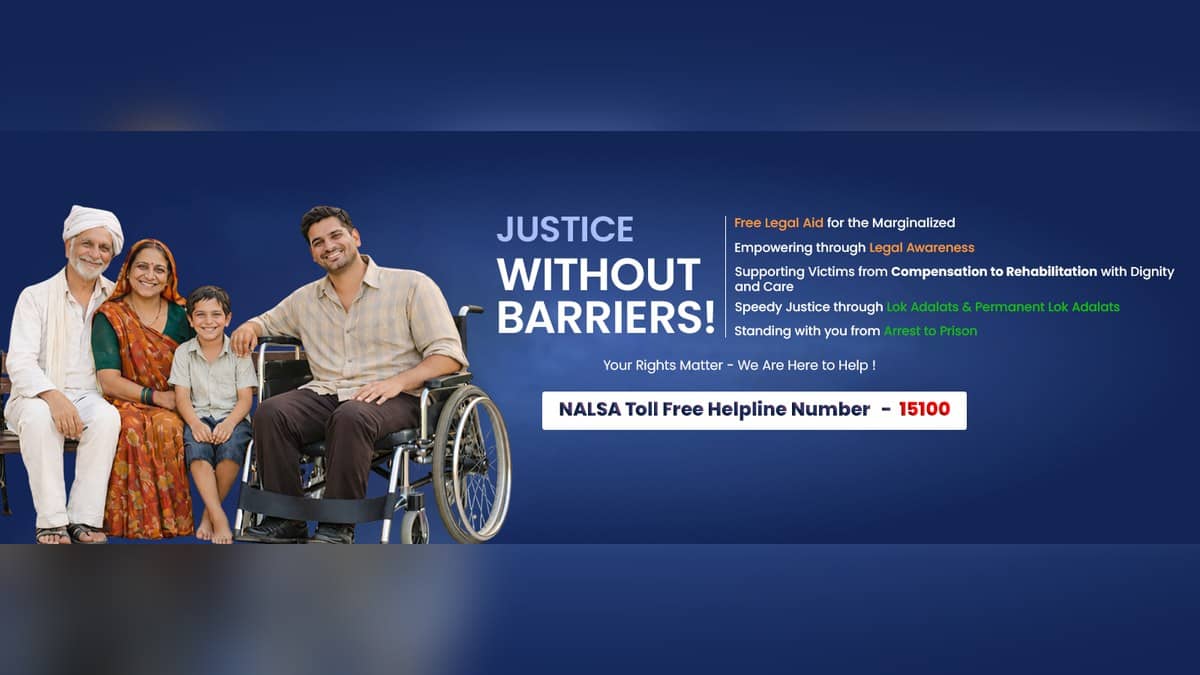
| National helpline | 15100 |
| Decision on an application | Immediately, and no later than seven days from receipt under the cited regulation |
Who is eligible for free legal aid?
Section 12 of the Act identifies several routes to eligibility, rather than requiring every applicant to pass the same income test. NALSA's list includes victims of trafficking or begar, and people facing circumstances such as mass disaster, ethnic violence, caste atrocity, flood, drought, earthquake or industrial disaster. Explain the category on which the application relies and supply the relevant supporting material.
For women, the FAQ is explicit that financial status does not remove the right to apply under Section 12(c). Children are covered until the age of majority, 18 years. Senior citizen eligibility needs a separate check of the applicable state rules. Being retired alone should not be assumed to create the same entitlement everywhere in India.
For people applying on income grounds, NALSA lists an annual income below Rs 5 lakh for matters before the Supreme Court. For other courts, the applicable state limit matters. Its table lists Rs 3 lakh annually for Uttar Pradesh and Haryana. Confirm the applicable limit with the relevant authority, especially when applying in another state. These are eligibility thresholds, not amounts paid to applicants.
What expenses does free legal aid cover?
NALSA describes assistance in both civil and criminal matters. Depending on the case, it can include advocate representation, preparation of pleadings and appeals, translation and printing of case papers, certified copies, process fees and specified witness expenses. Someone who needs legal advice without immediately starting a court case can also seek assistance.
The application is free to obtain and submit. The FAQ says the legal services institutions bear expenses such as process, drafting and typing fees and panel lawyer fees. Approval does not promise a successful case, compensation or a fixed payment. It provides assistance with accessing justice, subject to the governing rules and the authority's assessment.
How to apply for NALSA legal aid
Begin with the institution matching the location and level of the case. That may be the Taluk Legal Services Committee, the District Legal Services Authority at the district court, a State Legal Services Authority, or the relevant High Court or Supreme Court Legal Services Committee. NALSA can forward applications it receives to the authority concerned.
- Use the official NALSA website or approach the appropriate legal services front office.
- State your name, address, contact details, the matter requiring assistance and the reason you qualify.
- Provide identity proof and certificates or an affidavit relevant to your category or income claim.
- Keep the acknowledgement or online application number for follow up.
A prescribed form is not the only route. The FAQ permits a written request on plain paper and an oral application, for which an officer or paralegal volunteer can assist. This matters for people who cannot comfortably complete an online form. Regulation 5 says a self certificate with self attested copies of relevant documents, if any, is ordinarily sufficient. Supporting documents depend on the eligibility category; there is no single certificate that proves every kind of claim.
How to track an application or seek help
For online submissions, NALSA says an application number is generated and status can be tracked on the portal. Its FAQ cites a decision period of immediately and no more than seven days from receipt under Regulation 7(2). That is an application decision rule, not a promise that the court case will finish within a week. NALSA's official homepage displays the toll free helpline 15100.
If assistance is refused, the FAQ provides an appeal route to the Executive Chairman or Chairman of the legal services institution. Applicants should keep their details accurate and cooperate with the authority: ineligibility, misrepresentation and other specified circumstances can lead to refusal or withdrawal. For related public service information, read our guides to e-Shram eligibility and status, official document charges, and checking DA orders and calculations.