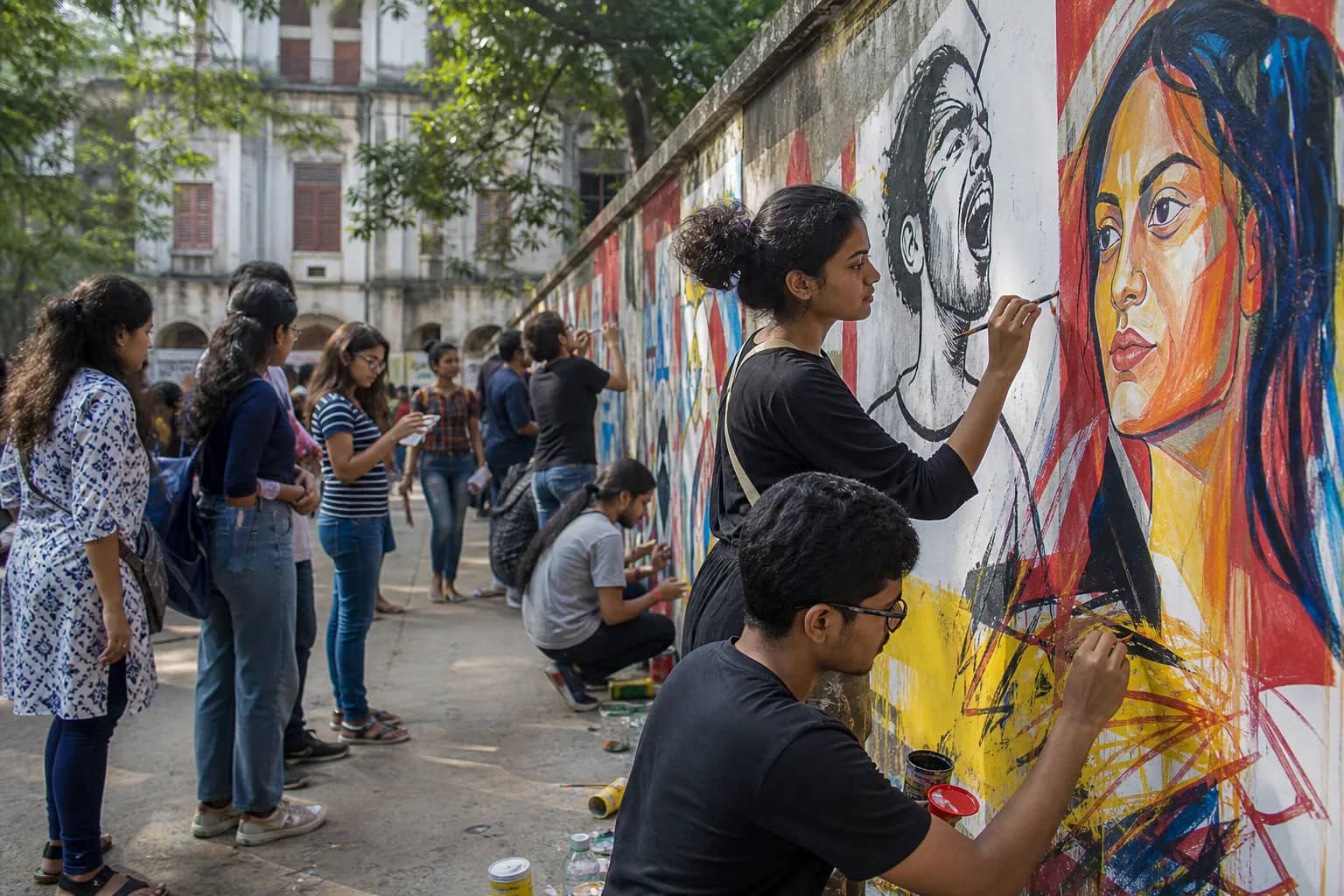
Students at Jadavpur University repainted political and cultural graffiti across parts of the campus on Monday, reopening a confrontation over who controls the walls and what kind of expression belongs on them. The action followed a university whitewashing drive that had removed works the authorities considered offensive.
The students described the afternoon effort as a mission to reclaim the walls. New images drew on figures including Rabindranath Tagore, Bhagat Singh, Pritilata Waddedar and Udham Singh, while other work carried messages of resistance and international solidarity. The activity remained a paint-and-brush protest rather than a reported physical confrontation.
The vice-chancellor draws a property line
Vice-Chancellor Chiranjib Bhattacharjee told reporters that the walls are university property and that he does not encourage political graffiti. He said such writing made the campus appear dirty to many visitors and suggested students use social media to communicate political messages.
That position collides with a campus tradition in which walls have functioned as an informal public forum. Students do not see every mural as defacement; administrators do not see every painted message as protected expression. The argument is therefore not only about cleaning. It is about whether a university should designate space for political speech, tolerate an inherited practice or remove work according to an administrative standard.
The dispute has also drawn intervention from outside the campus. Government and political objections to particular slogans have pushed the university to consider a committee that could decide what is acceptable. Any such body would face an immediate credibility test: its rules would need to be precise enough to distinguish threats or unlawful content from dissent that merely makes authorities uncomfortable.
A policy is better than selective erasure
Universities can regulate their property, but inconsistent enforcement creates its own problem. Removing one political position while leaving another turns maintenance into viewpoint selection. A defensible policy should state where temporary art is permitted, how long it may remain, what content is prohibited by law, who records a removal decision and whether student groups can appeal.
Designated walls are one practical option. They preserve a visible campus forum while keeping building entrances, safety signs and recently renovated surfaces clear. Regular repainting dates can prevent permanent accumulation without allowing the administration to erase work overnight on an ad hoc political instruction.
Students also carry responsibilities. Painting over another group's work, damaging protected architecture or using anonymous walls for targeted intimidation weakens the case for open expression. A shared space survives only if competing groups can use it without fear and if the physical campus remains usable.
The vice-chancellor's suggestion that politics move to social media does not fully answer the students' point. A campus wall is local, physical and collective; a platform feed is privately governed, algorithmic and easily fragmented. The two forms of expression are not interchangeable, even if both can carry the same sentence.
Monday's repainting ensures the issue will not disappear under white paint. Jadavpur now needs a rule made through consultation, not a cycle in which one side paints and the other erases. The quality of that rule will be measured less by whether it produces tidy walls than by whether it can protect safety and property without treating disagreement as dirt.