IIT-BHU will host the 10th Gleeble User Workshop India on October 30 and 31, 2026, at Annie Besant Lecture Theatre-4. The event examines how laboratory tests reproduce metal-processing conditions.
The Department of Metallurgical Engineering and Central Instrument Facility are organising the event. Their brochure lists demonstrations, user discussions and developments in cryogenic and induction heating.
What physical simulation actually measures
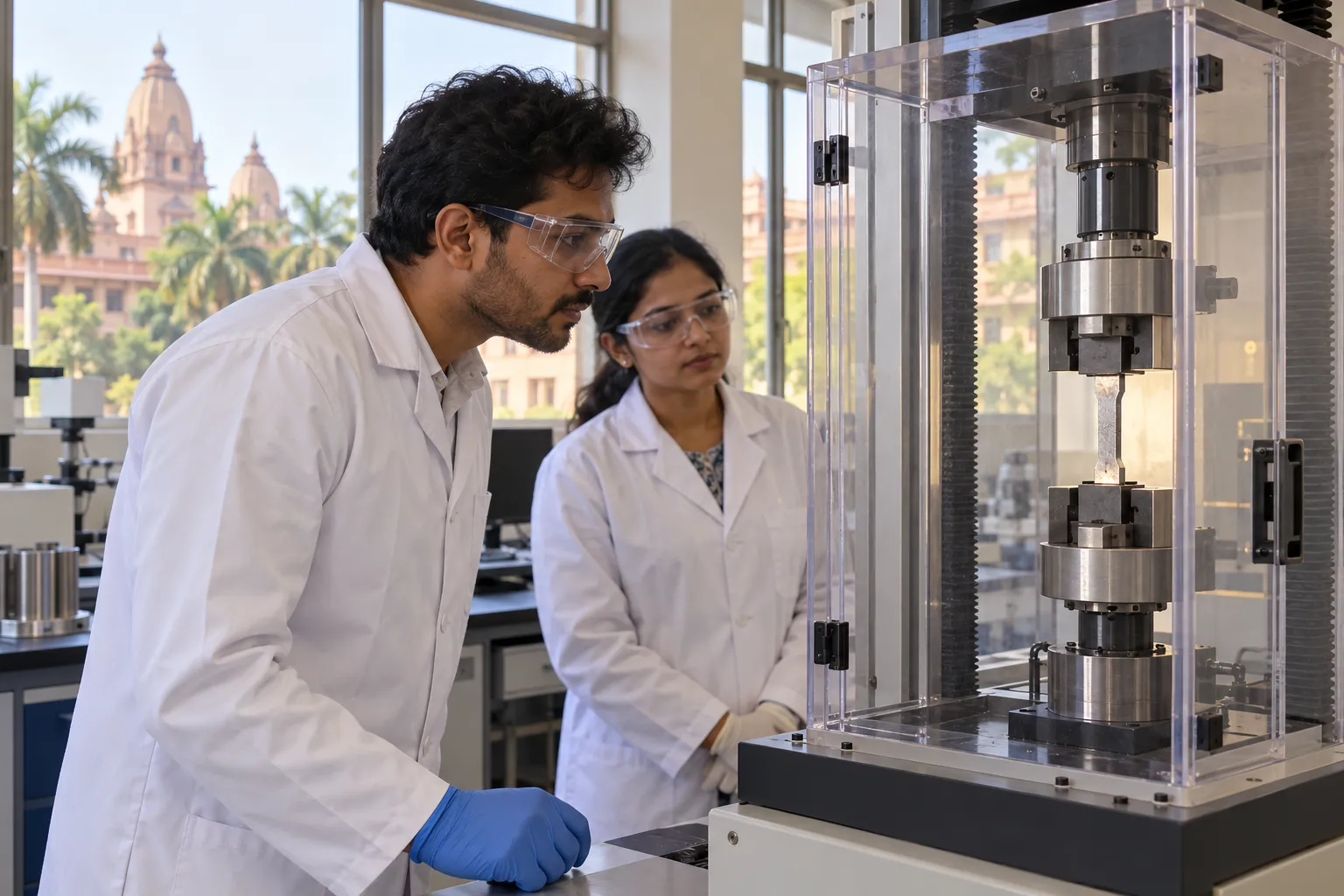
In the manufacturer's explanation of physical simulation, a small piece of real material undergoes a programmed sequence of temperature and mechanical loading. The aim is to reproduce the history it would experience during processing or use. A researcher can then measure what happened to that specimen, including its hardness, internal structure and resistance to deformation. The experiment is therefore about a sequence of conditions, rather than a single measurement at room temperature.
Computer models have a different role. They calculate how a material or component should behave using mathematical descriptions and input data. Physical tests can supply those inputs and help check the predictions. The distinction matters when reading claims about simulation: an attractive computer output and a measured response from a real specimen are different forms of evidence. Using them together allows assumptions in the model to be tested against observations.
Gleeble's published system overview describes direct resistance heating combined with hydraulic control of mechanical loading. It also lists programmed heating and cooling cycles and synchronized data collection. That combination lets researchers examine processes such as hot rolling or welding under controlled conditions. The equipment's ability to heat a sample is only part of the experiment; the timing of deformation and the cooling that follows are also part of the programmed history.
Why a rolling schedule matters
The manufacturer's technical guide explains the Hydrawedge accessory named in the workshop's focus. It is designed for repeated high-speed compression, including simulations of metal passing through successive rolling stands. Users can set the temperature, time between passes and the amount and rate of deformation. In plain language, how far the specimen is squeezed and how quickly that squeezing occurs are separate settings.
The same guide describes induction heating as an alternative to direct resistance heating for certain specimen shapes and test arrangements. It also explains that different grips and cooling methods affect the temperature distribution within a sample. These details show why a machine's headline temperature limit is an incomplete description of a test. The specimen, its supports and the selected heating method all help define the experiment being performed.
Cooling also needs control. The guide describes heat leaving the specimen through water-cooled grips, while faster cooling can use a programmed spray of air, gas, water or mist. Choosing how a hot sample cools therefore belongs in the test plan alongside how it is heated.
The Varanasi facility already offers testing routes
IIT-BHU's current instrument directory lists a Gleeble 3800-GTC system with cryogenic quenching and provides separate requisition forms for internal and external users. The listing establishes a local testing resource beyond the workshop itself. An event registration and a request to test one's own samples are separate processes, even when both involve the same facility.
The institute's 2024-25 annual report places the simulator within a broader collection of instruments for examining materials. Its Central Instrument Facility chapter describes structural, surface and thermal analysis, with access for academic and industrial users. It specifically connects the Gleeble system to controlled studies of multistage metal forming at high temperature and rapid deformation. This is historical institutional context, not a claim that the equipment was installed this month.
That wider laboratory setting matters because processing a specimen and examining the result are different steps. The annual report describes microscopy and other analytical equipment alongside the simulator. Dalimss News has separately reported on IIT-BHU's current equipment tenders and the Clean Rivers laboratory's project recruitment, other parts of the city's research infrastructure.
For researchers considering a separate experiment, the facility's external-user charge document distinguishes test types and user categories. The schedule treats conventional dilatation, thermal-fatigue and continuous-casting simulations separately. It also distinguishes outside academic or government laboratories from startups and industry. The applicable charge therefore depends on both the experiment and the user. The document adds 18% GST to charges for external users. Its conditions make sample preparation the user's responsibility. It also states that consultancy or interpretation can carry separately determined charges, and that cryogenic testing depends on liquid-nitrogen availability. Those conditions should be settled with the facility before treating a workshop fee as a budget for an independent testing project.
A test result still needs a defined question
An older research paper on joining aluminium to steel illustrates the kind of question physical simulation can address. The study, published in 2019 and deposited by its authors on arXiv in 2021, used a Gleeble-based method to investigate the layer formed where two different metals meet. The authors reported reproducing features including that layer's thickness and the mechanical properties of its constituents. This is background research by a separate team, not a finding from the forthcoming IIT-BHU event.
The example also sets a boundary on interpretation. Reproducing a particular joint's interface under specified experimental conditions does not establish that every alloy combination will behave the same way. A useful test has a defined material and processing question. For a workshop participant, understanding those choices is as relevant as watching the equipment operate.
Registration and fees
The first-come attendance cap is 100. Fees as of October 16, 2026, 9:39 pm IST are Rs 3,000 for external participants and Rs 1,000 for IIT-BHU participants, including GST. Applicants must complete the organiser-linked form before payment. The form displays no remaining-place count.