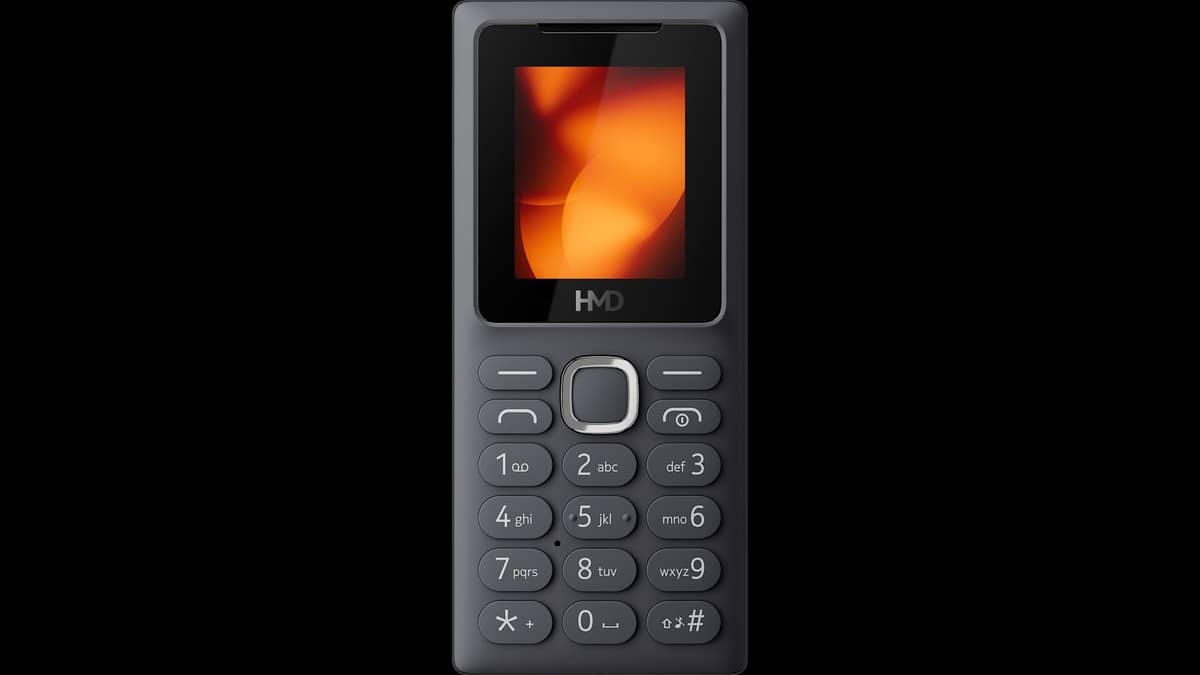
NEW DELHI: HMD 100 is listed at Rs 969 on the company's India store, while HMD 101 costs Rs 1,119. The difference is Rs 150 for the displayed configurations. Both are compact keypad phones, but the HMD 101 adds a music player with memory-card support and a larger battery. The comparison concerns the HMD 101 without the 4G suffix.
| Official specification | HMD 100 | HMD 101 |
|---|---|---|
| Displayed price | Rs 969 | Rs 1,119 |
| RAM and internal storage | 8MB + 4MB | 4MB + 4MB |
| Screen | 1.77 inches, 160 x 128 | 1.77 inches, 160 x 128 |
| Removable battery | 800mAh | 1,000mAh |
| Claimed standby, up to | 168 hours | 213 hours |
| Memory card | No expansion listed | Up to 32GB microSD |
| Network bands listed | GSM 900/1800 | GSM 900/1800 |
Price as of 28 October 2026, 00:21 IST. These are the displayed handset prices, without adding a recharge bundle or deducting a bank benefit. The selected HMD 100 is Grey and marked Single SIM; the selected HMD 101 is also Grey. The respective product pages are the basis for these amounts.
What the extra money changes
The useful distinction is what can be carried on the phone. HMD 101 has an MP3 player and accepts a microSD card, allowing an owner to keep music locally. HMD says the card is sold separately and is required for certain features. That accessory therefore needs to be considered alongside the handset when assessing its music function.
HMD 100 concentrates on calls, texts, FM radio, a torch and Text-to-Speech. Its specification sheet does not list a memory-card expansion option. Someone who only listens to radio is using a different part of the phone from someone who wants a personally selected music collection. That is the practical dividing line between these particular models.
The screens and controls stay familiar
Paying for the HMD 101 does not bring a larger display. Both specification sheets list the same screen size and resolution, and both phones use the Unisoc 6533G platform with S30+ software. The dimensions also match at 114.3 x 50 x 14.3mm, with a listed weight of 73g apiece.
HMD describes a large keypad and Text-to-Speech on the 101. The presence of a physical keypad may matter to a household replacing a familiar calling handset, but these pages do not establish how easily a particular person will read menus or press the keys. The specification comparison is a starting point for that assessment, rather than a usability test.
Battery claims need the right reading
The HMD 101's battery capacity is higher, and so is its published standby claim. HMD also lists up to seven hours of talk time for the 101 against six hours for the 100. The manufacturer identifies its standby and talk-time figures as laboratory results. They should not be read as a promise about an individual user's charging routine.
Both have removable batteries, Micro USB connections and 3.5mm headphone sockets. Their box lists include a Micro USB charger and removable battery. A household already using USB-C accessories should notice the connector before assuming its existing cable will fit either handset.
Check the exact model and network
The technical sheets specify GSM 900/1800 for these devices. They do not list LTE bands. An Indian user moving a SIM from another handset should therefore establish that the operator supports the required service locally. The similar name of another HMD phone does not establish network support for this one.
For a wider view of the budget category, our itel ACE 4 Shine report covers another keypad-phone design. Our Lava O2 and O1 comparison addresses the move to an Android handset, while the Redmi budget-phone price list puts that separate smartphone category in context.
Here, the HMD 101's case rests on local music playback and its higher published battery figures. The HMD 100 keeps the same basic screen dimensions and calling focus at a lower listed price. Neither specification sheet supplies evidence of faster everyday navigation, so that is not a claimed benefit of the price difference.
Official sources: HMD 100 India product page, HMD 100 specifications, HMD 101 India product page and HMD 101 specifications.