CHENNAI: Hathor Rockets, a spacetech start-up building liquid rocket engines in Chennai, has raised a Rs 14 crore pre-seed round led by IITM Unicorn Frontier Fund I, according to the company's newsroom announcement dated 26 September 2026. Angel investors including Kshitij Golwalkar, General Partner at Powerhouse Ventures, also joined.
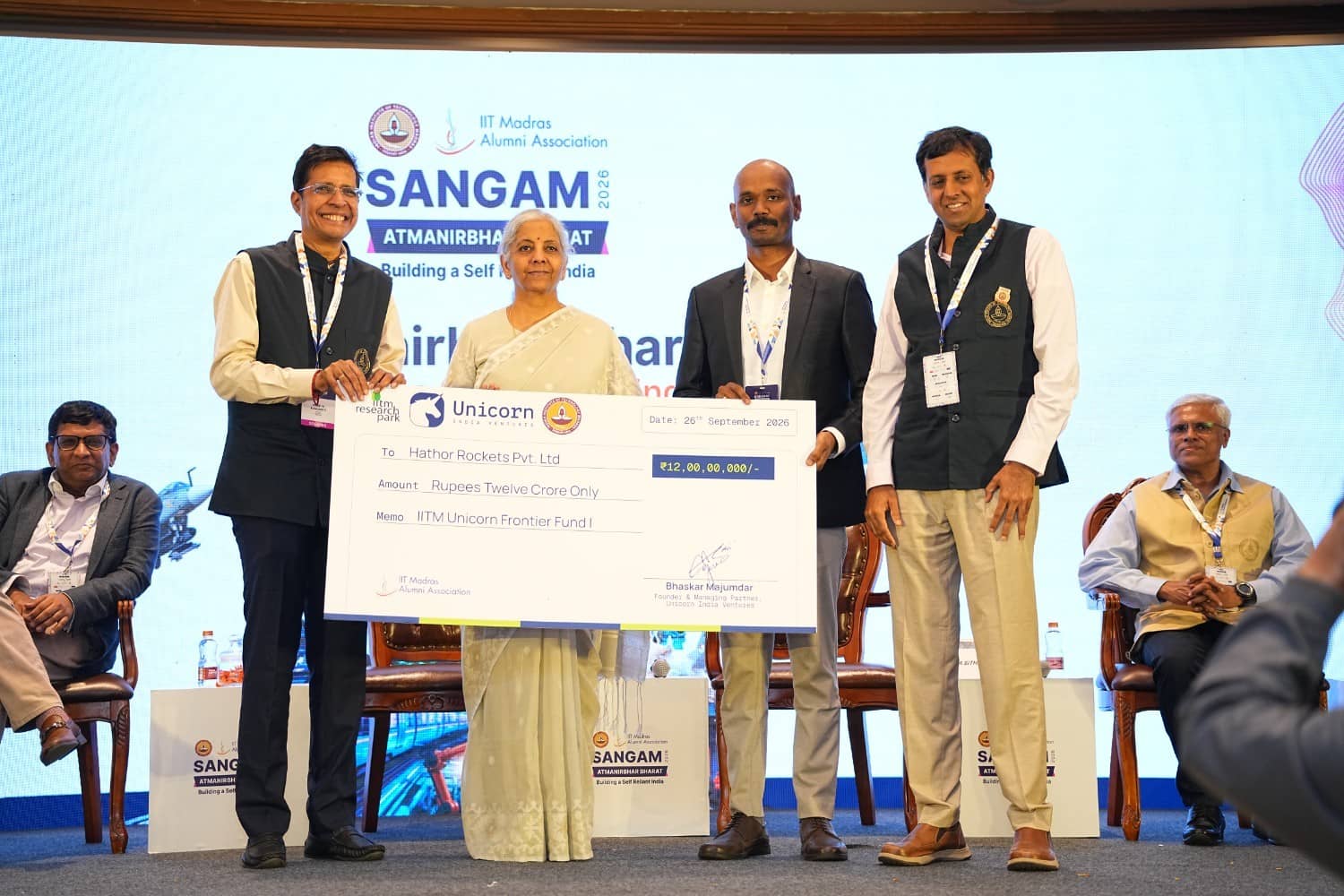
The announcement was made at Sangam 2026 in Bengaluru. Union Finance Minister Nirmala Sitharaman presented Hathor with a cheque for Rs 12 crore in the presence of IIT Madras Director Prof. Kamakoti Veezhinathan, marking the first close of the university-linked fund at Rs 450 crore. Hathor was named among the fund's first four portfolio companies, alongside Quanastra, TRIOLT Energy and Carbelim.
What Hathor builds
Most launch and in-space mobility companies still build propulsion in house from scratch, Hathor argues, which burns years and capital before a first flight. The company wants to be a specialised engine supplier instead: semi-cryogenic, cryogenic and earth-storable engines across thrust classes for launch vehicles, orbital transfer vehicles, lunar landers, hypersonic testbeds and strategic uses.
CEO V. K. Keerthivarman said in the release that aircraft makers long ago stopped building their own engines, and that space is reaching a similar point as launch cadence rises. Hathor says it has already designed, built and tested its first semi-cryogenic engine and is talking to clients in North America, Europe and India.
The new capital is meant to qualify and commercialise those engines, advance Amogha, an orbital-class cryogenic engine for small-to-medium lift vehicles, set up dedicated test infrastructure and expand the team. The company is targeting qualification of the orbital-class engine by mid-2028.
Institutional backing already on the record
Hathor was incubated at the Indian Institute of Space Science and Technology in 2023. It says it has signed an MoU with IN-SPACe to access ISRO test facilities, and has NIDHI Prayas and Excelium-SINE DeepTech Innovation grants. It also lists first place in the AWS APJ Spacetech Accelerator 2025 and a National Finalist slot at Boeing BUILD 5.0.
Indian private space coverage on Dalimss has recently included Skyroot Aerospace's Vikram launch vehicles and Dhruva Space's LEAP-2 deployment. Hathor's bet is different: sell engines to those who fly, rather than fly the vehicle itself.
Contacts and caveats
Media contact on the release is info@hathor.space. The corporate office is listed in Kottivakkam, Chennai. The release does not publish valuation, order book value or a delivery schedule for commercial engines beyond the mid-2028 qualification target.
A pre-seed cheque does not put an engine on a pad. What matters next is hot-fire data, customer contracts and whether overseas buyers will trust an Indian specialist for flight-critical propulsion.
India's private launch ecosystem has so far been dominated by companies that build the whole vehicle. An engine specialist is a different business model: fewer flight headlines, more qualification milestones, and revenue that can come from several vehicle makers at once. Hathor's comparison with aircraft OEMs is deliberate. If it holds, launch startups could buy engines the way airlines buy powerplants, and spend their capital on stages, avionics and operations instead.
The IITM Unicorn Frontier Fund angle matters beyond the cheque size. A university-linked fund with alumni capital above Rs 150 crore, as discussed at Sangam 2026 in related institute materials, is trying to shorten the deep-tech valley of death. Hathor sitting in the first four names puts propulsion on that shortlist beside quantum detectors, battery cells and climate hardware.
Foreign clients, if they convert, will demand export clearances, quality systems and flight heritage. Domestic launch startups will demand price and schedule certainty. Hathor's mid-2028 orbital-engine qualification target is the date on the wall. Between now and then, public hot-fire updates will be the cleanest way for outsiders to track progress.
Export ambition also changes the regulatory picture. Engines for foreign launch vehicles may need approvals that a purely domestic research project does not. Hathor's release mentions commercial interest from industrial companies and government agencies as it moves toward first deliveries. Converting interest into purchase orders with acceptance test criteria is the unglamorous work ahead.
For workers and suppliers in Chennai's deep-tech belt, a funded engine shop means machining, instrumentation and test-stand jobs rather than only software headcount. That industrial texture is part of why university-linked funds highlight hardware names in their first close.