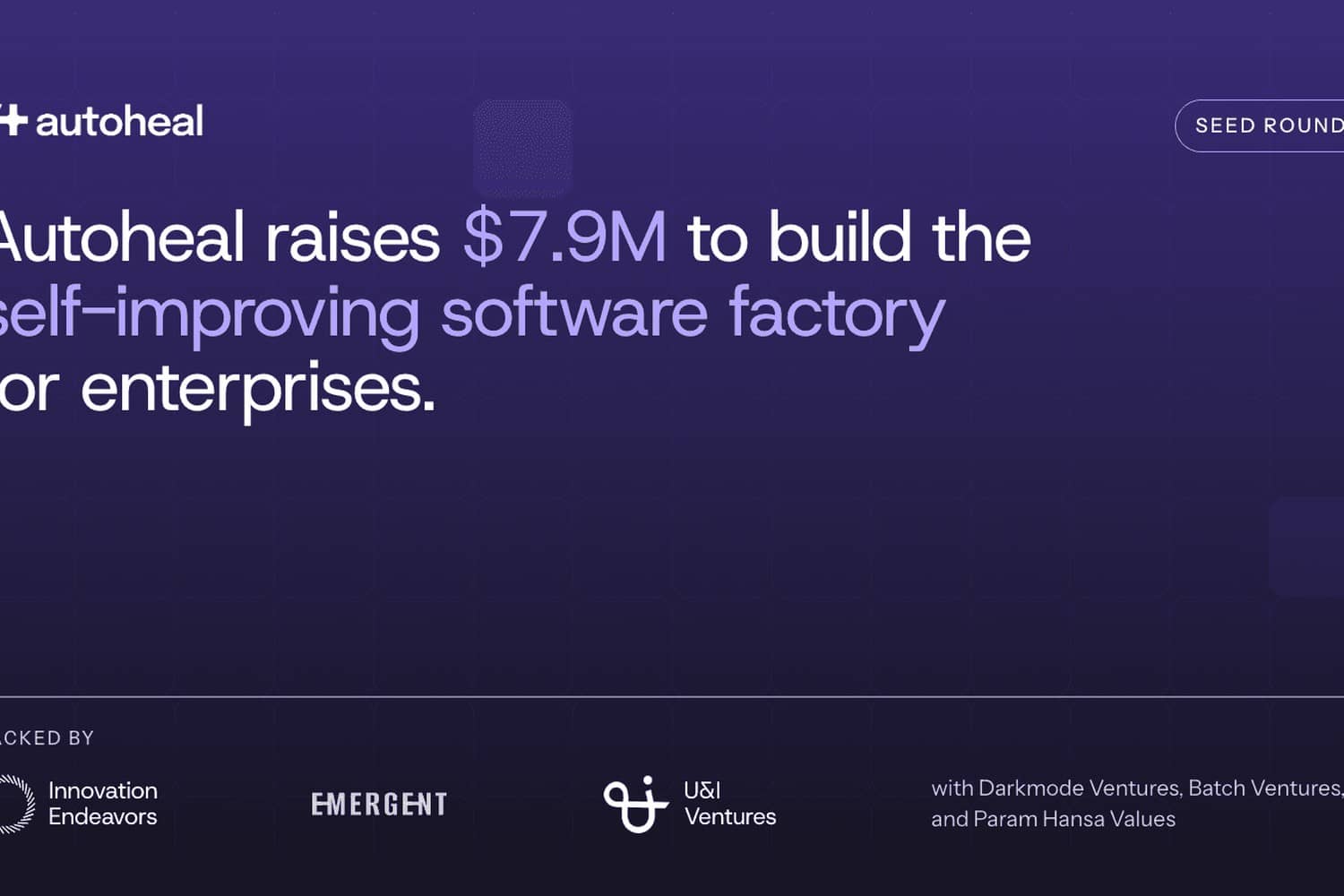
BENGALURU: Autoheal, a software company building what it calls a self-improving software factory for enterprises, has raised a $7.9 million seed round, according to a company blog post dated 28 September 2026. The round was led by Harpinder Singh at Innovation Endeavors, with participation from Emergent Ventures, U&I Ventures, Darkmode Ventures, Batch Ventures (CTO Fund) and Param Hansa Values.
Angel investors named in the post include Shawn Kung, Sumeet Arora, Anshu Sharma, Savin Goyal and Srikant Gokulnatha. The founding team is Sid Choudhury (CEO), Utkarsh Ohm (CTO) and Puneet Saraswat (CDO). They say they previously built and scaled the DevOps platform at Harness, and that experience shaped how they think about extensibility, reliability and enterprise control.
What Autoheal says it is building
The pitch starts from a bottleneck. AI coding agents sped up feature delivery, the company says, but left incident response, vulnerability remediation and AI coding cost controls as slow, manual work. Autoheal's answer is a shared cloud factory where worker agents handle those post-coding jobs, then feed lessons back into a shared engineering context that coding agents also read.
The post describes two planes. A context plane holds a graph of repositories, services, tickets and releases, plus skills and memories agents use for each task. A control plane holds agent definitions as code, budgets, model selection, identity, roles and approval policy, with a tool gateway that scopes and audits every integration.
Enterprises can run the system in their own cloud or fully air-gapped, the company says, with least-privilege access by default and private evaluations scored on the customer's own run history. That is aimed at banks and other regulated buyers who will not send production telemetry to a multi-tenant black box.
Early customers named in the post
Nomura Bank's Sameer Jain, CIO for Wholesale, is quoted saying Autoheal cut investigation timelines from hours to minutes and that running inside the bank's own cloud under its controls made the fit natural. AvidXchange CTO Krish Shetty says time to root cause fell to minutes, and that the team is now pushing the same agents left into other parts of the software lifecycle.
Those quotes are published by Autoheal. Dalimss News has not independently verified the time savings. Readers who want more on how Indian tech desks have covered AI tooling can start with our story on ShepHertz's offline AI models and the earlier report on Flipkart Ventures' backing of Keploy.
What happens next
Autoheal says customers can start with alert triage and incident response, or with AI coding cost and context governance, and that it runs a three-week proof of value against agreed measures. Contact listed on the site is hello@autoheal.ai. The post does not disclose valuation, burn or headcount.
For Indian engineering leaders already paying for coding agents, the seed round matters less than whether the factory stays accurate as codebases drift. That is the claim the company will have to prove in production, not in a blog post.
Enterprise buyers will also ask how Autoheal relates to the coding agents they already pay for. The company's answer is that it does not replace those agents. It changes the shared context they read, so a fix learned in incident response can improve the next coding session without a human copying notes between tools. That is a subtle pitch, and it only works if the context graph stays fresh as services and repositories change.
The Evaluator and Healer loop described in the post is meant to solve that drift. Every agent run is scored against downstream signals such as review comments, CI re-runs and the real root cause of an incident. Weak scores become proposed context changes, opened as pull requests for engineers to approve. If that loop works, agents improve inside the customer's security boundary instead of only in a vendor demo.
Indian IT services firms, banks and SaaS exporters are already experimenting with coding agents. A seed-stage factory aimed at the work after the commit is early relative to that wave. Autoheal's named design partners give the story weight. Broader adoption will depend on proof-of-value scores that finance and security teams both accept.