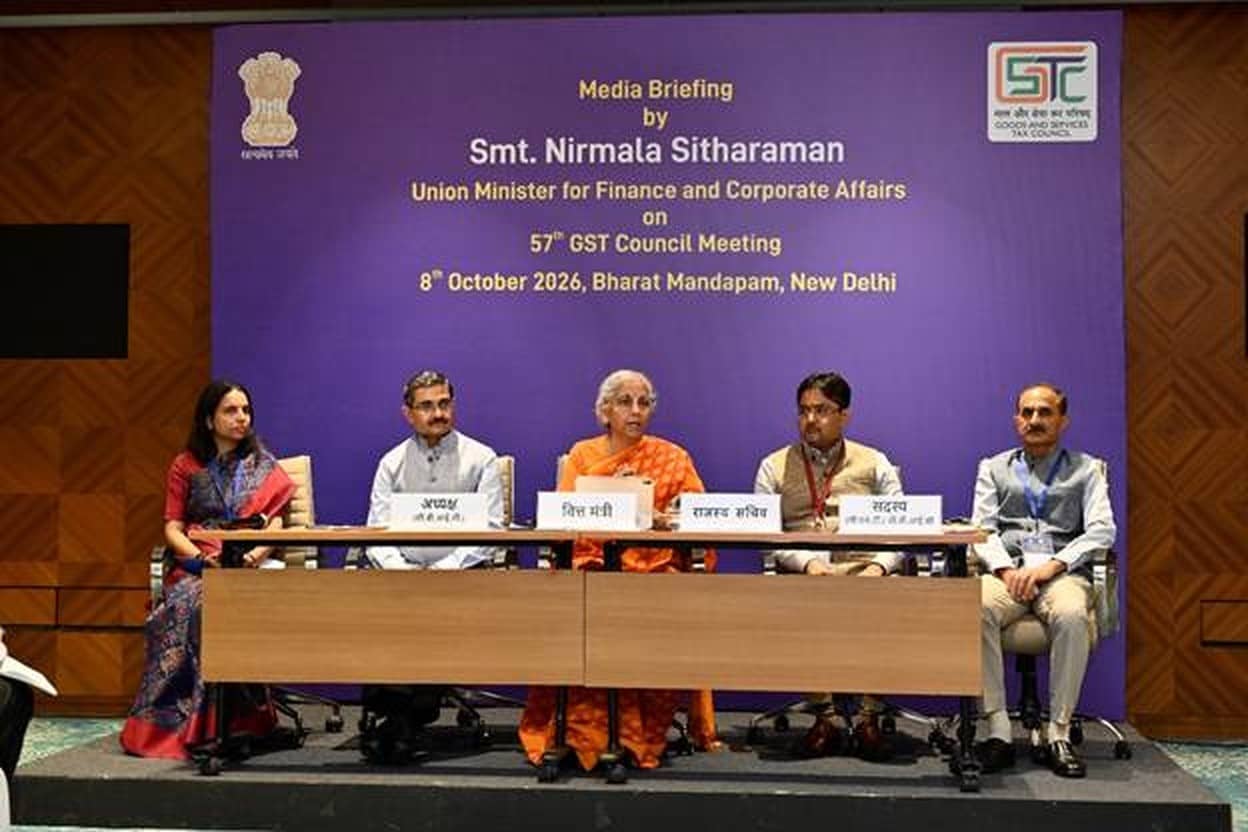
NEW DELHI: The GST Council has recommended taking the power of arrest out of the GST law and raising the amount of tax evasion that can lead to prosecution from Rs 1 crore to Rs 5 crore. Both recommendations came out of the Council's 57th meeting, held in New Delhi on Thursday, 8 October, under Union Finance Minister Nirmala Sitharaman.
What the meeting did not do is change tax rates on everyday goods. The Finance Ministry's release, issued through PIB at 7:03 PM IST, describes the session as one about process reforms in registration, returns, refunds and adjudication. Phones, laptops, televisions and other electronics do not figure in the list of rate changes, so festive sale buyers will not see GST move on the gadget in their cart. PIB also carried a statement in which Prime Minister Narendra Modi welcomed the recommendations as a step towards simpler, trust based tax administration.
Arrests, penalties and notices
The Council wants section 69 of the CGST Act, the provision that allows arrest, deleted. Prosecution will still be possible, but only above the new Rs 5 crore threshold, and the list of offences under section 132 is to be narrowed. One offence that stays is taking input tax credit without receiving any goods or services, or without an invoice.
Smaller disputes get cheaper. The maximum general penalty under section 125 falls from Rs 25,000 to Rs 10,000. No show cause notice is to be issued where the tax involved is under Rs 10,000, and pending notices or appeals below that figure will be treated the same way once the change takes effect. In cases without fraud, a taxpayer who pays the tax and interest within 30 days of an order under section 73, or 60 days under section 74A, will pay a reduced penalty of 5 percent. The Rs 10,000 minimum penalty in such cases goes.
For appeals against orders that only impose a penalty, with no tax demand, the pre-deposit will be capped at Rs 40 crore, split equally between central and state tax.
Refunds, credit and online sellers
Refunds move further towards automation. In the first phase, refunds of excess balance in the electronic cash ledger will be sanctioned by the system. The time allowed to acknowledge a refund application drops from 15 days to 10, after which the claim is treated as acknowledged. For exporters and businesses with an inverted duty structure, 90 percent of the claim will be sanctioned provisionally by the system on the basis of risk checks.
Input tax credit also widens. The Council recommended removing the block on credit for outdoor catering, health and life insurance, telecom towers, pipelines laid outside the factory, free samples, and goods destroyed on expiry where the law requires it. Refund of credit on input services in inverted duty cases will apply to credit taken on or after 1 November 2026. Refund of credit on capital goods will be spread over 60 months and will apply to credit taken on or after 1 April 2027.
Online sellers get a change many have asked for. Under a new rule 14B, a small seller supplying goods through an e-commerce platform will be able to register in a state where it has no shop or office by declaring the platform's warehouse there as its principal place of business. The condition is that the input tax credit it passes on is no more than Rs 2.5 lakh a month, and registration will be granted automatically.
Two service changes touch anyone who shops online. Delivery services, other than courier and post, supplied through an e-commerce platform by people who are not required to register will be taxed in the platform's hands at 5 percent without input tax credit. Delivery of goods ordered through a platform will also carry 5 percent without credit. The release does not give a start date or say whether platforms will change delivery charges.
There is a gadget angle in the scrap rules too. Electrical and electronic waste, plastic scrap, tyre scrap and used cooking oil will come under reverse charge when an unregistered supplier sells to a registered buyer, which means the buyer pays the tax. Between registered businesses, tax will be deducted at source at 2 percent.
What happens next
None of this is law yet. The release says the recommendations take effect only through circulars, notifications and amendments to the law, which alone carry legal force. Removing the arrest power needs a change to the CGST Act in Parliament and matching changes in state laws. The Council has also asked for public consultation on a new way of correcting tax and credit through returns, which it wants to start from the return for April 2027.
For small businesses, the release promises a late fee waiver for taxpayers with turnover up to Rs 5 crore who file a delayed return by the end of the month in which it was due. It also approves in principle an optional scheme with an annual return and quarterly payment for firms up to Rs 5 crore that sell only to consumers. Shopkeepers should also read our report on the UPI merchant fee from 15 October. Marketplace sellers can find the sale calendar in our guide to Amazon and Flipkart festive sale dates. The full list of decisions is in the Finance Ministry release on PIB.