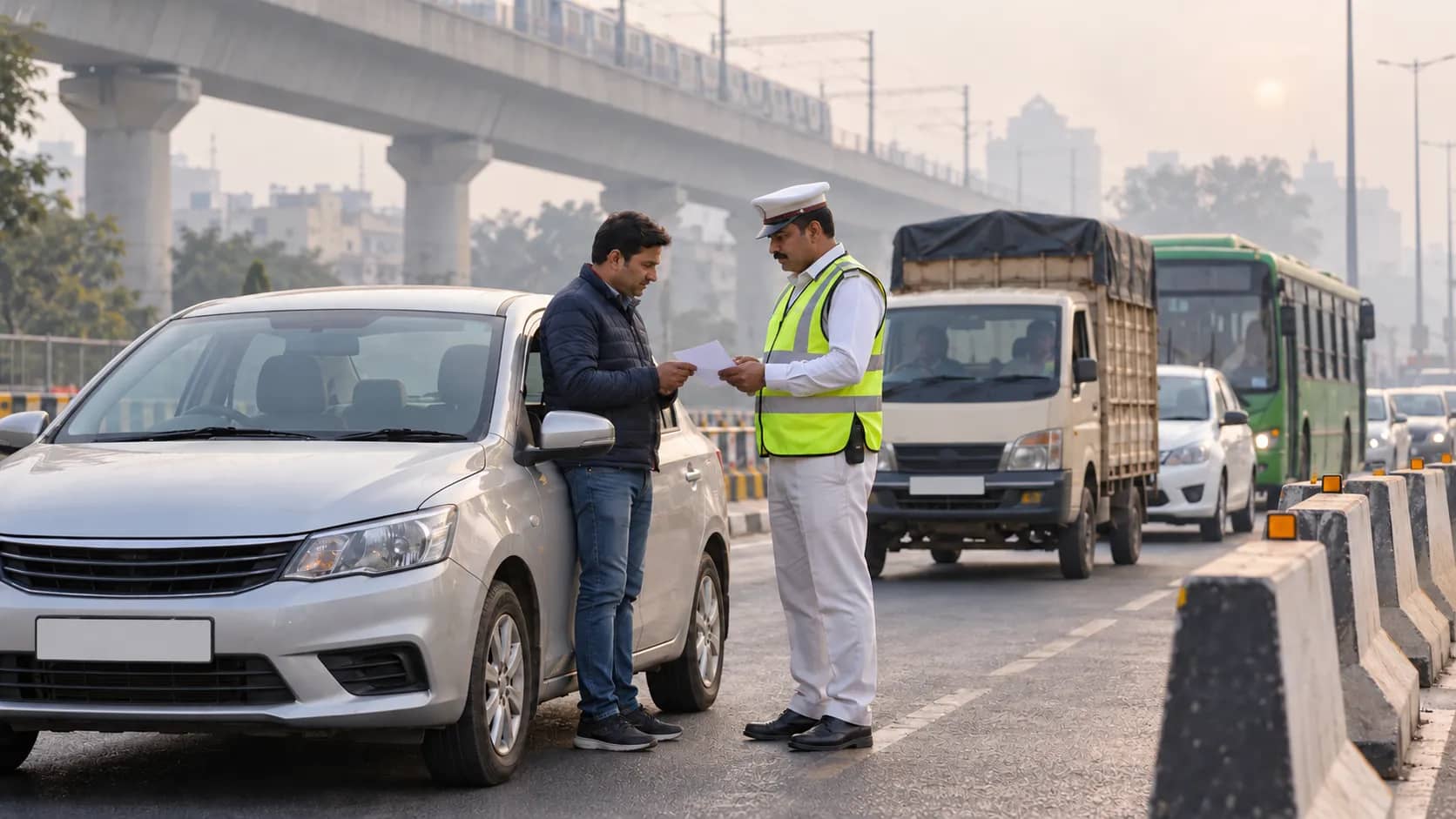

The Commission for Air Quality Management has called transport authorities from Uttar Pradesh, Rajasthan and Haryana to hearings over the rollout of camera-based fuel-station checks in their NCR districts. The notices, dated 8 October 2026, concern alleged delays in installing systems meant to enforce the restriction on supplying fuel to vehicles without a valid pollution under control certificate.
CAQM has asked the secretary in charge of each transport department and the state's transport commissioner to appear in New Delhi. Uttar Pradesh's hearing is scheduled for 15 October at 11 am, Rajasthan's for the same day at 3 pm, and Haryana's for 16 October at 11 am.
The commission expressly says it has drawn no conclusion about the liability of any department, departmental head or other officer. It describes the available material as indicating a preliminary case of non-compliance and is giving the authorities an opportunity to provide records and explanations. The notices are not findings of guilt or orders imposing a penalty.
What the commission says was delayed
According to the Uttar Pradesh notice, 987 fuel stations in the state's NCR districts had been identified for automatic number plate recognition, or ANPR, systems. The corresponding figures are 362 in Rajasthan and 2,780 in Haryana. Together, the three notices cover 4,129 identified stations.
In each case, CAQM says information reported by the state on its PAVAN portal showed that installation or deployment had not begun at those stations as of 30 September. That is the status date cited in the notices, rather than a fresh assessment of every station on 12 October.
The commission also says it sought implementation reports through earlier communications and had not received the required compliance material by the date of the notices. It cites reviews by its statutory Sub-Committee on Safeguarding and Enforcement on 12 June and 29 September, and a meeting with transport commissioners on 22 July.
The fuel restriction and its technology
The underlying requirement comes from Direction 101, issued on 15 May 2026. As reproduced in the notices, it set 30 September as the deadline for installing, integrating and making suitable technology-enabled enforcement systems operational at fuel stations. The restriction on dispensing fuel to vehicles without a valid PUCC took effect from 1 October.
The systems are intended to combine number-plate recognition with the VAHAN vehicle database and PUCC records, allowing identification of vehicles whose pollution certificate is invalid. A camera identifies the vehicle for a database check; the notices do not describe it as measuring exhaust emissions at the pump.
The quoted direction does not make the fuel restriction dependent solely on a working ANPR camera. It permits identification through other technology-enabled systems or otherwise. Consequently, a delay in camera installation is not described in these notices as an extension of the compliance deadline or a suspension of the underlying rule.
The direction allows fuel to be supplied in exceptional circumstances, including medical emergencies, law-and-order duties and disaster response, or other situations specified by the Delhi or NCR state governments. The notices do not publish a new general exemption for motorists or certify that enforcement is operating uniformly at every fuel station.
Authorities must explain their next steps
Each state has been asked for a comprehensive updated report supported by records, explaining implementation progress and the reasons for delay. CAQM also wants a time-bound action plan with definite dates for completing installation, database integration and operation. The hearings are therefore intended to establish both what happened and how the remaining work will be completed.
The commission warns that, without sufficient cause, failure to provide the explanation or attend could lead it to decide the matter on the available record without another hearing opportunity. Any such decision would be a subsequent step; the 8 October documents do not announce its outcome.
Dalimss News previously covered Haryana's preparations for the no-PUCC fuel policy and Gurugram's district winter air-quality plan. These latest notices concern the commission's scrutiny of state-level implementation after the September technology deadline, with the authorities' explanations due at this week's hearings.