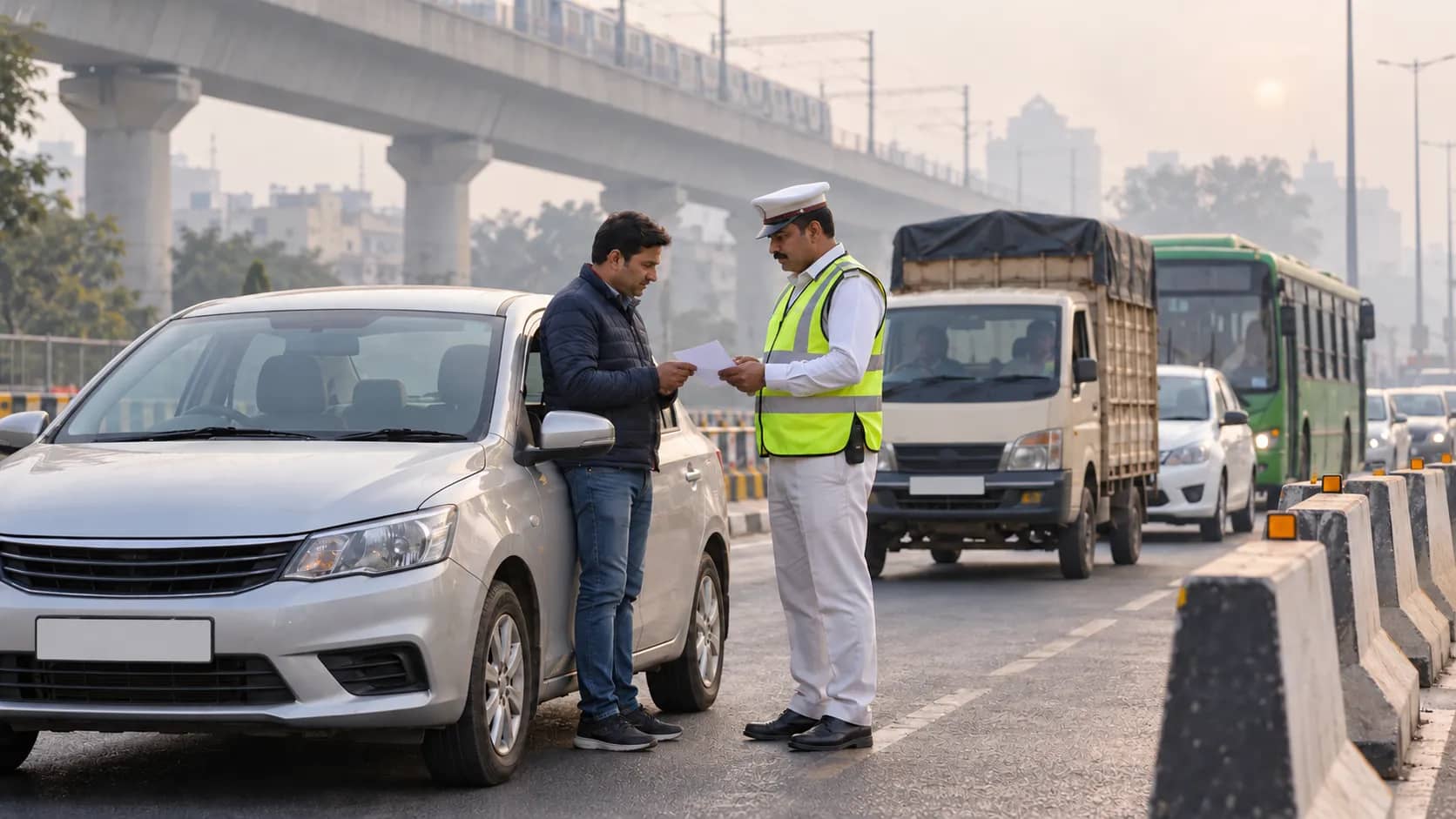
Delhi-NCR's revised winter pollution framework brings restrictions on older inter-state buses into an earlier stage and extends its older-car curbs to Sonipat. The Commission for Air Quality Management issued the changes on 29 September 2026 through Direction 104, which also removes essential-commodity exemptions for specified goods vehicles during the more severe pollution stages.
The distinction for motorists is between a revised rulebook and an activated restriction. The official direction makes the framework effective immediately, but expressly says measures under each stage apply when that stage is invoked through an order. Its publication alone does not activate every vehicle ban.
Stage orders determine when restrictions apply
The Graded Response Action Plan, or GRAP, has four stages linked to Delhi's air quality index: Stage I covers 201 to 300, Stage II 301 to 400, Stage III 401 to 450 and Stage IV readings above 450. The system also uses forecasts, rather than waiting only for an observed reading to cross a threshold.
CAQM's sub-committee can invoke a stage in advance when forecasts indicate sustained deterioration. If an unexpected episode pushes air quality across a threshold, immediately enforceable measures can be brought in at once. Restrictions from lower stages continue alongside those imposed at a higher stage, so the applicable order matters more than the calendar date.
Cars and buses face different provisions
At Stage III, the revised schedule requires restrictions on BS-III petrol and BS-IV diesel or below-standard four-wheel light motor vehicles in Delhi and five high-vehicle-density districts: Gurugram, Faridabad, Sonipat, Ghaziabad and Gautam Budh Nagar. Sonipat is the addition to the district list announced in the revision.
A specific exemption remains for people with disabilities using BS-III petrol or BS-IV diesel light motor vehicles specially adapted for them, provided the vehicles are used only personally. The clause is therefore not a blanket restriction on every petrol or diesel car, nor does it classify vehicles solely by their age.
The bus restriction now sits in Stage I. Inter-city and inter-state buses from Haryana, Uttar Pradesh, Rajasthan, Punjab, Himachal Pradesh, Madhya Pradesh, Uttarakhand and Jammu and Kashmir may ply in Delhi-NCR only if they are electric, CNG or BS-VI diesel under this provision. CAQM's 29 September announcement confirms that the measure moved down from Stage II. Unlike the freight-entry clauses, this bus provision covers plying in Delhi-NCR, rather than only entry into Delhi.
Stage I also calls for tighter pollution-under-control enforcement and action against visibly polluting vehicles. Transport agencies are directed to increase CNG and electric bus, Metro and RRTS services through additional vehicles or higher frequency, and introduce differential fares to encourage off-peak travel. These are directions to agencies, not a published timetable or fare offer.
Goods-vehicle rules tighten as pollution worsens
At Stage III, Delhi-registered BS-IV and below diesel medium goods vehicles face restrictions on plying within Delhi. Diesel light and medium goods vehicles of those standards registered outside Delhi cannot enter the capital. The schedule sets out these vehicle categories separately; the Delhi-registration clause concerns medium goods vehicles.
Stage IV stops heavy goods vehicles from entering Delhi, while allowing LNG, CNG, electric and BS-VI diesel trucks. It also bans Delhi-registered BS-IV and below diesel heavy goods vehicles from plying in the city. The commission's announcement specifies that carrying essential commodities no longer provides the earlier exemption for the affected vehicles in Stages III and IV.
Those pollution-stage restrictions operate alongside separate standing entry rules. Dalimss News has reported the 31 October end of the BS-IV goods-vehicle transition window under amended Direction 88. That deadline does not override a stricter GRAP stage order issued before it.
There is also a distinction for road works: pothole repairs are permitted under the Stage III construction provisions, while Stage IV extends construction restrictions to linear public projects such as roads, highways, flyovers and overbridges. For daily travel, the commission directs residents to check the applicable stage on its website. Its enforcement activity is covered separately in Dalimss News' report on the October inspection review.