BLW and Varanasi Municipal Corporation Sign Two-Part Waste Management Pact
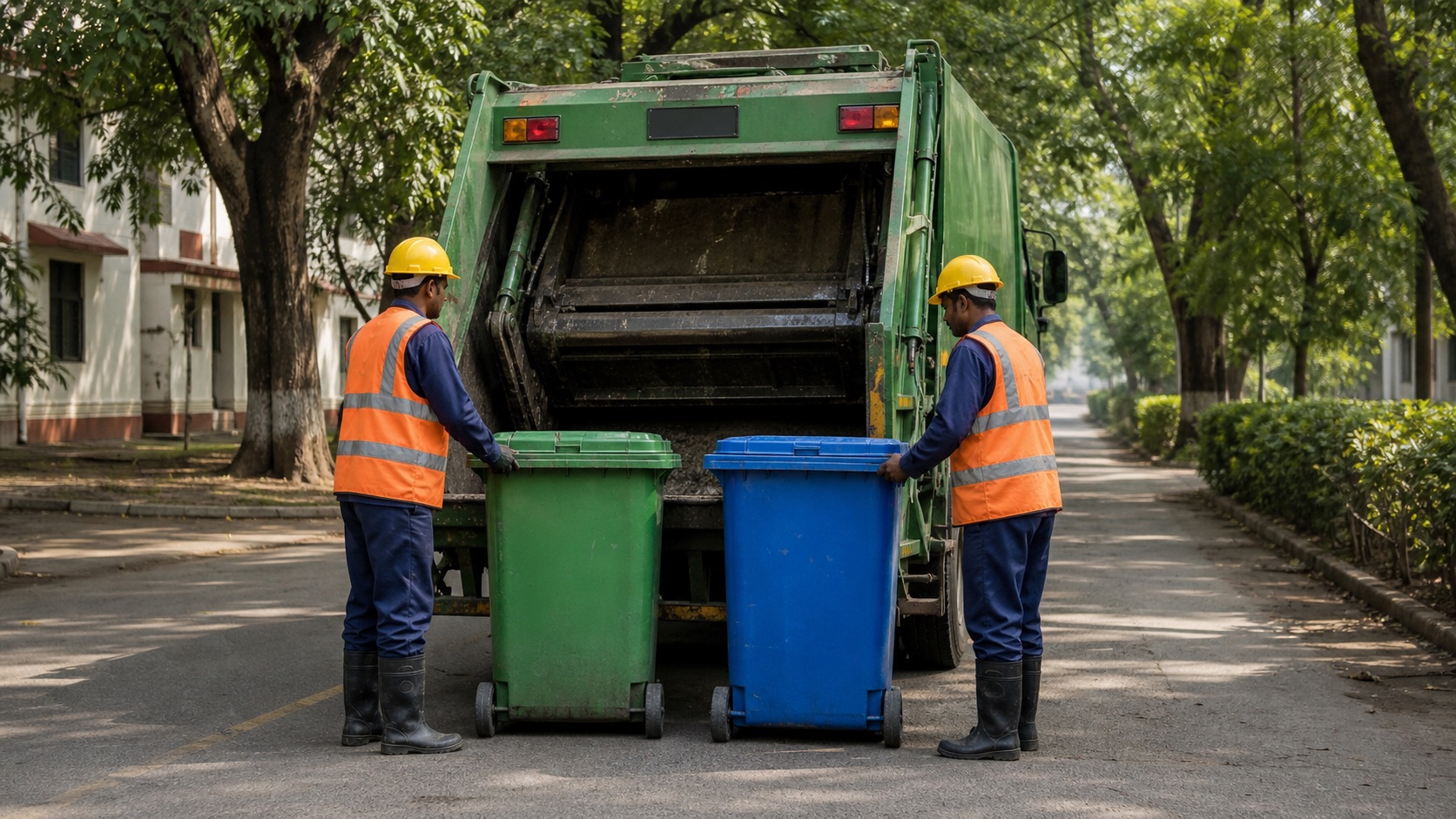
Varanasi: Banaras Locomotive Works and the Varanasi Municipal Corporation have signed two service agreements intended to change how waste is collected, transported and processed across the BLW township. One addresses the accumulated dump site; the other covers the waste generated every day.
Under the first agreement, legacy waste at the BLW dumping area is to undergo bioremediation, scientific processing and safe disposal. Legacy waste is not solved by pushing an old heap to a new corner. It requires screening, recovery of usable fractions, treatment of contaminated material and documented disposal of what cannot be reused.
The second agreement runs for one year. BLW will collect daily waste in designated bins, while VMC will transport and process it for a fixed monthly service fee. That division of responsibility is useful only if both sides measure the handoff: how much segregated waste leaves each zone, when a vehicle arrives and what quantity reaches an authorised facility.
The documents were exchanged by BLW deputy chief engineer Saket and additional municipal commissioner Durgesh Mishra in the presence of BLW general manager Ashutosh Pant and municipal commissioner Himanshu Nagpal. Senior engineering, mechanical, electrical and finance officers also attended.
Officials described the arrangement as a step towards zero-landfill operations and compliance with the Solid Waste Management Rules, 2026. The ambition needs a clear baseline. BLW and VMC should publish the estimated tonnage of legacy material, daily waste generation, segregation rate and target completion date. Without those numbers, “zero landfill” remains a slogan that cannot be audited.
Township residents and railway employees have a direct role. Wet waste mixed with plastic and sanitary material is harder and more expensive to process. Bins should be consistently colour-coded, collection staff trained not to remix separated material, and bulk generators such as canteens monitored under appropriate rules.
Bioremediation near homes or workplaces also requires environmental safeguards. Dust, odour, leachate and vehicle movement should be controlled, with workers given gloves, masks, washing facilities and formal safety training. Informal waste pickers should not be displaced without considering livelihood and inclusion in safer recovery work.
The one-year daily-waste contract provides a natural review point. Monthly data on missed collections, complaints, processing receipts and user fees can show whether the arrangement is working before renewal. Independent sampling would add credibility where reported segregation rates appear unusually high.
BLW is a large, bounded township, making it a practical place to demonstrate disciplined municipal waste management. If the two agreements turn old waste into reclaimed land and stop new mixed heaps from forming, the model will deserve attention elsewhere in Varanasi. The proof will be on the ground, not in the signing photograph.
Sources and reporting
Based on the service agreements exchanged by BLW and VMC officials in Varanasi on 3 August 2026.
Related Stories
Court Issues Arrest Warrant for HSVP Brass
MCG Finalises Sohna Site for Fresh Waste
GMDA Seeks Station-Wise Metro Parking Plans

Thar Rams Rapido Cab After Sector 89 Quarrel
FDA Raids 3 Outlets Over Paneer Quality