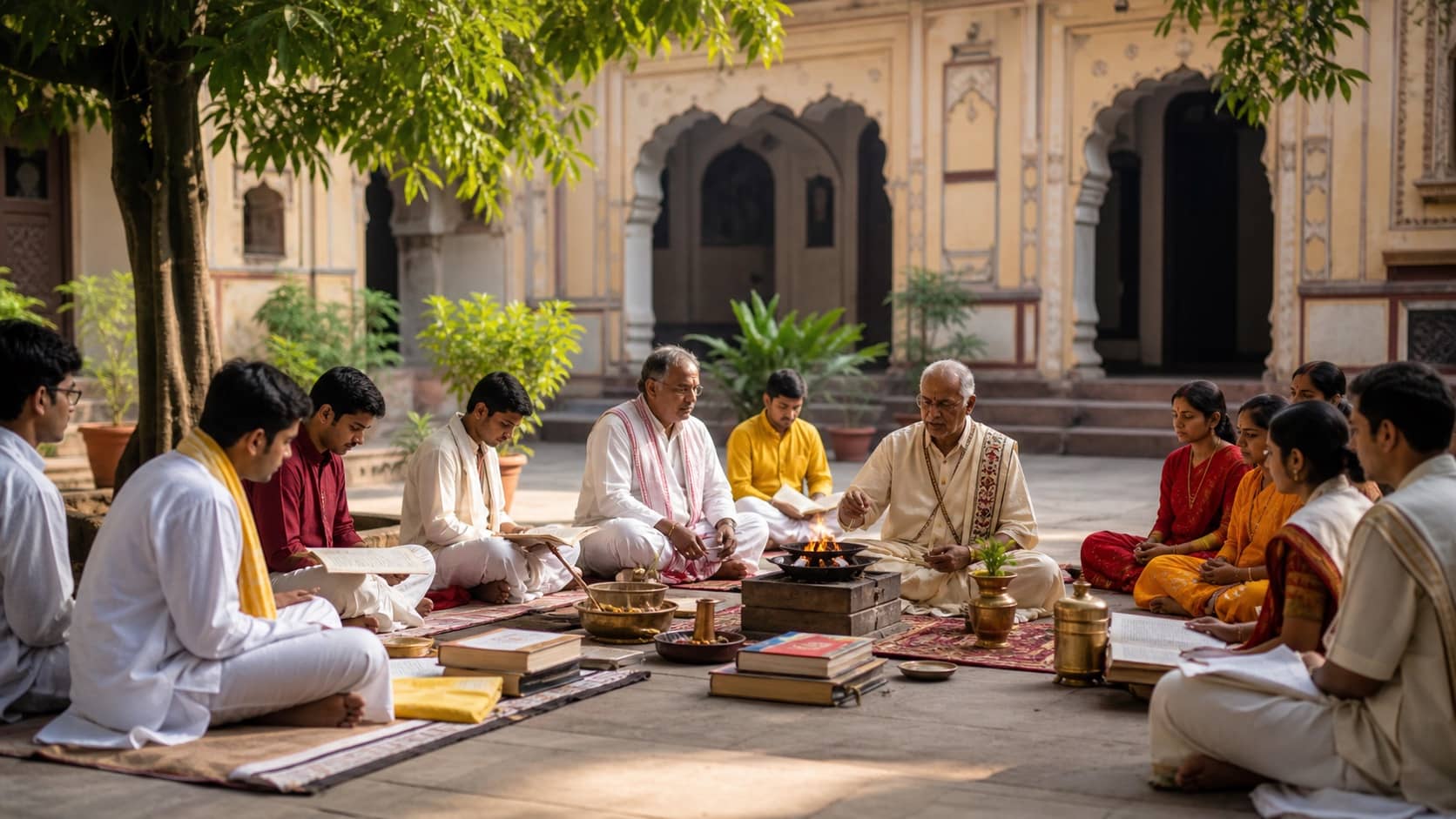
Teachers, research scholars and students at Banaras Hindu University and Sampurnanand Sanskrit University observed Shravani Upakarma on Friday, joining ritual renewal with an appeal to sustain Sanskrit and Vedic learning. The programmes included bathing rites, rishi worship, consecration of the sacred thread and the tying of protective threads.
At BHU, the observance followed a tradition associated with the university since the time of founder Madan Mohan Malaviya. Participants completed the initial rites at Tulsi Ghat before continuing at Malaviya Bhavan. Hemadri sankalp, the prescribed forms of bathing, panchagavya prashan and tarpan formed part of the morning sequence.
The gathering later performed rishi pujan and yajnopavita pujan at Malaviya Bhavan. A sacred thread was also offered to Malaviya, a gesture that ties the institution’s founder to the living academic tradition. Professor Upendra Kumar Tripathi coordinated and officiated, with Dr Narayan Prasad Bhattarai serving as co-coordinator and Professor Sunil Katyayan presiding.
At Sampurnanand Sanskrit University, the Veda Department organised its own Upakarma. Vice-Chancellor Professor Bihari Lal Sharma extended greetings and urged participants to contribute to the advancement of Sanskrit. Professor Mahendra Pandey chaired the programme, while chief guest Professor Rampujan Pandey spoke about the meaning, method and continuity of the observance.
Upakarma is sometimes seen only as a change of sacred thread, but in an academic setting its connection with study becomes clearer. The annual rite asks participants to remember the teachers and rishis through whom knowledge is transmitted, acknowledge lapses and recommit themselves to disciplined learning. That makes it especially relevant in institutions where Sanskrit texts and Vedic traditions are subjects of both practice and research.
The two university programmes also demonstrated that heritage survives through organised teaching. Precise recitation, ritual sequence and interpretation cannot be preserved by symbolism alone. They require instructors, students, regular practice and space within an academic calendar. Younger participants learn not just what is done, but why a particular step appears where it does.
By holding the ceremonies on the same festival day, BHU and Sampurnanand Sanskrit University presented two institutional versions of a shared Kashi tradition. The settings and organisers differed, but the message converged: ritual renewal carries meaning when it leads back to study, responsible conduct and the patient work of passing knowledge to the next generation.
Both institutions now have an opportunity to document the ceremony carefully for students who could not attend. A short archive of the mantras, sequence and academic explanation would strengthen the link between annual practice and year-round teaching.