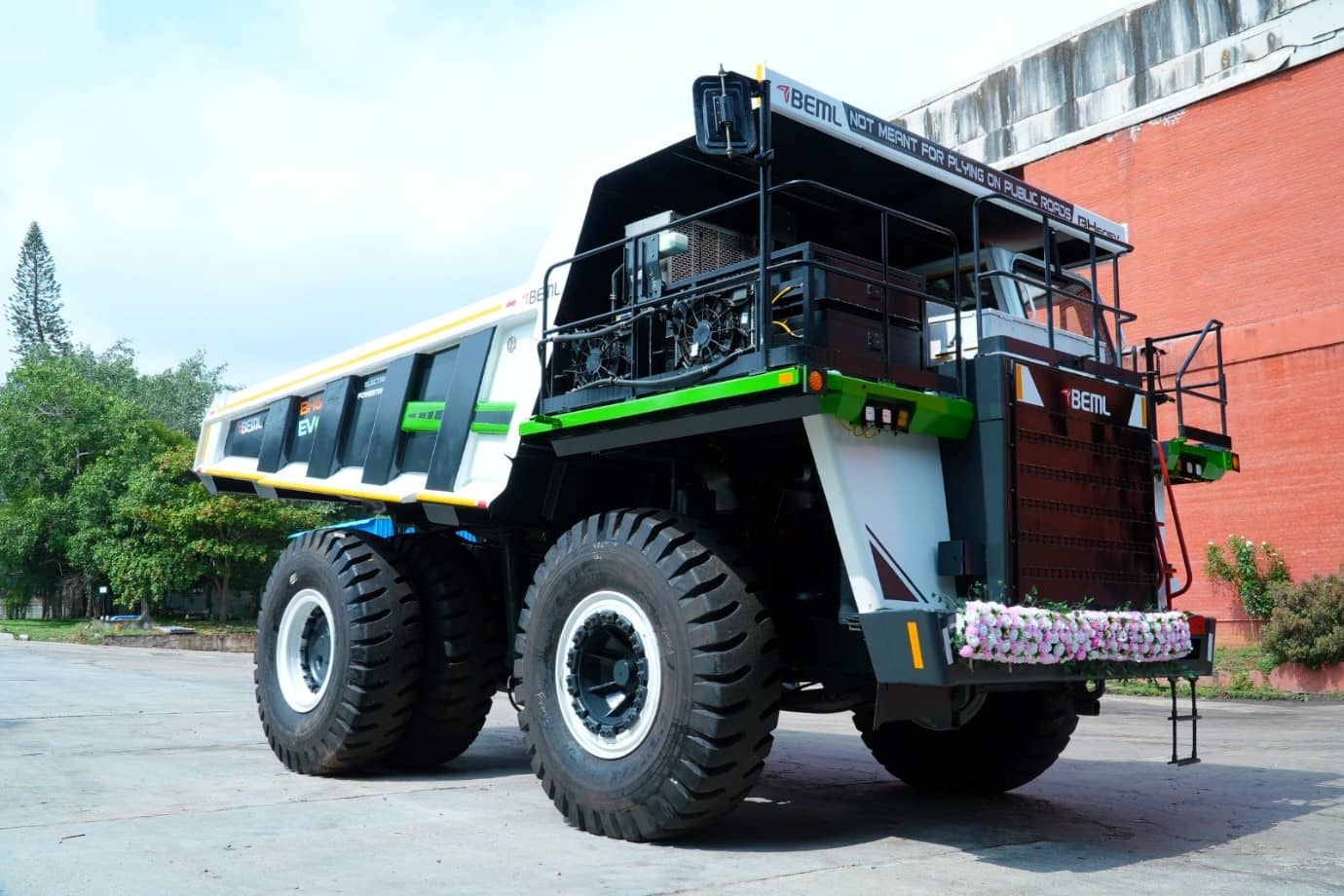
BEML has expanded its electric mining-equipment range with the BH60-EV, a dump truck carrying a 1,000 kWh battery and a specified rock-body payload of 54,500 kg. Unveiled at the company's Mysuru complex on 30 September 2026, the machine takes its battery-powered programme beyond the smaller electric dumper introduced in April.
The company describes the BH60-EV as an indigenously designed and developed vehicle in the 60-ton class. That description should be read alongside its precise payload figure: the release specifies 54.5 tonnes, rather than saying the rock body can carry 60 tonnes of material. Its stated volumetric body capacity is 36.4 cubic metres.
The announcement concerns an unveiling for mining and infrastructure applications. Neither the Ministry of Defence release published through PIB nor BEML's accompanying stock-exchange filing announces a purchase price, a first customer, order volumes or a customer-delivery date.
A larger battery-powered mining platform
The BH60-EV uses a permanent magnet synchronous motor connected to a gearbox, with energy supplied by a high-voltage lithium-ion battery pack. BEML says the combination provides high tractive effort and instant torque for gradients encountered in heavy-duty work. It does not give a numerical motor-output rating, maximum gradeability or operating range in the announcement.
The safety equipment listed includes a roll-over protective structure around the cabin, emergency steering and sealed oil-cooled disc brakes. BEML also describes the cabin as ergonomically designed. These are the manufacturer's stated provisions, rather than the results of an independently published crash or mine-site performance test.
The truck was developed at Mysuru and unveiled virtually by BEML chairman and managing director Shantanu Roy. BEML operates under the Ministry of Defence, with mining and construction equipment forming one of its three business divisions alongside defence and aerospace, and rail and Metro products.
Charging is part of the equipment offer
BEML says it also offers a complete charging-station solution designed around a customer's site electrical infrastructure and capable of scaling up for fleet operations. This is part of its proposed deployment package for electric heavy equipment, rather than an announcement of access to a particular public-road charging network.
The charging statement does not specify the BH60-EV's charging power, connector standard or time needed to replenish its 1,000 kWh battery. Those details are separate from battery capacity, which records the amount of stored energy. The release therefore does not establish how long the larger truck can work between charges or how quickly it can return to a loading cycle.
On operating economics, BEML estimates costs could be 40 to 60 per cent below those of conventional diesel-powered equipment. It also puts the possible annual carbon-dioxide reduction at around 130 tonnes per vehicle, subject to operating conditions. Both figures are company estimates; the release does not provide the underlying comparison duty cycle or measured customer results.
What differs from the April electric dumper
BEML's 10 April announcement described a smaller machine with a 35-tonne payload, an approximately 60-tonne gross vehicle weight and a 300 kWh lithium-ion battery. Its gross weight is a different measure from the payload specification used to describe how much material a truck carries.
For that April vehicle, BEML listed regenerative braking for recovering energy, particularly downhill, and a liquid-cooled battery thermal-management system. It also specified IP67/IP68-rated electrical systems, integrated fire protection and an estimated zero-to-80-per-cent charging time of 60 to 90 minutes.
Those detailed claims relate to the smaller model. They cannot be transferred automatically to the BH60-EV simply because both machines belong to BEML's electric range. The September release confirms the larger battery, motor-and-gearbox arrangement, payload and cabin safety provisions, while leaving several operating and commercial specifications open.
The development broadens India's commercial-vehicle electrification story beyond the road-going segments covered in Dalimss News' September retail report. It also sits within a manufacturing sector adding capacity, including the separately reported Federal-Mogul Goetze expansion. For BH60-EV, the confirmed step remains the September unveiling; commercial deployment details have not been announced in the cited documents.