
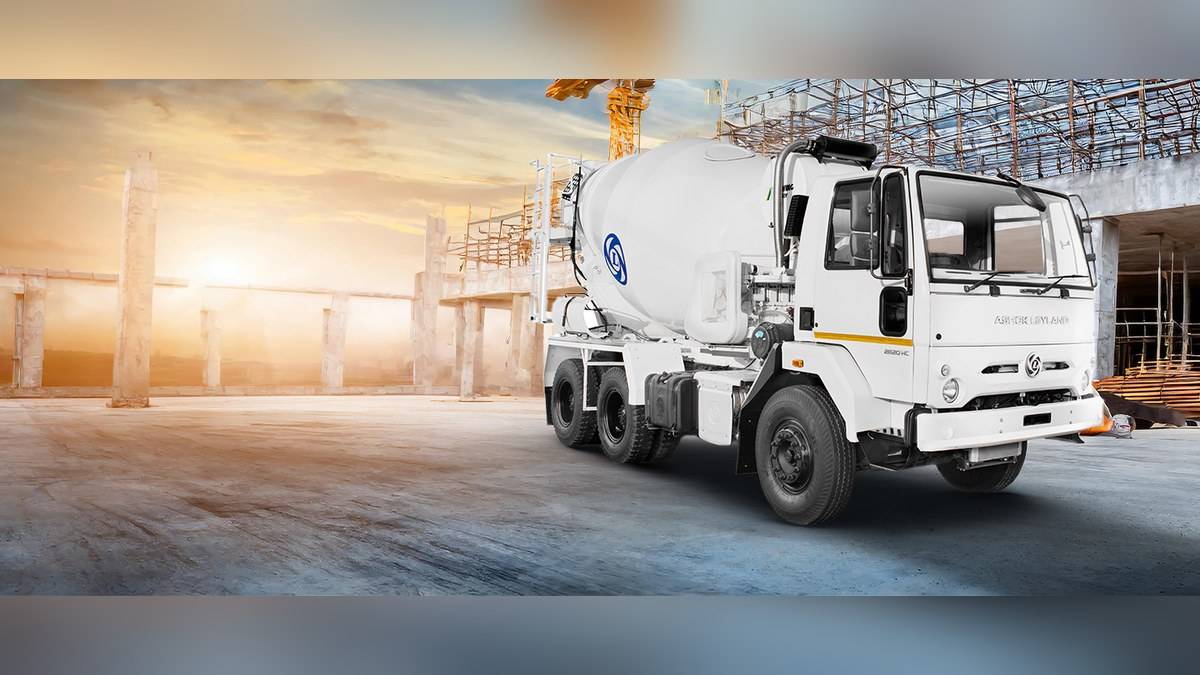
NEW DELHI: Ashok Leyland lists the Cargo 2820 RMC at Rs 52,40,000 onwards and the AVTR 3525 RMC at Rs 64,70,000 onwards. Their technical pages describe different concrete-mixer configurations: the Cargo entry lists smaller drum choices, while the AVTR entry lists larger drums and a different engine and gearbox.
| Published detail | Cargo 2820 RMC | AVTR 3525 RMC |
|---|---|---|
| Starting figure | Rs 52,40,000 onwards | Rs 64,70,000 onwards |
| Engine | 5.7 L, H-series 6-cylinder | 6.0 L, H-series 6-cylinder |
| Power | 147 kW | 184 kW |
| Gearbox | ALGB940, 6-speed direct drive | ZF9S1110, 9-speed direct drive |
| Listed drum choices | 6 or 7 CBM | 9 or 10 CBM |
| Fuel tank | 220 L | 300 L |
Price as of 9 November 2026, 23:51 IST. Both prices are onwards figures from the manufacturer. The website does not assign a separate verified price to every drum size, so these amounts cannot be presented as a complete variant-by-variant tariff.
The drum makes this a specialist comparison
A concrete mixer has to be considered as a working combination of chassis and mounted equipment. The engine specification describes only part of that combination. The drum, its drive arrangement and the completed vehicle's weight documentation are also needed to understand the configuration that will enter service.
For these particular listings, the drum choices are the clearest distinction to retain in a fleet record. Copying the larger model's drum capacity into the smaller model's quotation would misdescribe the vehicle. Treat the capacity printed against the selected model as its own entry, with the equipment description attached.
CBM expresses volume. It should not be rewritten as a payload in tonnes. Establishing the load carried by a completed mixer needs the relevant weight and configuration information; the drum figure alone is insufficient. That is particularly important where a brief mixes a requested concrete volume with a road-going vehicle's permitted mass.
Different transmissions accompany the engines
The Cargo specification includes a single dry-plate clutch with a 380 mm diameter, non-reactive rear suspension and a tiltable Cargo day cabin. The AVTR specification lists a 430 mm dry-plate clutch, bogie rear suspension and a U cabin. These are differences in the published builds, not optional accessories assumed from the price gap.
The named gearboxes also make the two entries more specific than a comparison of engine output alone. A maintenance record should retain the gearbox identity alongside the truck identity. That allows workshop planning to follow the actual powertrain instead of treating all mixers under a manufacturer badge as mechanically interchangeable.
More gears or a larger engine does not establish a fuel-economy advantage by itself. The official pages read here provide no matched consumption test for these vehicles doing the same concrete-delivery duty. Any claim about diesel saved on a particular shift would therefore go beyond the evidence available.
Where concrete-delivery planning changes the question
Consider a dispatch schedule that includes loading at a batching plant, travelling to a site, waiting for access and discharging. Comparing only the distance between plant and gate leaves the rest of the working cycle unspecified. The equipment record needs to explain the intended duty rather than substitute a general highway-truck description.
That context is especially relevant to this pair because their drum sizes are different. A larger stated volume does not automatically mean more concrete delivered during a shift. Site access, the available discharge window and the actual dispatch requirement have to be known before an operator can model completed deliveries. No daily productivity promise follows from the table.
The same separation applies to the tanks. The published fuel capacities identify fitted storage; they do not establish how far either mixer will travel between fills. A range calculation would require a supported consumption input for the relevant duty cycle. None is supplied in this comparison.
Keep the quotation matched to the completed vehicle
The starting figures are useful only if their configuration limits remain visible. A quotation should identify the exact chassis and mounted mixer, the selected drum and any equipment supplied separately. It should also state the relevant tax and registration treatment rather than leave the reader to infer an on-road total from a homepage tile.
This report is a comparison of the manufacturer's public entries, not a claim that either truck has just launched or changed price. There is no official effective-date notice attached to the amounts read for this article. The timestamp records when they were checked, rather than inventing a new price announcement.
Related dalimss.news coverage examines Car price guide, AVTR 4925H vs 4525H price: 4525H starts lower at Rs 49,70,000 and Ashok Leyland BOSS loading spans: 4.3 m to 9.75 m explained. Those separate applications do not supply missing mixer specifications.
Official sources: Ashok Leyland price listings, Cargo 2820 RMC specification and AVTR 3525 RMC specification.