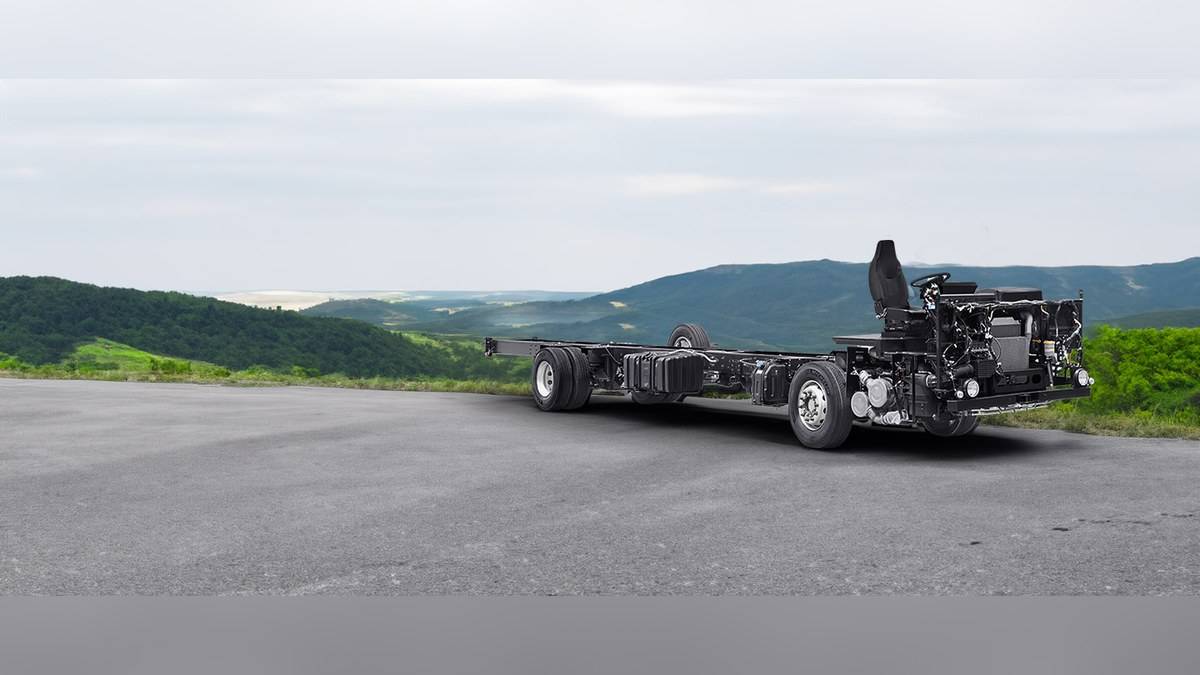
NEW DELHI: Ashok Leyland lists a turning-circle figure, labelled TCD, of 20.7 m for the Garud 13.5M coach. Its detailed specification gives a 7,000 mm wheelbase and an overall length of 13,500 mm. Those dimensions need to be read together when assessing access to a terminal, depot or passenger pick-up point.
| Garud 13.5M detail | Official figure |
|---|---|
| TCD, overview | 20.7 m |
| Overall length | 13,500 mm |
| Wheelbase | 7,000 mm |
| Front overhang | 2,400 mm |
| Width | 2,600 mm |
| Maximum GVW | 19,500 kg |
| Indicative passenger layouts | 36+D sleeper; 52+D push-back seats |
The official bus listing shows the Garud 13.5M at Rs 43,90,000 onwards. Price as of 9 November 2026, 23:51 IST. It does not provide a separate public price for every passenger-body layout, so the amount should not be taken as a complete quotation for both arrangements.
A turning circle is not a terminal plan
The published TCD is a vehicle dimension, rather than confirmation that the coach can negotiate any entrance of similar width. A real entrance combines the approach angle, the gate opening, adjacent walls and the space available after the turn. A route assessment needs the complete movement through that space.
That distinction has a particular consequence for this long coach. The driver may have room to begin a turn while the body still passes close to an obstacle elsewhere. Checking only the position of the front wheels leaves the rest of the vehicle out of the assessment.
A swept-path drawing is the appropriate kind of information to examine alongside the published dimensions. It shows the space occupied through a manoeuvre, rather than representing the bus as a point moving along a line. The product pages used here do not provide such a drawing or an approved route-specific clearance.
Wheelbase and overhang answer different questions
The Garud's wheelbase describes the distance between its axle positions. Front overhang describes the body extending ahead of the front axle. Overall length describes the complete longitudinal envelope. These figures are related, but none can stand in for all the others when a depot layout is being reviewed.
In a terminal with an angled bay, the relevant question is the movement into and out of the bay, including the surrounding body clearance. At a roadside passenger stop, the issue may instead be how the stationary vehicle sits relative to the boarding area and through traffic. The same coach can present different access questions in those locations.
The width entry similarly belongs in a complete clearance review. A published body dimension should not be assumed to describe every projection or the space needed beside an operating passenger door. Those details need the selected body's drawings and the completed vehicle's documentation rather than an estimate from a product photograph.
Passenger arrangements do not change the access check
Ashok Leyland's detailed page identifies single-door sleeper and push-back seating arrangements. The website calls their capacities indicative. An actual coach must therefore be identified by its own approved passenger layout, rather than a capacity copied from a general model heading.
For a night service, berth allocation and boarding are part of the operational brief. For a seated service, the roster follows a different passenger arrangement. Neither description removes the need to assess how the full coach reaches its stop and where passengers enter or leave it.
A useful record links the route access review to the exact body and layout. If a different body configuration is later assigned, the earlier review should not be treated as automatically transferable. This is an interpretation of what the published dimensions can establish, not a manufacturer-issued route-approval procedure.
For this coach, retaining the terminal drawing beside the vehicle dimensions also makes later changes visible, such as a relocated barrier or a different boarding bay.
Keep the selected powertrain in view
The overview refers to H6 and A4 engine families. The readable detailed specification presents an A-series diesel configuration with 185 kW and 900 Nm, paired with a six-speed overdrive gearbox. Those figures describe that displayed specification; they should not be assigned indiscriminately to every engine choice mentioned in the overview.
A long-distance timetable cannot be calculated from engine output or tank capacity alone. The official pages do not provide a matched fuel-consumption or journey-time test for a named route. This report consequently does not promise a range between refills, faster arrival time or a daily earnings figure.
Related dalimss.news reports cover Car price guide, Ashok Leyland Sunshine seating: 32+D to 49+D school layouts and Ashok Leyland BOSS loading spans: 4.3 m to 9.75 m explained. Each concerns a different commercial-transport task; none establishes an access clearance for the Garud.
Official sources: Garud 13.5M overview, technical specification and bus price listing.