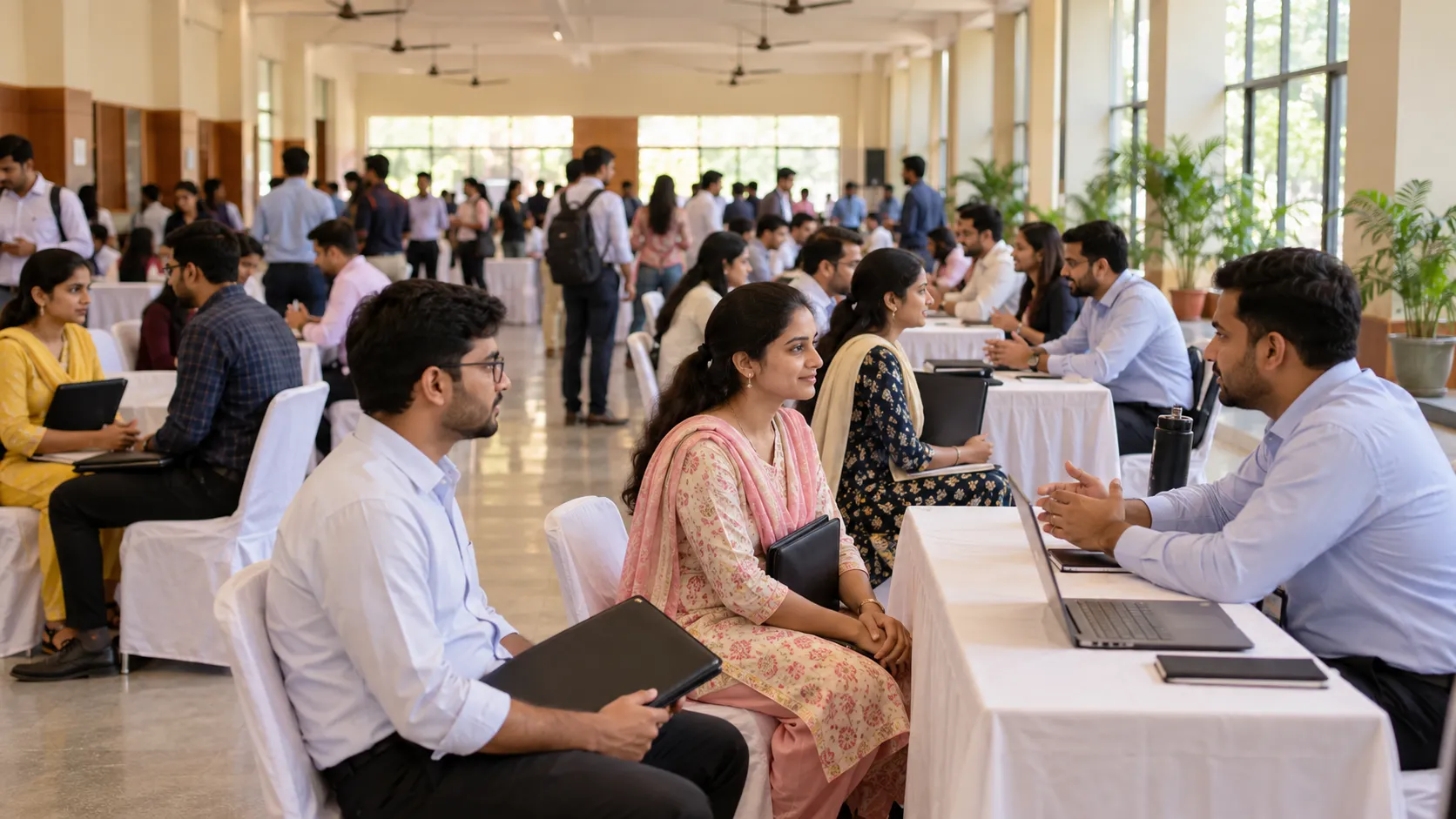
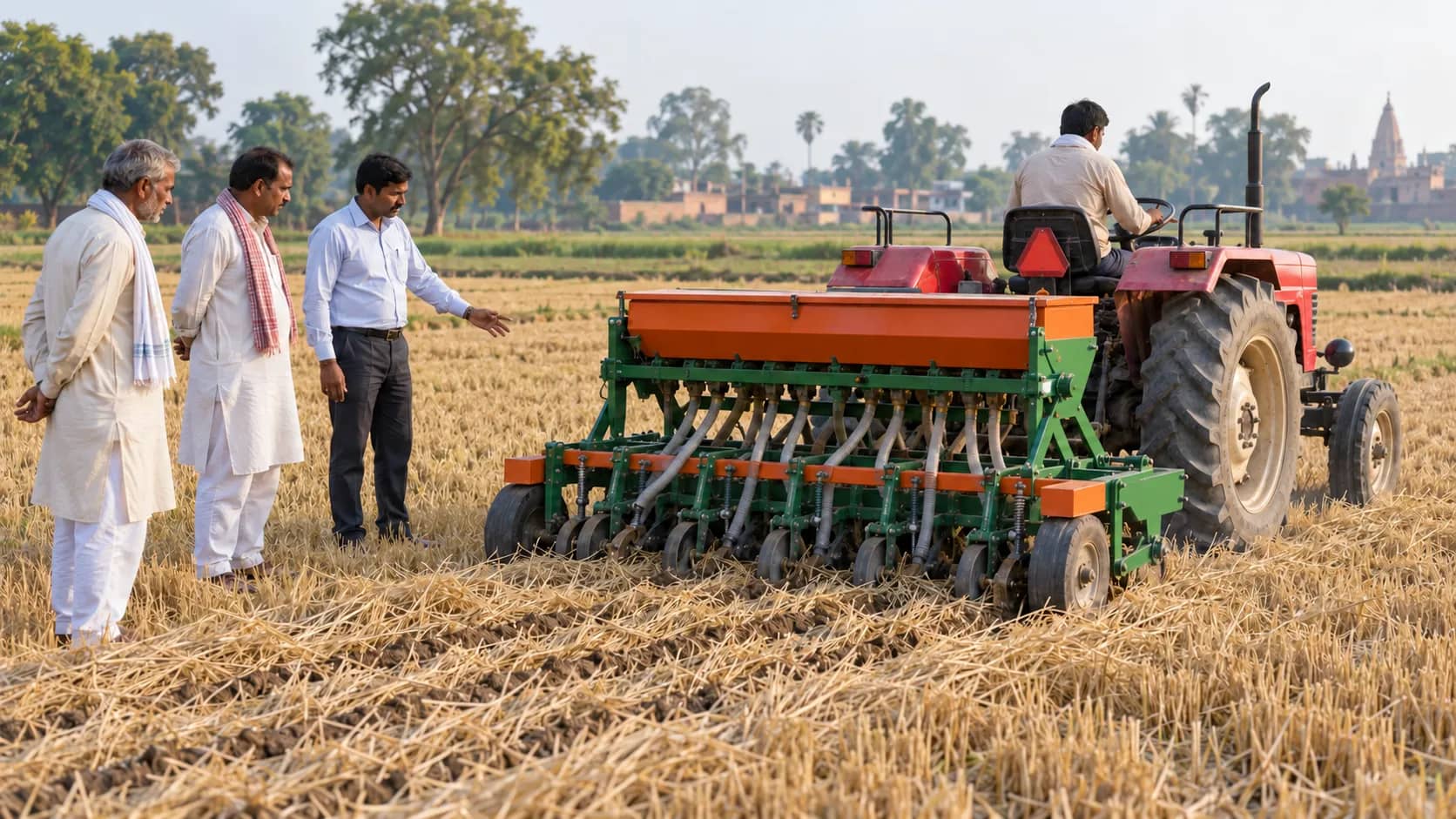
A two-day programme in Varanasi trained farmers, machinery operators and agricultural extension workers in zero-tillage wheat and crop residue management. The International Rice Research Institute (IRRI) and CIMMYT held it at IRRI’s South Asia Regional Centre on 8 and 9 October, according to its 15 October report.
The 63 participants from eastern Uttar Pradesh studied machinery economics and operation. Practical sessions demonstrated Happy Seeders, Smart Seeders, balers and compost turners. The programme sought to prepare farmers and service providers to pass skills on to others.
IRRI senior consultant R. K. Malik urged wheat sowing before 20 November to reduce the risk of heat stress. No measured post-training yield or adoption results were reported.
A seed drill and a baler do different jobs
Zero tillage means sowing without first ploughing the field. The Indian Agricultural Research Institute’s 2014 technical handbook describes a specially designed drill that places seed and fertiliser while disturbing relatively little soil. It also distinguishes equipment able to work where residues remain on the surface. The basic idea is to shorten field preparation between harvesting rice and establishing wheat. The drill changes how the crop is established; it does not remove the need for crop management.
The handbook also describes retaining plant material on the surface as part of the system, supporting soil organisms and reducing the loss of soil organic carbon.
That timing matters because the handbook identifies earlier wheat establishment as a way to reduce exposure to heat near the end of the crop’s growing period. It also describes lower fuel use from fewer land-preparation operations. These are technical reasons for examining the method. The handbook’s older cost estimates should not be read as a quotation for a Varanasi machine hire in October 2026.
A CIMMYT account of research published in 2020 explains why the implement matters. A Happy Seeder clears and processes straw in its sowing path, places seed and fertiliser, and returns residue as a mulch. The study compared conventional tillage, basic zero-tillage drills and Happy Seeders across more than 1,000 farm households in 52 villages. The machines were not treated as interchangeable.
Among the options examined, the Happy Seeder could sow directly through large quantities of rice residue. The study reported savings and wheat yields comparable to, or slightly above, conventional tillage. Those findings explain the interest in the equipment; they do not establish what an individual Varanasi farm will save this season. Hiring cost and actual field requirements still need checking.
The research account also describes hiring sowing services as an alternative to every farmer purchasing a specialised implement. That gives service providers a role alongside farmers who cultivate their own plots.
Baling is a different route. A 10 December 2024 parliamentary reply explains that balers collect and bundle residues for uses outside the field. It separately lists seeders, mulchers and other equipment used to manage residues within the field. Thus a demonstration containing several machines is showing different operations, not several names for the same service. Whether straw stays on the land or is collected changes what work needs arranging.
What to check before arranging a service
For readers looking for a hiring route, the Agriculture Ministry’s existing FARMS platform connects farmers with machinery services, including custom hiring centres and machinery banks. Individual farmers can also offer equipment for rental. The ministry describes the app as a multilingual platform. A listing is a starting point for finding a provider; the proposed job and its terms still need to be checked.
The platform’s published disclaimer asks both sides to verify offers and quotations independently. Price and service terms are negotiated outside the app. Before agreeing, a farmer can therefore ask which implement is being offered, whether the charge covers the operator and tractor, and when the work can be done. These are checks on the proposed service, not a published government tariff or a guarantee of availability.
Dalimss News has previously reported on micro-irrigation training in Kallipur and rice research at ISARC in Varanasi. Those reports provide further reading on local training and research, separate from the current machinery programme.