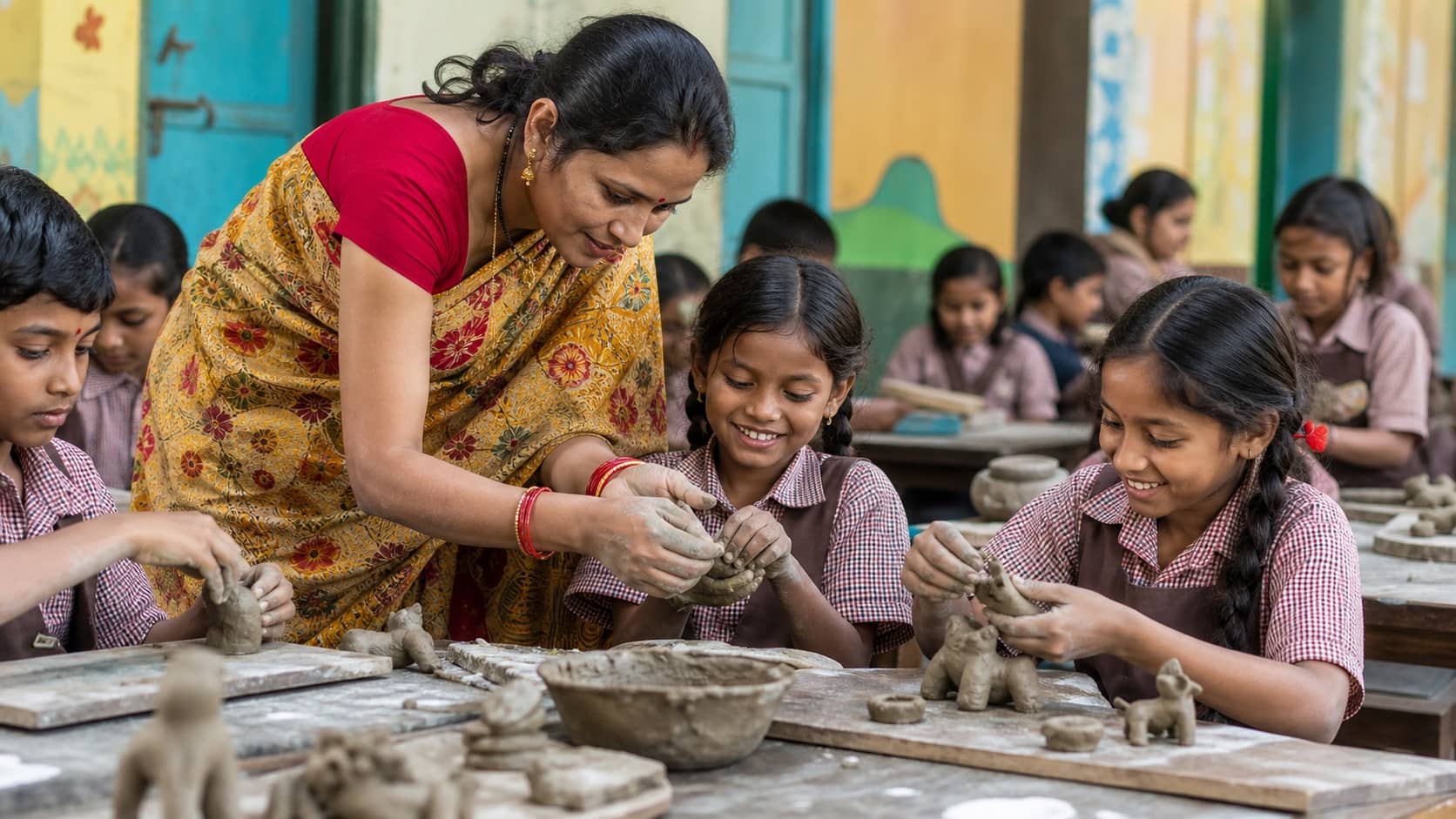
Children in Varanasi’s government primary, upper-primary and composite schools will learn to make clay toys and sculptures as part of a series of bagless Saturdays under Samagra Shiksha. Eleven Saturdays between August and November have been set aside for practical and creative activities outside the usual textbook routine.
The academic calendar includes clay modelling, visits to a potter’s workshop and school art-and-craft exhibitions. Students will be able to see how raw clay is prepared and shaped, then try the process themselves. Other tasks will involve plants, seeds and organic manure, linking craft work with environmental learning.
Each school is to receive ₹6,500 for materials such as clay, colours, brushes, chart paper, stationery, craft supplies, plants and seeds. Basic Education Officer Bhupendra Singh said the activities follow directions from the directorate and are intended to help children acquire new skills while developing their talents.
A bagless day works only when it is planned as learning, not treated as an empty timetable. Handling clay can teach proportion, patience and fine motor control; a visit to a potter introduces children to a local occupation and the relationship between material, tool and finished object. Exhibiting the work gives students a reason to explain what they made and how.
The scheme also creates room for children who may not stand out in written tests. A student who struggles with memorisation may show strong spatial sense, observation or craftsmanship during a practical task. Teachers can use that information to understand ability more broadly without turning every activity into another graded competition.
The modest budget will need careful use. Schools should purchase safe, age-appropriate material, keep simple records and avoid asking families to cover costs that the grant is meant to meet. Where a local artisan is invited, the session should allow genuine demonstration and questions rather than a brief ceremonial appearance.
By November, the success of the 11 Saturdays should be visible in more than photographs. Children should be able to describe a process, work together, care for tools and connect classroom ideas with local life. Clay toys may be the most colourful result, but the larger purpose is to make school feel less like carrying a bag from period to period and more like a place where knowledge can be touched, tested and made.
Teachers should also photograph or display work only with appropriate school consent and avoid ranking every product. The point is participation, experimentation and reflection—not reproducing examination pressure in a room that happens to contain clay.