Varanasi's Queens' College Opens UP's First School AI and Robotics Lab
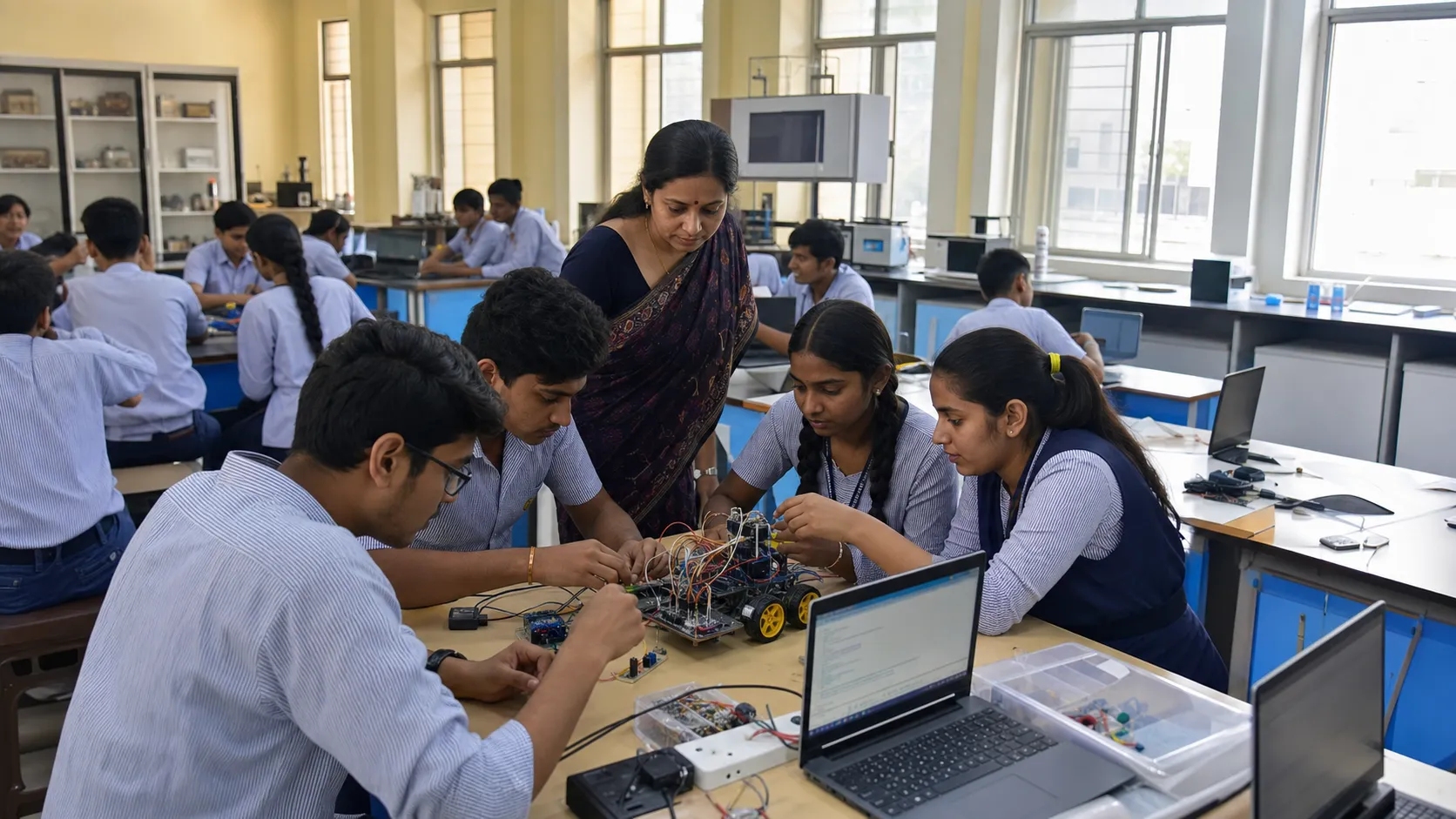
VARANASI — Students at PM Shri Rajkiya Queens' Inter College now have a laboratory built for a different kind of school practical: writing code, reading sensors, assembling robots and learning how machines respond outside a textbook diagram.
The roughly ₹50-lakh facility, inaugurated in July, is being described as Uttar Pradesh's first advanced artificial-intelligence and robotics lab at school level. It is intended to serve not only Queens' College but students from about 31 government schools across Varanasi through a wider training programme.
The proposed learning menu includes robotics, artificial intelligence, coding, drone-making, electric-vehicle concepts and practical repair skills for mobile phones and laptops. An academic partnership with the Indian Institute of Information Technology Vadodara has also been planned, with certified experts expected to support instruction.
FROM WATCHING TECHNOLOGY TO BUILDING IT
Many school students use algorithm-driven apps every day without knowing what an algorithm is. A functioning lab can close part of that gap. A child who connects a sensor, tests a motor and fixes a failed circuit learns that technology is made through trial, error and documentation, not magic.
Project-based work can also bring subjects together. A small line-following robot uses mathematics, basic physics, logic and teamwork. An electric-vehicle model opens questions about batteries, energy efficiency and road design. Even device repair teaches careful diagnosis and responsible handling of electronic waste.
The initiative is associated with Professor Dharmendra Singh, director of IIIT Vadodara and a former student of the college. That alumni link gives the project a welcome local story, but the lab's success will depend on what happens after the inauguration: who teaches, how often children enter the room and whether equipment that breaks is repaired quickly.
ACCESS WILL DECIDE THE RESULT
Serving 31 schools requires a timetable that does not leave visiting students with one demonstration a year. The district should publish the number of seats, training duration, selection method and travel support for participating schools. Girls and students from schools farther from the city centre must have the same opportunity to enrol in the hands-on sessions.
Teachers need training too. An outside expert can launch a module, but school staff must be confident enough to supervise projects between visits. Safety rules are important where batteries, soldering tools, drones or moving components are involved. Cybersecurity, privacy and the limits of AI should sit beside coding in the curriculum.
The biggest risk is turning the room into a showroom that opens for guests and stays locked for students. A public activity calendar, project exhibition and inventory of working kits would make the programme easier to evaluate.
Varanasi's government-school children do not need to be told that AI is the future; they hear that phrase everywhere. They need time with the tools, patient instruction and permission to fail at a prototype before trying again. If Queens' College provides that routine, the ₹50-lakh lab could become less of a first and more of a model worth repeating.
Sources and reporting
Based on details released about the July 2026 inauguration at PM Shri Rajkiya Queens' Inter College and the proposed training partnership with IIIT Vadodara. Outcome claims will depend on regular access, staffing and equipment use.
Related Stories

Railways Orders Weekly Puja Special 09465 via Varanasi Through November
Hindi Diwas Marked Across BHU, Sanskrit University and Kashi Vidyapith

Lohta Police Register FIR After Bhitari Villager Alleges Hostage Beating

Baragaon Police Book Named Youths After Kazisaray Tea-Stall Assault and ₹1,900 Loot

Mayor Announces Stricter MCG Drive Against Stray Cattle