
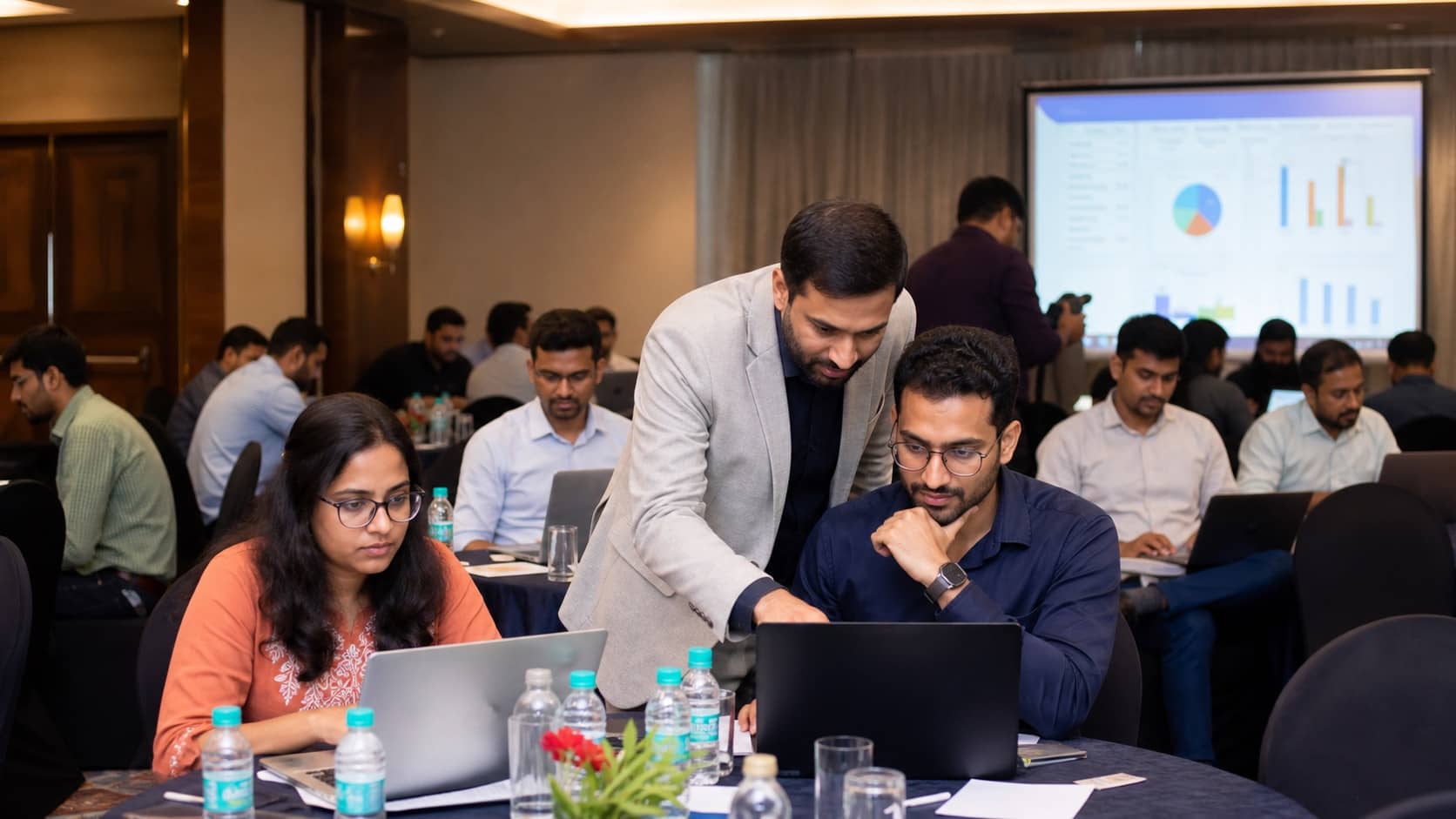
VARANASI: Local industry representatives and young professionals worked through the practical side of enterprise software at an AI-powered ERP and business-analysis workshop held at the Four Elements hotel in Manduadih. The session was organised by the Varanasi chapter of the Indian Industries Association with technology training firm Tech Brains.
The programme covered enterprise resource planning, business analysis and automation rather than treating artificial intelligence as a stand-alone product. Speakers including Rajesh Bhatia and Neeraj Parikh discussed how companies map routine processes before selecting software. Tech Brains founder Eva Ketan, co-founder Rishi Upadhyay, Prashant Agarwal and Gaurav were also associated with the session.
ERP systems connect functions such as inventory, sales, purchasing, finance and production in a common database. For a small manufacturer, the promise is straightforward: fewer duplicate entries and a clearer view of stock and cash flow. The difficulty is that software exposes weak processes; it cannot repair them merely by being installed.
That is where business analysis becomes useful. Before automating an approval or generating a dashboard, a team has to decide who owns each step, what information is necessary and which exception requires human review. Workshops that begin with process mapping are more likely to produce durable change than demonstrations built around dramatic AI outputs.
Varanasi’s business landscape includes manufacturers, exporters, traders, hospitals, schools and hospitality firms with very different levels of digitisation. Many rely on a mix of spreadsheets, messaging apps and paper records. Moving to a unified system can improve control, but it also creates migration costs and dependence on accurate data entry.
Participants were encouraged to think about job roles as well as software. A business analyst translates between operational staff and developers, asks why a report is needed and tests whether the result matches the requirement. Those skills are portable across platforms and may be more valuable to young professionals than learning one vendor’s menu by memory.
AI adds speed to forecasting, anomaly detection and document handling, but businesses should be cautious about confidential records. Customer details, prices and payroll data should not be pasted into public tools without clear policies. Access controls, backups and an audit trail are basic requirements, not optional extras for larger companies alone.
The Manduadih workshop offered an entry point rather than a finished digital plan. Its practical message was that technology earns its cost only when it solves a defined problem. For Varanasi firms considering automation, the next step is to choose one measurable process, improve the data behind it and expand only after the result is visible.