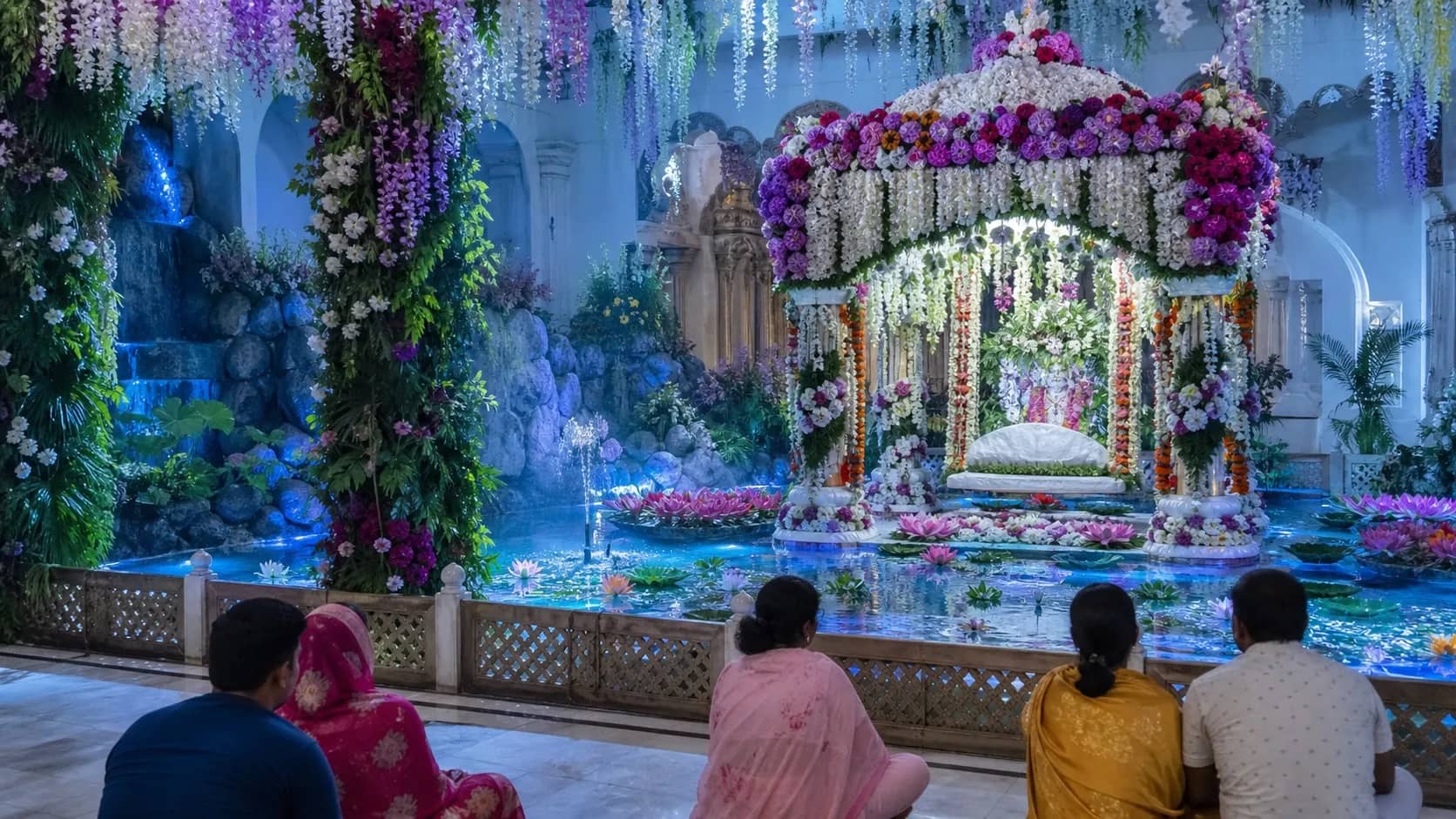
VARANASI: Tridev Mandir welcomed devotees with one of the season’s most elaborate floral installations on Sunday, turning part of the temple complex into a stylised lake scene for Sawan. At the centre was a roughly 60-foot artificial water feature, framed by flowers and populated with decorative ducks and lotus blooms.
A flower-covered swing for Radha and Krishna formed another focal point. The wider display incorporated jasmine, juhi, lotus, ashok, kamini, roses, tuberose and orchids. Gardeners brought from Kolkata worked on the arrangement, combining tightly packed floral surfaces with looser foliage so that the space retained depth instead of reading as a single decorative wall.
The organisers also used more than 300 slabs of ice to cool parts of the installation and sustain the desired atmosphere. A representation of the twelve Jyotirlingas and tableaux of other deities expanded the display beyond the central jhanki. Bharat Saraf and Radhe Govind Kejriwal took part in the puja and arrangements, according to the temple’s account.
Floral shringar is a familiar part of temple practice in Varanasi, especially during Sawan, but large temporary environments have become increasingly ambitious. They draw families who may already be visiting for darshan and give neighbourhood temples a distinct identity in a month crowded with religious programmes.
The sensory effect is central: fragrance, colour, cool air and reflected light work together. For many devotees, the installation is not separate from worship. The crafted landscape offers a visual language for ideas of abundance, rain and divine play that are repeatedly invoked in seasonal songs and stories.
Temporary displays also carry practical responsibilities. Fresh flowers wilt quickly in humid weather, water features require secure electrical fittings and artificial materials must be removed without adding to local waste. Crowd movement is another concern when visitors stop for photographs in narrow approaches. Clear entry and exit routes can preserve both safety and the devotional character of the space.
The use of ice is visually effective but raises an additional question about energy and water in large celebrations. Temples and organisers across the city are beginning to think more carefully about reusable frames, locally available flowers and composting after an event. The artistry need not be reduced; it can simply be planned with the full life cycle of the materials in mind.
For Sunday’s visitors, however, the immediate experience was one of transformation. A familiar courtyard had become a miniature monsoon landscape, complete with lake, lotus and a flower swing. In Sawan, when the city repeatedly reimagines itself through green cloth, bells and wet stone, Tridev Mandir added its own densely fragrant scene.