
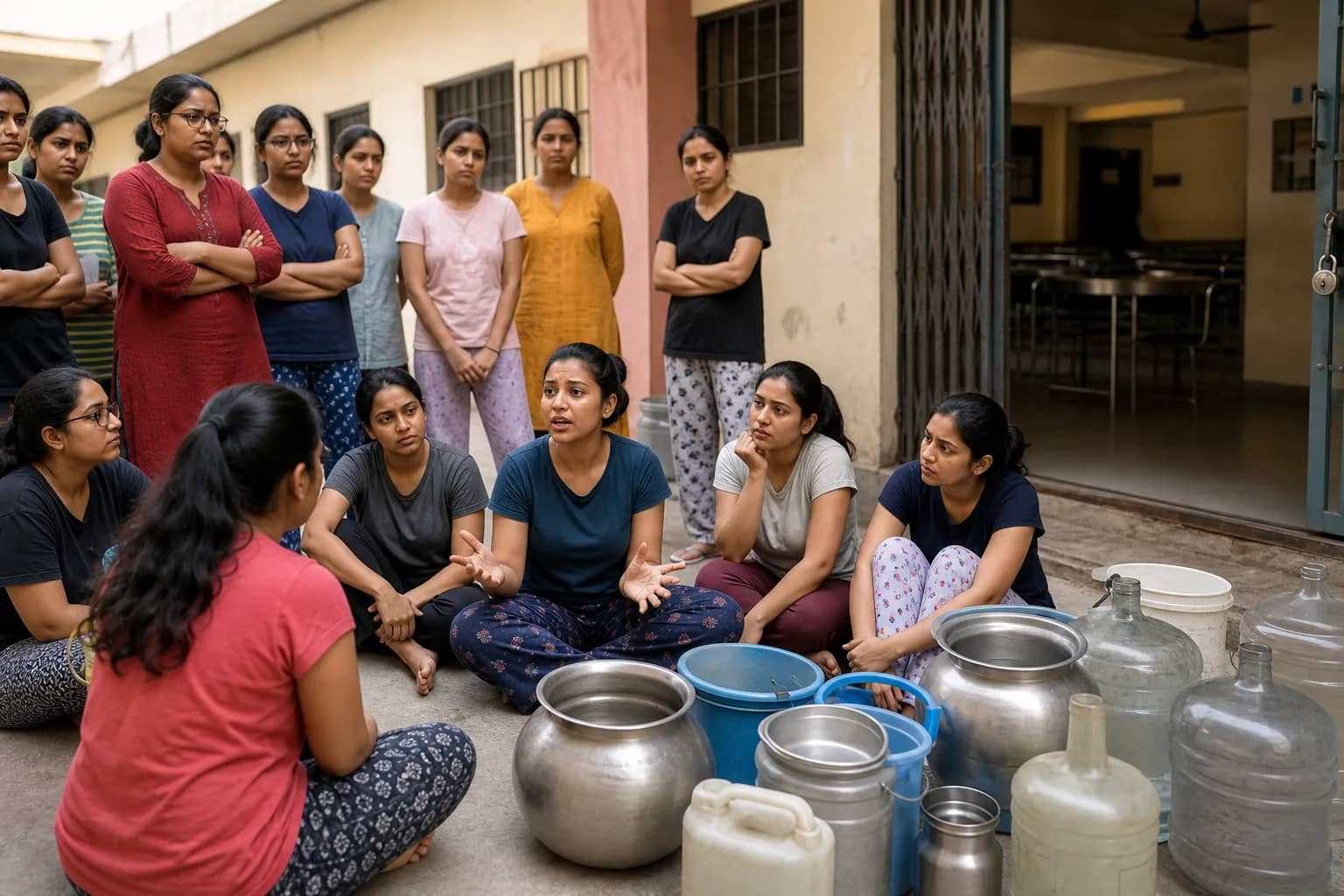
Women students at the government-run Samras Girls’ Hostel in Surat staged a protest on Wednesday over what they described as poor food, water shortages, inadequate cleaning and failures in basic facilities, bringing a long-running hostel grievance into public view.
Students raised slogans and sang Ramdhun during the protest. Police reached the hostel as the gathering continued. One resident, speaking in the public reporting reviewed for this article, said water problems had persisted for years and alleged that filters were not working properly. She said the hostel has capacity for about 2,000 residents and currently houses roughly 1,200.
These are student allegations and should be reported as such. A detailed response from the hostel administration or the responsible department was not available in the source material checked before publication. That absence does not settle the complaint in either direction; it makes a prompt inspection and a written reply more important.
A hostel complaint is an education issue
Food, water and sanitation are sometimes treated as matters outside the academic system. For a residential student, they shape whether study is possible. Time spent queuing for water, managing illness or repeatedly pursuing repairs comes directly out of classes, laboratory work and examination preparation.
Women’s hostels also carry a particular duty of care because residents may have moved from another district and may not have easy alternatives. Strict entry rules and limited mobility can increase dependence on the institution for food, safe water, bathrooms, lighting and grievance redressal. A hostel cannot demand compliance from residents while leaving essential services informal.
The first official response should be practical. Authorities should test drinking water through an accredited laboratory, inspect filters and storage tanks, check kitchen hygiene and food records, assess washrooms and waste disposal, and publish a dated rectification list. If a facility is already functional, the inspection should document that fact rather than rely on a general assurance.
Food complaints also need a method. A menu displayed on a wall does not prove that portions, preparation and quality meet the standard. The institution should retain purchase and kitchen records, conduct unannounced checks and include elected resident representatives in a mess committee. Complaint samples and photographs should be logged, not dismissed as isolated dissatisfaction.
The grievance route matters
Students need a channel that produces an acknowledgement and a deadline. A complaint box that is never opened, or a phone number that produces no record, is not a grievance system. The hostel should identify the warden, nodal officer and escalation authority, and provide a safe way to report retaliation.
The presence of police at a student protest should remain focused on safety. It should not convert an amenities dispute into a disciplinary case merely because residents spoke collectively. Any allegation of damage or violence can be examined on evidence, but peaceful complaints about water and food fall within ordinary student welfare.
Parents will also want clear information. A short official bulletin can state what was inspected, what immediate measures were taken, what requires repair and when the next water-quality report will be available. Such communication is more credible than asking each resident to telephone home with fragments of information.
What should happen next
An independent inspection team should speak to residents without hostel staff present, because students may otherwise hesitate to describe recurring problems. The team should check whether complaints differ by block or floor, whether supply failures occur at particular hours and whether emergency drinking-water arrangements are adequate.
The occupancy figures should be verified as well. Capacity affects kitchen output, cleaning staff, water demand, bathroom use and emergency planning. If staffing or maintenance budgets were calculated for a different number of residents, the gap needs correction.
Finally, the administration should respond to the duration claim. A problem described as several years old cannot be closed by a one-day tanker or cleaning drive. Records of repairs, vendor contracts and earlier complaints can establish what failed and whether the present protest reflects a chronic maintenance issue.
Students should preserve written complaints and avoid circulating unverified names or personal allegations. Officials, in turn, should not ask residents to prove every systemic failure individually before inspecting shared facilities.
The Surat protest is a demand for ordinary institutional competence: potable water, safe food, clean living areas and an answer that can be tracked. Those are not optional comforts in a student residence. They are the foundation on which access to education away from home depends.