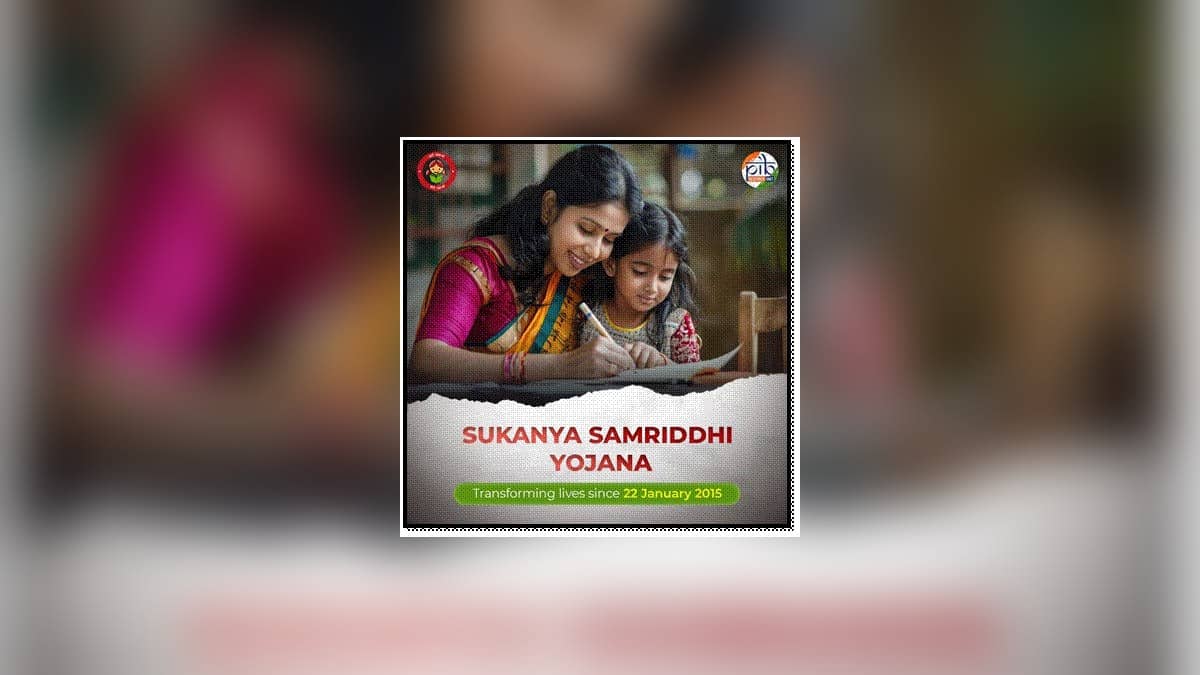
Sukanya Samriddhi Yojana allows a guardian to open a savings account for a girl who has not yet turned 10. The minimum annual deposit is Rs 250 and the maximum is Rs 1.5 lakh per financial year. Deposits can be made for 15 years from opening, while normal maturity is 21 years from opening. These are separate timelines, and neither is measured from the child's birth.
The governing reference is the Sukanya Samriddhi Account Scheme, 2019 on the National Savings Institute website, notified on 12 December 2019. For current interest, Indian Bank's dated small savings table lists 8.20% annually for 1 October to 31 December 2026. That quarter's rate was checked on 4 November 2026 at 10 pm IST and should not be projected as a fixed rate for the entire account term.
| Rule | Requirement |
|---|---|
| Age at opening | Girl below 10 years |
| Annual deposits | Rs 250 minimum, Rs 1.5 lakh maximum |
| Contribution period | 15 years from opening |
| Normal maturity | 21 years from opening |
| Education withdrawal ceiling | Up to 50% of the previous financial year's closing balance, subject to conditions |
Who is eligible, and how many accounts can a family open?
One guardian may open the account in the girl's name, and each girl can have only one account under the scheme. Ordinarily, a family can open accounts for a maximum of two girls. There are specified exceptions for multiple births, supported by an affidavit and the relevant birth certificates.
The multiple birth exception has qualifications, including a restriction where the first birth order results in two or more surviving girls. Families affected by twins or triplets should take the birth records to the account office and have it apply the precise provision. The general two account limit should not be expanded simply because a household has more than two daughters.
How to open a Sukanya account and prepare documents
The scheme requires an application in Form 1, the girl's birth certificate and the guardian's required documents. SBI, an implementing bank, states that the facility is available at all its branches. Readers can ask the chosen authorised bank or post office for its current account opening and identity verification requirements before submitting the form.
SBI's official Sukanya FAQ addresses Aadhaar and PAN or Form 60 requirements. It also explains conditions and time limits where an Aadhaar enrolment reference or an initially absent PAN is involved. These requirements need to be checked against the applicant's documents, rather than treating a general list as a guarantee that an account will open.
There is no annual application window in the scheme text. The age condition applies on the actual opening date. The guardian operates the account until the holder reaches 18; after that, the holder operates it herself after submitting the necessary documents. Retain the account records and ask the account office how to obtain an updated balance or statement.
What are the deposit limits and default rules?
The opening minimum is Rs 250, with subsequent deposits in multiples of Rs 50 under the scheme. The financial year runs from 1 April to 31 March. The Rs 1.5 lakh limit applies per financial year to the account, rather than to each individual instalment or payment method.
If the minimum annual deposit is missed, the account is treated as in default. It may be regularised before completion of the 15 year contribution period by paying Rs 50 for each default year together with the minimum annual deposit for those years. An excess deposit accepted through an accounting error does not earn interest and must be returned.
Interest is calculated for a calendar month using the lowest balance between the close of the fifth day and month end, and credited at financial year end. The current quarter's official rate table should be read separately from older rates still reproduced in the original scheme notification. A calculator using one unchanged rate for 21 years is an illustration, not an assured maturity payout.
When can money be withdrawn for education or marriage?
Education withdrawals can be requested after the holder turns 18 or passes Class 10, whichever occurs earlier. The ceiling is 50% of the account balance at the end of the financial year preceding the application year. A confirmed admission offer or fee slip is required, and the withdrawal is limited by the actual eligible education requirement.
The scheme allows a lump sum or instalments, with no more than one withdrawal per year for a maximum of five years, subject to its ceiling and conditions. This is a restricted education facility, rather than general permission to withdraw half the balance whenever the guardian wants money.
Normal closure occurs after 21 years from opening. Earlier closure for marriage requires proof that the holder will be at least 18 on the marriage date and the prescribed declaration. It cannot be allowed earlier than one month before the intended marriage or later than three months after it.
Separate provisions cover death of the holder and documented compassionate circumstances. The five year restriction applies to the compassionate grounds provision, so it should not be confused with the separate death clause. For account status, documents or assistance, use the maintaining bank or post office; the scheme text does not give a dedicated application status portal or universal helpline.
Related guides explain Janani Suraksha eligibility, National Family Benefit Scheme support and PMAY Urban applications. These are distinct schemes, and their benefit rules do not determine Sukanya account eligibility.