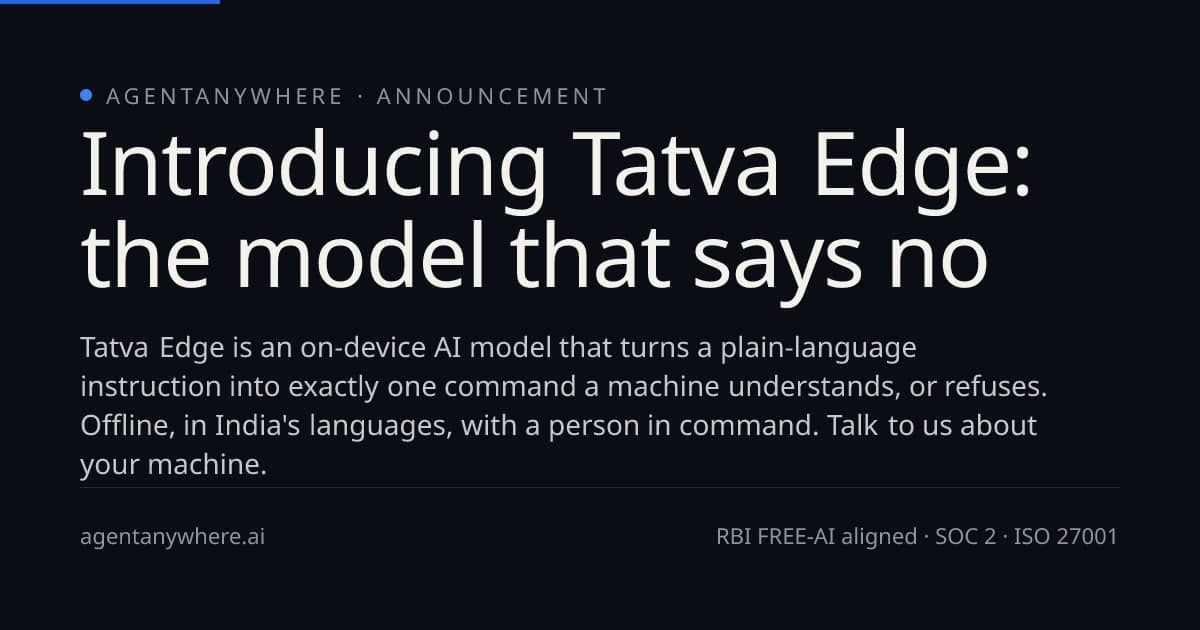
Most AI models are built to answer everything. ShepHertz, an applied AI company that says it has worked in production AI since 2012, has announced one built to do the opposite. Tatva Edge, introduced under its AgentAnywhere platform, turns a plain-language instruction into exactly one command a machine understands, or it refuses and does nothing. This explainer sets out what the company says Tatva Edge is, where it is meant to run and what remains to be proven.
Everything here comes from the company's own website and launch post, checked on 9 October 2026. These are vendor claims, not independent test results.
A model that compiles instead of chatting
The launch post, written by Siddhartha Chandurkar and dated 30 September 2026 with an update on 8 October, makes a simple argument. Language models are good at producing text, but machines do not need text. A drone needs one exact instruction, a robot arm needs one task and a satellite needs one telecommand, sent in a window that can be measured in minutes. For a machine, the company says, the most dangerous thing a model can do is improvise and the most valuable thing it can do is decline.
So Tatva Edge is built to compile, not to chat. Its output is limited to the command grammar of the machine it serves, which means what comes out is either a valid command with named arguments or an explicit "no action". The company's phrase is that there is no free-text path from a sentence to a motor.
The three promises
The post lists three things the model does. It obeys: plain language goes in and exactly one schema-valid command comes out, using the machine's own vocabulary with the operators' phrasing built in. It stays: it runs on the device, offline, in India's languages, including English, Hinglish and Indian languages, on hardware as small as Raspberry-Pi-class boards, as well as laptops, servers and browsers, using the company's own runtime.
It proves: rules outside the model decide what is allowed, a named person approves anything consequential, and every step leaves a signed receipt that can be verified offline. The company stresses that the model is never the last word. In its demonstration videos, a Hinglish instruction is approved, an unsafe one is blocked by policy outside the model and an out-of-scope one is refused. The company states that the humanoid and drone demonstrations are simulated, while the model outputs and the policy code are real.
Where it is meant to run
The post names six settings, each with its own deep-dive page: drones, satellites, launch operations, robotics and industry, humanoids and defence. For drones, the pitch is missions that keep going when the communication link does not. For satellites, it is plain-language commanding checked against flight rules. For defence, the company describes air-gapped use, observing and assisting, with a human in command.
At Drone Expo 2026, according to the company's homepage, ShepHertz unveiled three India-built models that run offline on constrained devices, from satellites to smart rings: Tatva, Sanjaya and Drashta. Tatva handles on-device commands. Sanjaya is described as a model for critical telemetry and signals, and Drashta as machine vision for satellite and aerial imagery. The site lists Tatva as in private preview and Sanjaya and Drashta as available to design partners, so none of them is a general release.
The platform behind it
Tatva sits inside AgentAnywhere, which the company calls India's sovereign AI platform. The site lists eight model families, including Taksha for AI engineering, Manthan for general reasoning, Kuber for banking and insurance, Seva for service operations and Vaani for Indic voice, and it states each one's status openly, from available now to private preview.
A set of trust tools surrounds the models. Agent Gateway applies policy to each request and signs a receipt. Aavaran masks personal data before any model sees it. Kavach is a shield against prompt injection. TrustFabric signs the provenance of claims, and Custodian maps controls for compliance frameworks such as SOC 2, ISO 27001 and RBI guidance. The company says it is opening part of this toolchain under the Apache 2.0 licence, starting with a data factory called Shuddhi.
Numbers and credentials
ShepHertz says it serves more than 80,000 customers in 150 countries and has processed more than 108 billion API calls. It says AgentAnywhere maps to all 26 recommendations of the Reserve Bank of India's FREE-AI framework for responsible and ethical AI in finance, and that its platforms are SOC 2, ISO 27001, HIPAA and GDPR compliant. These are the company's statements and were not independently checked.
What buyers should ask
A refusing model is only useful if it refuses the right things. A drone operator or a plant manager will want measured data: how often does the model produce a valid command for a valid request, how often does it wrongly refuse, and how does it handle ambiguous or noisy speech in a real hangar or workshop? The launch post says the model's outputs shown are real recordings, but it does not publish error rates.
Defence and space buyers will also ask who certifies the policy layer, since the safety claim rests on rules outside the model. The company's design, with a named person approving consequential actions, is a sensible one, and it will need to hold up under field trials.
Why it matters in India
On-device AI that works offline and in Indian languages answers a real need, from drones working beyond network coverage to factory floors that keep data inside the plant. For other Indian teams working on machines and autonomy, see our reports on ATI Robotics' factory robots and Marut Drones' farm drones, and on voice AI the earlier explainer on Gnani.ai's sovereign voice models.
The company invites teams to request a pilot through its website.