Rendezvous Robotics has raised $20 million in a seed round led by MaC Venture Capital and Toyota Ventures, the Golden, Colorado company announced on October 28. The financing supports a spacecraft design in which separate modules connect after launch, rather than sending a complete structure into orbit.
The company calls this its first priced funding round. Participants include the University of Michigan Endowment, Astera and Industrious Ventures, alongside returning investors Aurelia Foundry, ATX Venture Partners and Mana Ventures. The money is intended for spacecraft development, flight demonstrations and expanding the team.
Rendezvous is preparing a free-space demonstration no earlier than April 2028. Seven independent spacecraft tiles would join, separate and then form a different configuration. That is a planned test, not an assembly operation the company has already completed. A parabolic flight campaign is scheduled for November 2026 to examine movement and electromagnetic actuation in microgravity.
What the investors are backing
Toyota Ventures describes the startup, founded in late 2024, as an attempt to address a physical constraint on satellite design: structures must fit within the volume available inside a launch rocket. Its investment explanation contrasts modular assembly with systems that fold for launch and unfold once they reach orbit.
The investor says the proposed tiles would stack compactly before launch and use electromagnetic control to assemble after deployment. Its account describes a system intended to operate without astronauts or an external robotic arm. These are descriptions of the approach being developed, not proof that a full-size commercial spacecraft has flown.
Toyota identifies possible uses involving communications, power generation and computing in orbit. It also describes replacing fixed spacecraft architecture with structures that could be upgraded or rearranged. Those uses are prospective. The investment case does not itself establish that customers are receiving such services or that the proposed structures have achieved their intended performance.
The distinction matters when reading a financing announcement: investment in developing an architecture is different from a completed demonstration of that architecture in operational conditions.
How separate tiles would work together
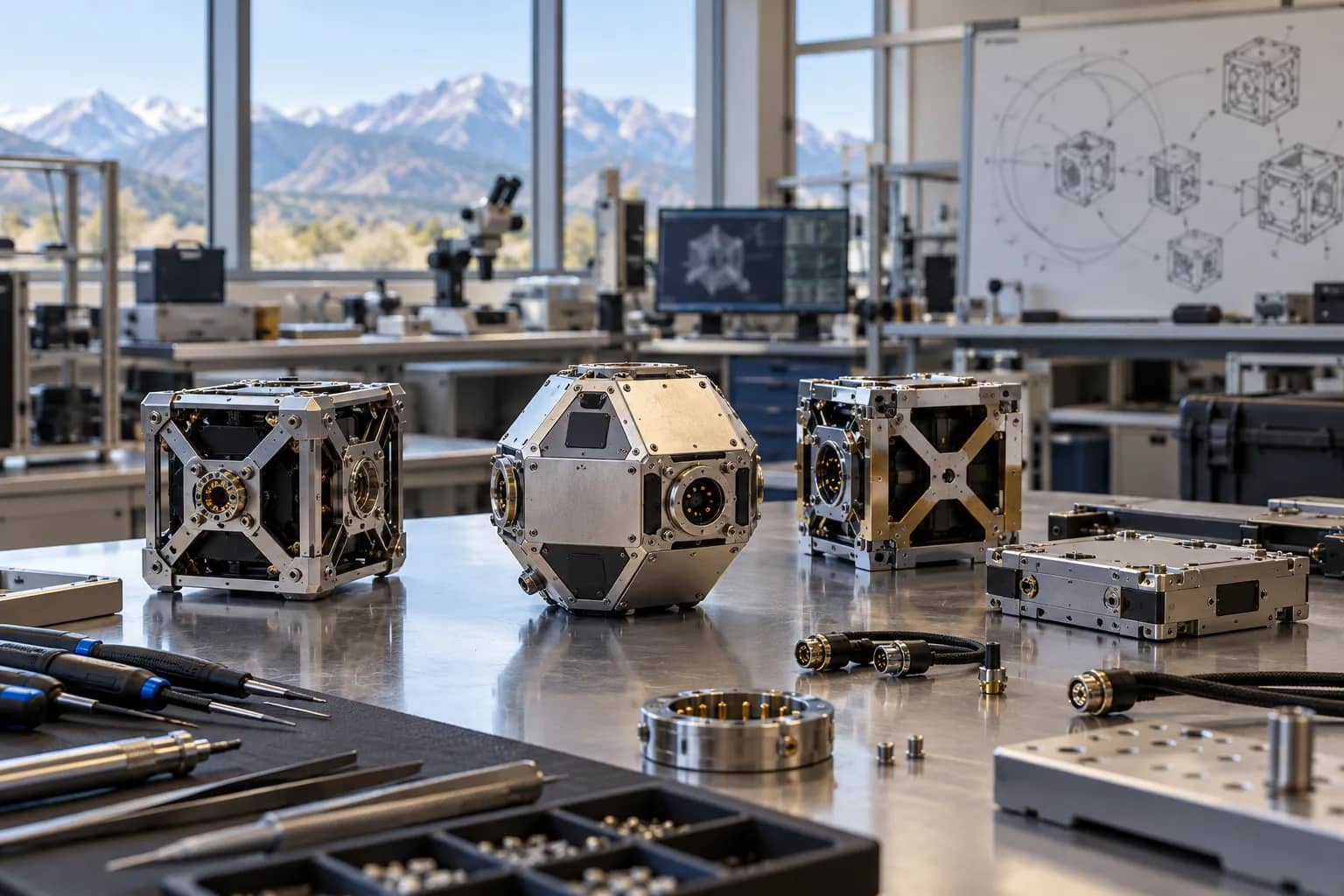
Rendezvous's own technical overview gives a more concrete account of the proposed components. Each tile has a processor intended to coordinate autonomous assembly. Sensors at the edges would help establish the positions of neighbouring tiles, while electromagnetic actuators attract, repel and control their motion.
Mechanical latches are intended to hold the assembled structure rigidly. Connected tile edges would also provide power and data connections. The company describes the processor taking on computing tasks after assembly, rather than serving only the initial task of bringing the modules together.
That design explains why the company's proposal is not simply a collection of independently orbiting satellites. Its modules are intended to become a physically connected structure. Adding tiles would, in the company's account, expand antenna apertures or power arrays; rearranging them would allow a different configuration after launch.
Those capabilities remain the company's development objectives. Its overview describes prospective missions rather than providing independently verified evidence of commercial-scale performance in orbit.
Earlier experiments are not the next spacecraft
The research history is documented separately by MIT's Media Lab. Its TESSERAE project page records a 2017 parabolic-flight experiment and a 2019 New Shepard test examining sensors, communications and controlled magnetic bonds during microgravity. These were predecessors, not the newly financed spacecraft demonstration. MIT says the 2019 flight provided three sustained minutes of microgravity, allowing tests of communications between tiles and their power requirements during the experiment.
In March 2020, seven prototype tiles were sent to the International Space Station for a 30-day experiment inside a contained platform. MIT reports that they assembled in microgravity and used controlled magnets to correct bonding errors. The page also describes prototypes prepared for the 2022 Axiom Space Ax-1 mission.
That history helps explain the technical starting point while preserving the distinction between research and deployment. Contained tests of bonding and reconfiguration do not demonstrate that larger independent spacecraft can manoeuvre and assemble in open space. Rendezvous's announced programme is aimed at that next step; the funding provides resources to pursue it, not a result from a mission still to come.
Related coverage: Fragment procurement funding and Blacksmith code-validation funding.