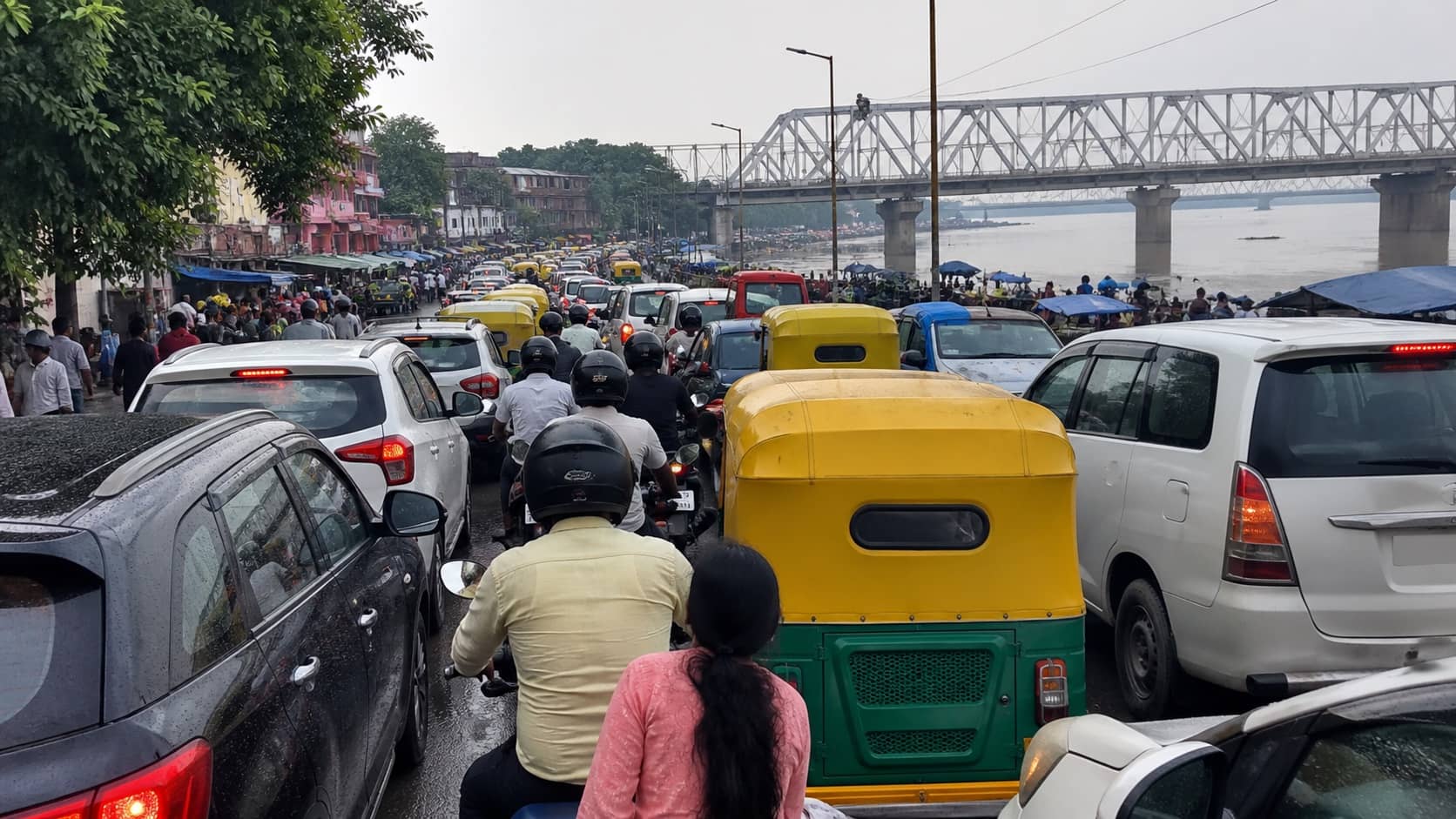
Raksha Bandhan travel brought traffic to a crawl across Varanasi on Friday, with a queue stretching for about three kilometres reported near Rajghat. The pressure was not confined to one crossing: Harahua, Shivpur, Pandeypur, Chaukaghat, Ramnagar, Lanka and Rohania also saw slow movement as families travelled between the city and surrounding districts.The festival creates a particular traffic pattern. Movement begins early, stays spread across much of the day and is not limited to office corridors. Two-wheelers, cars, buses and shared vehicles converge on bridges and major junctions as people head to relatives’ homes. Vehicles arriving from neighbouring districts add to the load on roads that already carry regular city traffic.Rajghat is especially vulnerable because the bridge and its approaches serve as a critical link across the Ganga and toward the eastern side of the city. When flow slows near a junction, toll point or narrow approach, the queue can quickly extend backward. A stalled heavy vehicle or irregular lane-changing then magnifies the delay for everyone behind it.Elsewhere, the locations affected show how widely the pressure spread. Harahua and Shivpur handle airport-side and northern approaches; Pandeypur and Chaukaghat feed dense urban corridors; Lanka and Rohania connect important southern and highway routes. Slowdowns at several of these points at once leave motorists with few genuinely clear alternatives.For passengers, the cost of a jam is not only inconvenience. Bus and train connections can be missed, elderly travellers may be stuck without easy access to water or toilets, and ambulances must negotiate lanes with little spare space. Motorcyclists are exposed to an additional risk when they squeeze between stationary vehicles or move into the wrong lane to save time.Festival-day management requires more than personnel at the largest junctions. Advance diversion notices, quick removal of broken-down vehicles, temporary restrictions on roadside parking and clear handling of buses near stops can prevent a short disruption from turning into a corridor-wide queue. Drivers also have a role: keeping intersections open and resisting wrong-side movement helps traffic recover faster.Friday’s congestion was a reminder that Varanasi’s mobility problems stretch from the old city to its outer roads. Raksha Bandhan made the demand visible in one concentrated day, but the choke points are familiar. Once the festival rush subsides, the three-kilometre queue at Rajghat should still be examined—not as an unavoidable ritual of celebration, but as evidence of where traffic planning needs stronger contingency arrangements.
The congestion also underlined a familiar festival lesson for commuters: routes near the bridge can change quickly when private vehicles, buses and pedestrian movement peak together. Travellers heading across the Ganga should leave additional time and follow on-ground diversions.