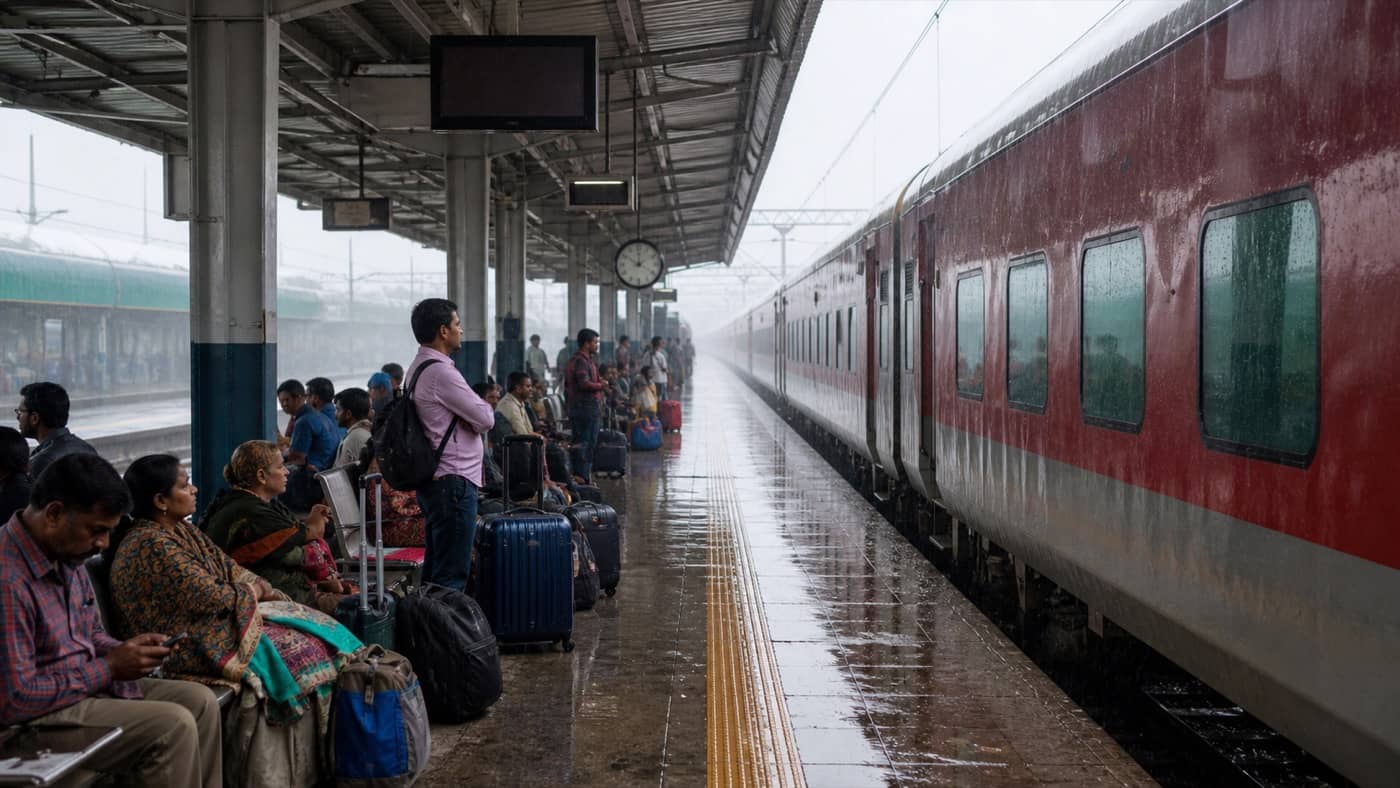
VARANASI: Heavy rain across western and central India disrupted long-distance rail services into Varanasi, leaving several trains between four and ten hours behind schedule. Passengers at Cantt station and intermediate stops spent Saturday repeatedly checking enquiry counters and the National Train Enquiry System as arrival estimates moved.
The Ahmedabad–Gorakhpur Express reached Varanasi more than ten hours late, while the Mysuru–Varanasi Superfast was delayed by about nine and a half hours. The Durg–Nautanwa service ran roughly eight and a half hours late and the LTT–Gorakhpur, commonly known as the Kashi–Dadar Express, by about seven hours.
Other affected services included the Secunderabad–Danapur Superfast at about six hours 20 minutes late, LTT–Jaynagar Pawan Express at six hours 10 minutes and Durg–Chhapra Sarnath Express at around six hours. The LTT–Ranchi and LTT–Ballia Kamayani services were reported about four hours 45 minutes and four hours late respectively. Several weekly, special and passenger trains had delays between two and three hours.
For railway users, the headline number is only part of the disruption. A ten-hour delay can erase an onward reservation, strand a family after local transport has stopped or cause a patient to miss an appointment. Platform crowding also builds because passengers for multiple scheduled arrivals wait in the same space while fresh trains keep coming.
Rail operations are interconnected across zones. Waterlogging, speed restrictions, signal problems or congestion hundreds of kilometres away can follow a train through its entire route. Recovery is difficult because a delayed rake, crew or path must be fitted around services that are still running on time. Pushing a train faster later is neither always possible nor safe.
A Varanasi–New Delhi special service was also scheduled to operate for passenger convenience. Travellers should verify its current status and platform through official railway channels before leaving home, since special-train timings can change during network disruption. Screenshots from private tracking applications are useful, but station announcements and official systems remain the final reference.
Railway authorities can reduce the human cost even when they cannot stop the rain. Accurate estimated times, clear bilingual announcements, working displays and help for passengers with missed connections make a long wait manageable. Saturday’s delays were a weather story on the network; at Varanasi Cantt, they became thousands of individual plans being rewritten in real time.
Passengers with confirmed reservations affected by major delays should preserve messages and check the applicable refund or cancellation rules through official railway channels. Food and water planning becomes important on an unexpectedly long journey, particularly for children, older adults and people taking timed medicines. A delay forecast is most useful when it reaches passengers before they leave for the station.