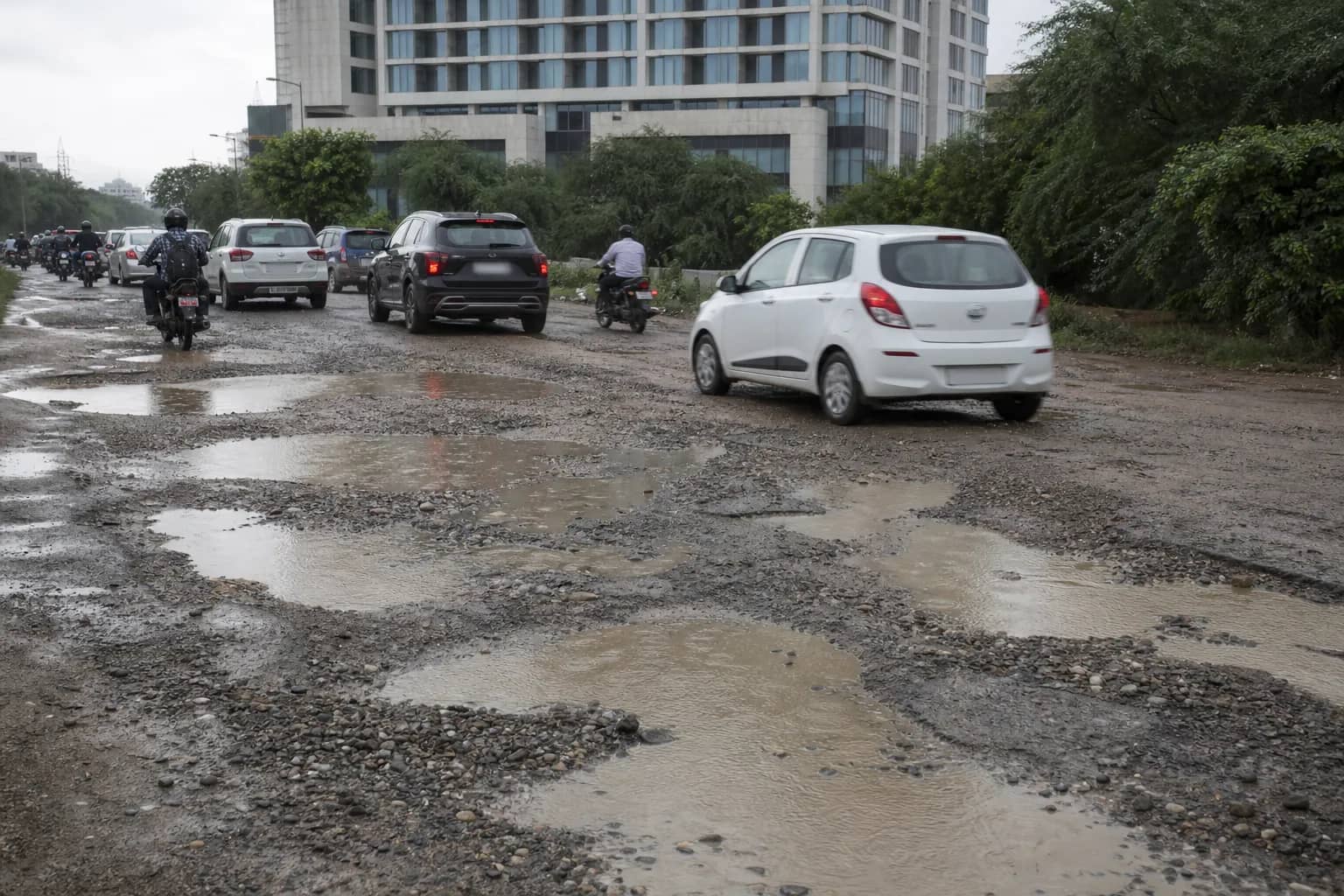
GURUGRAM: A badly damaged service road near Kherki Daula toll has become a daily obstacle course for commuters, with deep potholes, loose gravel and mud forcing vehicles to slow or swerve near the Sector 76-77 junction.
The affected stretch lies opposite Hyatt Regency and carries local traffic alongside the Delhi-Jaipur highway corridor. Commuters say the road has remained in poor condition for more than three months even though it was resurfaced only about a year ago.
Monsoon rain has made the defects harder to judge. Water settles in the craters, concealing their depth from motorcycle riders and small-car drivers. When the surface dries, broken aggregate turns into dust and loose stones, creating a different hazard for vehicles travelling close together.
Heavy trucks using the service lane add stress to an already weakened surface. Residents have also complained about wastewater allegedly reaching the road from a nearby residential development. That allegation requires inspection, but any persistent discharge would accelerate the loss of the road base and make fresh bitumen fail early.
Patch repairs have not held
Users of the stretch say repeated patchwork has delivered only temporary relief. Filling the visible hole without correcting drainage or rebuilding the damaged base can produce a familiar cycle: the patch breaks at its edges, rain enters the joint and a larger crater returns.
The location makes that cycle especially risky. Service roads absorb turning traffic, buses, goods vehicles and commuters entering or leaving nearby sectors. A rider trying to avoid one pothole can be pushed into the path of a vehicle coming from behind, while sudden braking creates a chain-reaction risk during busy hours.
Repair work should begin with a joint inspection of the carriageway, drains and any suspected wastewater outlet. The responsible road agency must establish whether the failure is limited to the top layer or extends into the foundation. If water is entering from the side, resurfacing before stopping the flow will merely reset the clock on the next failure.
A test of routine road maintenance
Gurugram's large road projects receive attention because of their scale, but service roads often shape the last kilometre of an everyday journey. Their condition affects residents, hotel and office staff, delivery workers, school transport and highway users who need a safe place to enter local streets.
Until permanent repairs are completed, the deepest craters need proper barricading and reflective warnings, particularly at night. Loose debris should be cleared rather than left at the edge of moving traffic. Temporary measures are not a substitute for reconstruction, but they can reduce immediate risk.
The quick deterioration after resurfacing also warrants a review of material quality, thickness and drainage provisions. A repair that survives only one monsoon is poor value regardless of how quickly it was laid. For the Kherki Daula stretch, the useful outcome will be a durable surface with a clear water exit, not another thin patch before the next shower.