
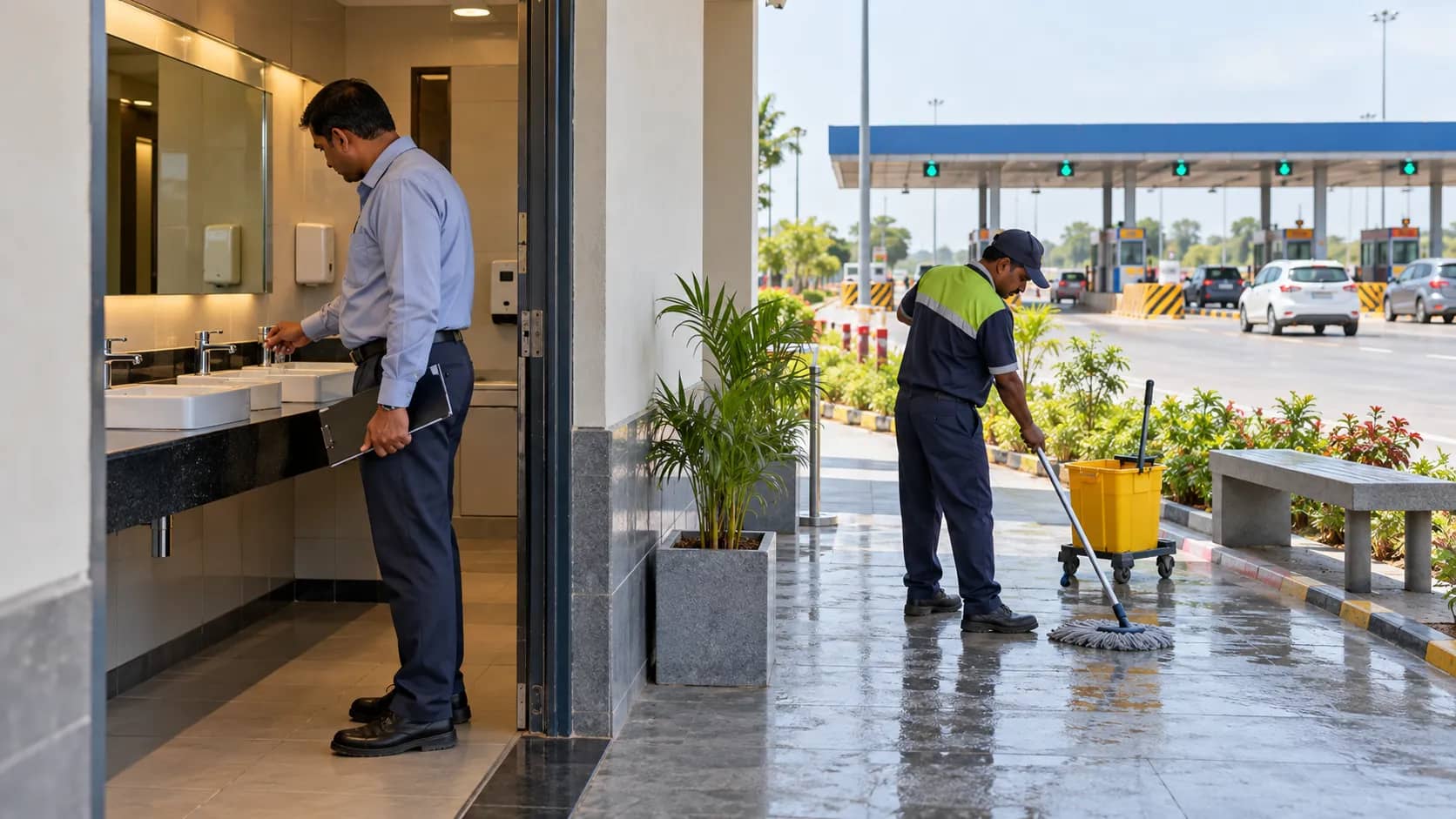
NHAI has directed field officials to inspect toilets and other public-facing facilities at its covered toll plazas at least once a week, with unresolved maintenance failures potentially costing collection agencies access to future bids. The tighter monitoring mechanism was announced by the Ministry of Road Transport and Highways on 12 October.
The checks extend beyond toilet blocks to toll booths, surrounding areas and signboards. The mechanism applies to publicly funded plazas and other plazas where NHAI appoints the user-fee collection agency. It should not be read as a new inspection rule covering every toilet beside every highway.
A notice must lead to documented corrective action
Under the official announcement, a deficiency found during inspection triggers a show-cause notice to the responsible collection agency. The agency is directed to rectify the problem within the stipulated period. The release does not prescribe one universal number of days for every type of defect.
The notice and dated photographs are to be uploaded to NHAI's Data Lake portal. The agency must then submit a reply and photographs showing the corrective work. Field units are responsible for monitoring progress and whether the deficiencies are addressed within the specified time.
That creates a record of both the inspection and the claimed repair. The requirement is more specific than asking an operator to say a toilet has been cleaned: the notice, date and photographic response form part of the process that officials are expected to follow.
The bidding restriction is linked to unresolved deficiencies across an agency's operations. If the number of unresolved notices reaches or exceeds 10 per cent of the total toll plazas operated by that agency, it will be classified as a non-performer, according to the release.
Such an agency becomes ineligible to participate in NHAI bidding for toll plazas, regular toll-plaza contracts, civil works or other bids for 15 days or until all pending deficiencies are rectified. This is the wording given in the announcement; the release does not set out a separate monetary amount for this new bidding consequence.
Existing penalties remain relevant. Where a deficiency breaches the contract or prescribed service standards, NHAI says the applicable penalty will still be imposed under existing provisions and guidelines. The new inspection and bidding mechanism operates alongside those obligations rather than replacing them.
The public-feedback route remains available
Travellers can continue using NHAI's Clean Toilet Picture Challenge. A 23 July announcement extended it to 30 June 2027. It is an existing reporting scheme, not a reward programme newly launched with this week's inspection order.
NHAI's July extension also gave a record of payments: around 429 commuters had received Rs 1,000 FASTag recharges in 2026 by that date for reporting unclean toilets. The challenge began in September 2025.
Reports through the Rajmargyatra app need clear photographs carrying location and time information, along with the facility location, the person's name, mobile number and vehicle registration number. The scheme covers toilets under NHAI's jurisdiction, excluding fuel-station, dhaba and other facilities outside its control.
An eligible, verified report can receive Rs 1,000 as a FASTag recharge linked to the vehicle registration number. Each registration number can receive only one reward during the scheme, and the benefit cannot be transferred or taken as cash. Where several people report the same facility on the same day, only the first valid submission qualifies.
Entries undergo AI-assisted screening and manual validation where required. Submitting a photograph therefore does not automatically establish entitlement to a reward. These conditions distinguish the feedback programme from the separate weekly inspection and agency-enforcement process.
What highway users can take from the order
The announcement sets out a procedure for finding and following up on maintenance failures. It does not certify that every covered facility is already clean, nor does it publish inspection results for individual plazas. A traveller's current experience still depends on the actual condition at the stop being used.
Dalimss News has separately explained Paranur's barrierless tolling and FASTag rules and NHAI's wildlife-crossing work. For the new facilities order, the next evidence of implementation will be the weekly inspections, recorded notices and documented closure of defects, rather than the announcement alone.