Neuron Industries has announced a $10 million seed round to develop industrial controllers and the software used to programme machinery. The October 29 announcement names FCVC and Obvious Ventures as co-leads, alongside Y Combinator, Thin Line Capital, Zee Prime Capital and Founder Factor. The financing follows the company's public launch in August.
The company says the money will support a wider family of control equipment, including its own input and output hardware and operator displays. It also plans to add production capacity in the United States. These are development and manufacturing plans, rather than an announcement that the complete product range is already shipping to customers.
Kenneth Rhee's company profile describes software designed to make machine behaviour testable, with unit tests, simulation and version control built into the controller. Its stated purpose is to give controls engineers development tools familiar from software engineering. This is the company's design approach, rather than independent evidence that every generated programme will behave correctly on equipment.
A controller with its development tools built in
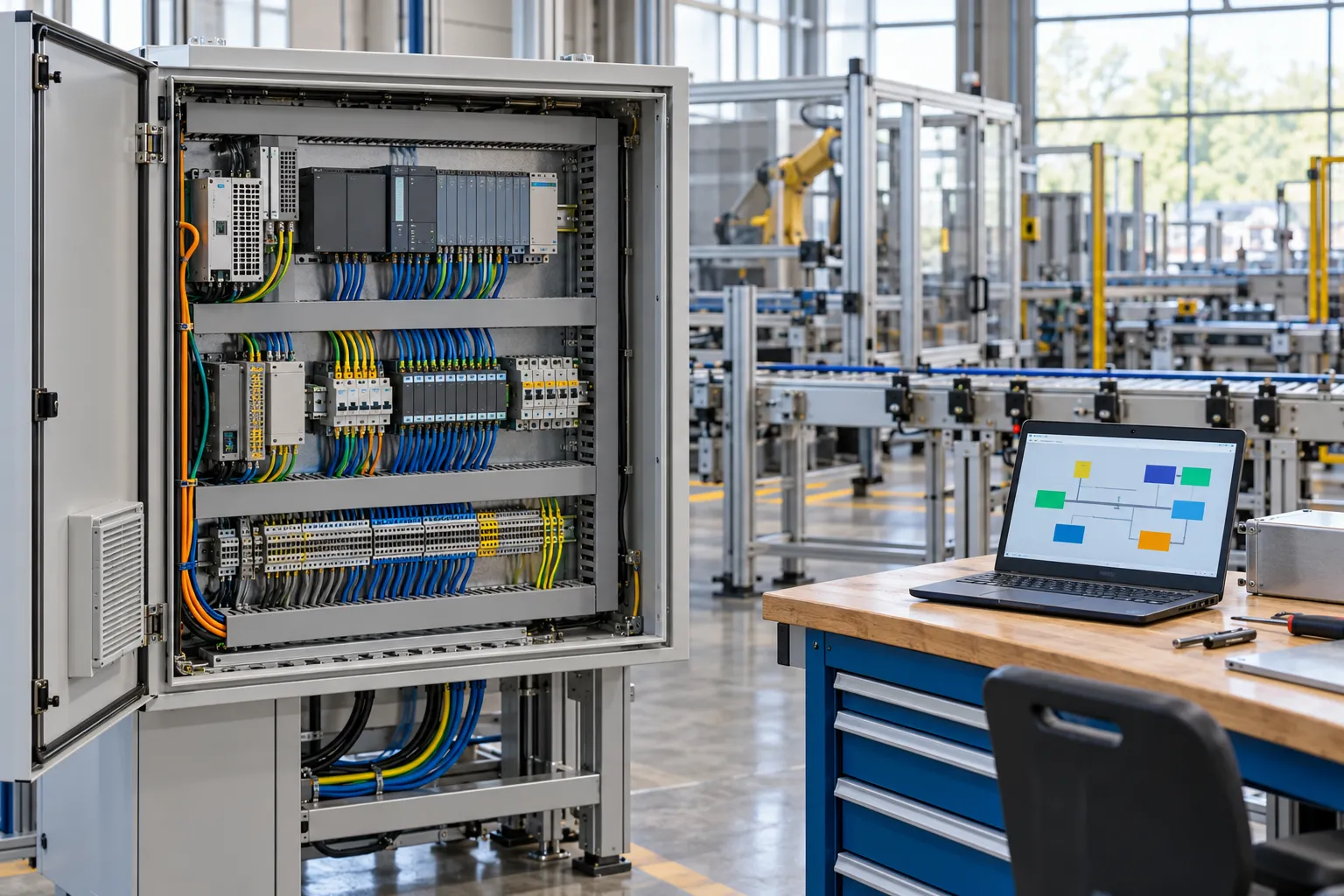
Neuron's current product page describes a device combining machine control with Synapse, its browser-based development environment, an operator interface and a store of process data. The company says engineers can describe required behaviour in ordinary language and inspect the resulting Python code. Its stated design also allows the tools and stored history to operate without an internet connection.
The current roadmap separates two configurations. Cortex Mini is listed for the first quarter of 2027, while Cortex is listed for the second quarter. Neuron labels those launch windows as estimates and its specifications as production targets that may change. This is more specific than the funding release, which referred broadly to a first-quarter Cortex release.
The website also marks UL and CE certifications as planned for both configurations. Those labels should not be read as completed certification. Buyers assessing the technology therefore have to distinguish the company's published design and delivery targets from capabilities or approvals demonstrated on a delivered production unit.
What the investor and an earlier project show
Obvious Ventures' own investment account, dated October 29, confirms its participation in the seed round. It describes programmable logic controllers, or PLCs, as the computers responsible for actions such as moving conveyors and opening valves. Its investment thesis is that new hardware and software can make those controls easier for engineers to develop and maintain.
The investor names NOX Metals, Lazarus Energy and Rise Reforming among companies working with Neuron. These are statements from a backer of the business, not independent performance tests. The account points to industrial users as the intended customer base, rather than consumers buying a general-purpose AI application.
A more detailed example appears in Neuron's August case study about CureWood in Surrey, British Columbia. The company says it replaced the controller on a finger-jointing line originally commissioned in 1991. Its description covers a machine with cutting stations, saws and a hydraulic press, connected through 189 hardwired input and output points.
According to that account, the team compared the recovered programme with the version actually running on the old controller and found differences from the documentation. It then tested the replacement programme in a simulation. Neuron says the physical changeover took one eight-hour shift. This is an earlier company-reported installation, not a new October deployment or a guarantee of identical results elsewhere.
The case study says the hardwired emergency-stop and guard circuits were left unchanged. It also says the old controller was removed intact, retaining a physical route back to the previous arrangement. Those details describe the boundaries of this particular retrofit; they do not establish certification or suitability for every industrial application.
The founders' previous work
Neuron's profile of chief executive Dennis Ren traces the hardware work to his time at Freeform, where he developed real-time controls and input/output devices for metal printing. Its profile of chief technology officer Kenneth Rhee describes WorkIPO's manufacturing software for Freeform as the collaboration that preceded Neuron. The funding now backs their effort to turn that combination of hardware and software experience into a broader industrial-controls business.
Related coverage: Cohere's Series E financing and Nevis's Series B and enterprise software plans.