
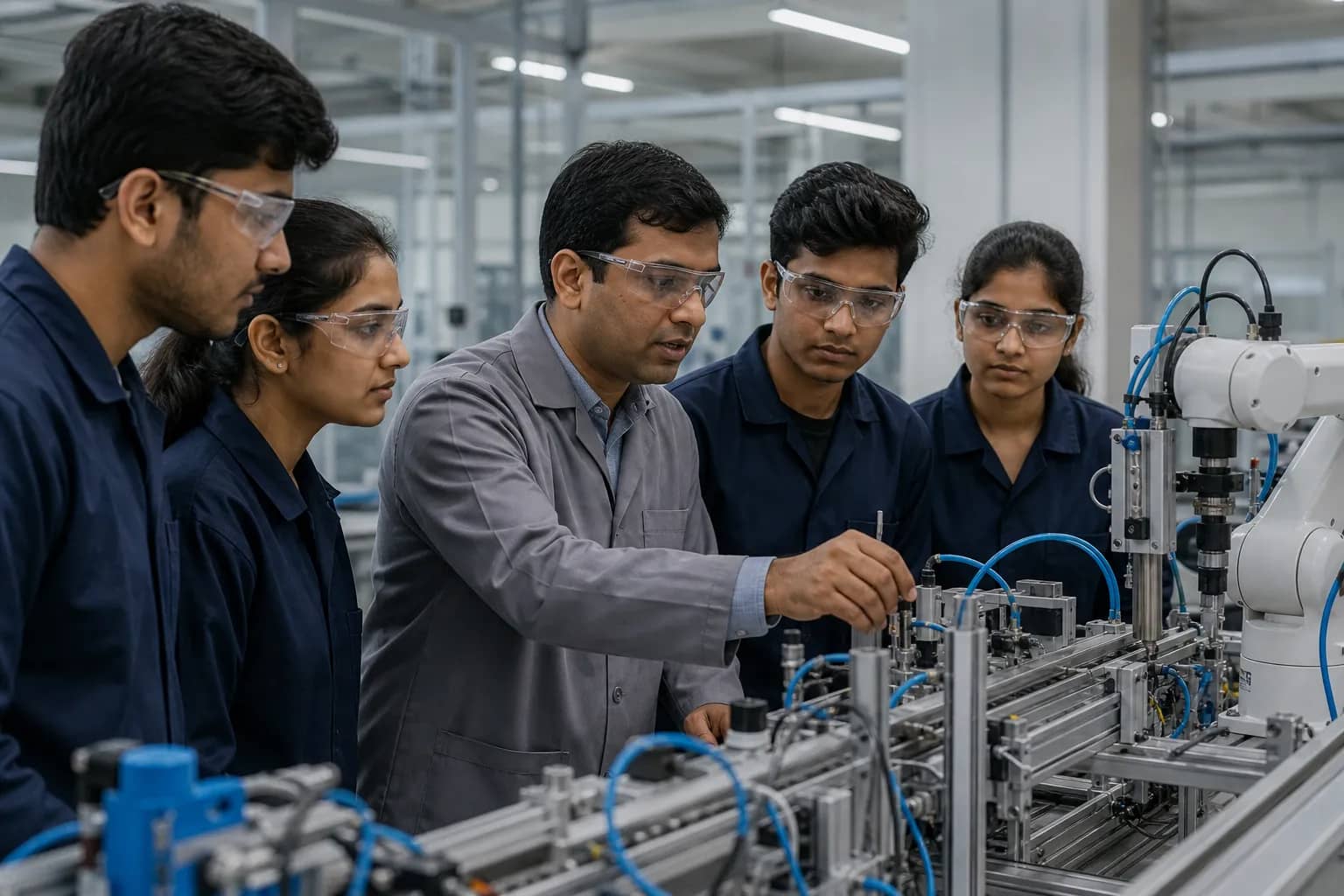
The University of Mumbai has introduced an apprenticeship-embedded Bachelor of Engineering pathway that will allow a limited group of final-year students to complete a full year of industry training as part of their degree. Up to 15% of final-year BE students may enter the route, subject to academic eligibility and merit-based selection.
The apprenticeship will run through the seventh and eighth semesters. A student on the pathway must complete at least 1,260 hours of practical training and will receive 42 academic credits for the year. That makes the arrangement a formal part of the engineering curriculum, not an optional internship added after regular classes.
The university's Academic Council approved the Apprenticeship Embedded Degree Programme under the Faculty of Science and Technology. The initiative is aligned with the experiential and employment-oriented approach of the National Education Policy 2020 and relevant technical-education guidelines.
Who can enter the programme
The first academic filter is a minimum CGPEA of 6.75 in the fifth semester. Selection will be made on merit, with preference going to students with higher CGPAs. Since participation is capped at 15%, reaching the minimum score makes a student eligible for consideration but does not guarantee a place.
Students who have opted for an Honours programme, a Minor, or Honours with Research are not eligible for this apprenticeship route. That exclusion creates an important choice for students planning the final year. One pathway offers a specialised academic or research credential, while the new option replaces much of the conventional final-year structure with supervised industry learning.
Students should check the exact CGPEA recorded by their college rather than trying to convert marks informally. They should also wait for their institution's implementation notice covering applications, the merit list and the available industry positions.
A full academic year in industry
The requirement of at least 1,260 training hours signals a substantial workplace commitment across two semesters. Students may be exposed to live projects, production or service processes, current technologies, quality systems and professional routines. The university also expects the experience to strengthen communication, teamwork, problem-solving, decision-making and time management.
The 42-credit allocation is equally significant. Credits are the academic value attached to successful learning, so the apprenticeship must involve more than attendance at a workplace. Colleges and industry partners will need clear supervision, assessment and documentation to show that students have met the programme outcomes.
For students, this means the name of an employer should not be the only consideration. The quality of mentoring, relevance of assigned work, safety arrangements, assessment method and opportunity to apply engineering knowledge will determine whether the year produces meaningful learning.
What students still need to confirm
The announcement sets out the broad academic design, but students will need institution-level details before opting in. These include the application timeline, participating employers, branch-wise opportunities, attendance rules, evaluation pattern, stipend arrangements, travel expectations and the process for addressing a workplace grievance.
An apprenticeship should also not be mistaken for a job guarantee. It can give a student evidence of workplace competence, professional contacts and a clearer understanding of industry expectations, but recruitment will still depend on the employer's needs and selection process. Students should seek written terms before accepting a placement and understand how a disruption in training would affect their credits and graduation timeline.
Bridging the classroom-workplace gap
Engineering colleges have long used short internships and final-year projects to provide practical exposure. The Mumbai University route goes further by assigning an entire year's credit load to structured industry training for selected students. It can reduce the distance between a classroom problem and the constraints of an actual plant, laboratory, design team or technology operation.
Vice-Chancellor Ravindra Kulkarni has presented the programme as a response to an environment in which a degree alone may not be enough. The university's stated objective is to combine institutional knowledge with industry requirements so that graduates understand professional practice before completing their course.
The outcome will depend on execution across affiliated institutions and employers. If colleges protect academic standards and industries provide genuine engineering work, the route could give selected students a strong transition into employment. If placements are poorly matched or weakly supervised, a large credit allocation could magnify those shortcomings. Transparent selection, detailed agreements and regular academic review will therefore be as important as the headline promise of one year in industry.