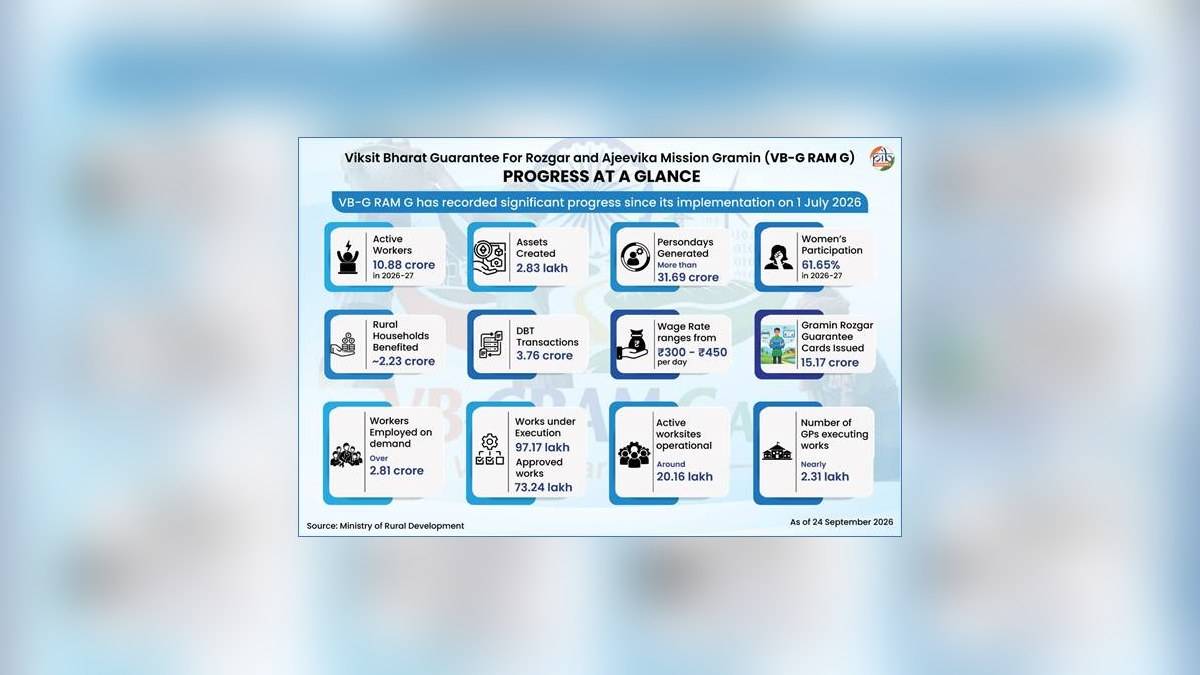
Existing MGNREGA job cards with completed e-KYC continue to be valid until new Gramin Rozgar Guarantee Cards are issued, according to the government's official transition guidance. Readers searching for MGNREGA job card validity in 2026 also need to know that the Viksit Bharat-G RAM G Act, 2025 took effect on July 1, 2026. It replaced MGNREGA and provides a statutory guarantee of 125 days of wage employment per financial year to eligible rural households.
| Question | Official position |
|---|---|
| New framework began | July 1, 2026 |
| Annual employment guarantee | 125 days per eligible rural household |
| Existing cards | e-KYC completed cards remain valid until replacement cards are issued |
| Registration authority | Concerned Gram Panchayat |
| Work after application | Within 15 days |
Is an old MGNREGA job card still valid?
The official PIB FAQ, dated May 11, 2026, ties continuity to the issue of new cards under the replacement law. It says existing cards for workers with completed e-KYC continue until the new Gramin Rozgar Guarantee Cards are issued. That is the relevant transition rule, rather than assuming the change in the law automatically invalidated every older card.
The accompanying government commencement note also says employment must not be denied merely because e-KYC is pending. It provides for assistance to complete e-KYC, including at worksites where needed. These are two connected but distinct points: continuity of verified existing cards, and protection against denial solely over pending verification.
A worker whose record is unclear should ask the Gram Panchayat to check the household's registration, verification position and replacement card status. Keep the existing card and any relevant acknowledgments available when requesting that check. An online search result showing the old scheme name does not establish that a household has been removed from the current programme.
Who can register for a new rural employment card?
The FAQ describes eligibility in terms of a rural household whose adult members volunteer for unskilled manual work. A household without an MGNREGA job card can approach its concerned Gram Panchayat through an adult member. The registration details specified in the guidance are the names, ages and address details of the household.
Ask the Panchayat which supporting identity, residence, account and verification records are needed for the local registration process. The public FAQ does not publish one universal upload checklist for every state, so a document list copied from an unrelated state portal should not be treated as a national requirement. Registration and the request for actual employment are separate steps.
How to demand work and check the 15-day rule
Adult members can demand employment through the Gram Panchayat. The published channels include an oral request, a written application using the existing Form 6, or digital platforms. The request can be made to the Gram Panchayat, Programme Officer or another authorised person. The official timeframe is employment within 15 days of the application.
For a status enquiry, identify which stage needs checking: household registration, a work demand, work allocation, attendance or wages. Ask for the relevant record and keep the application details so that the office can trace it. The guidance places household registration, receipt of work applications and maintenance of programme records within the Panchayat's responsibilities.
If work is not provided within the stipulated period, the official guidance provides for unemployment allowance payable by the state government. It specifies at least one-quarter of the notified wage rate for the first 30 days during the financial year and at least one-half for the remaining period. This is a conditional entitlement under the law, not an automatic fixed payment to everyone holding a card.
What changed from the old 100-day guarantee?
The statutory household guarantee increased from 100 to 125 days per financial year. It is a household entitlement, so readers should not interpret 125 days as a separate allocation for every adult member. PIB's October 24, 2026 factsheet confirms that the replacement framework came into force on July 1.
State governments must notify periods covering peak agricultural seasons during which programme works will not be undertaken. The FAQ also says employment should, as far as possible, be within five kilometres of the applicant's village. Where work is farther away but within the block, an additional 10% of the wage rate is provided for transport and living expenses.
Wages are paid into workers' individual bank or post office accounts. The FAQ states weekly payment, or no later than a fortnight after muster roll closure. It separately specifies delay compensation of 0.05% of unpaid wages per day when payment is delayed beyond 15 days after muster closure. Confirm the applicable record and state process with the programme office before calculating or expecting a payment.
For related official portal explainers, read our guides to e-Shram registration, CPGRAMS grievance tracking and free legal aid eligibility. Those are separate services. For this employment programme, the Gram Panchayat and block Programme Officer are the practical starting points for registration, demand records and unresolved status questions.