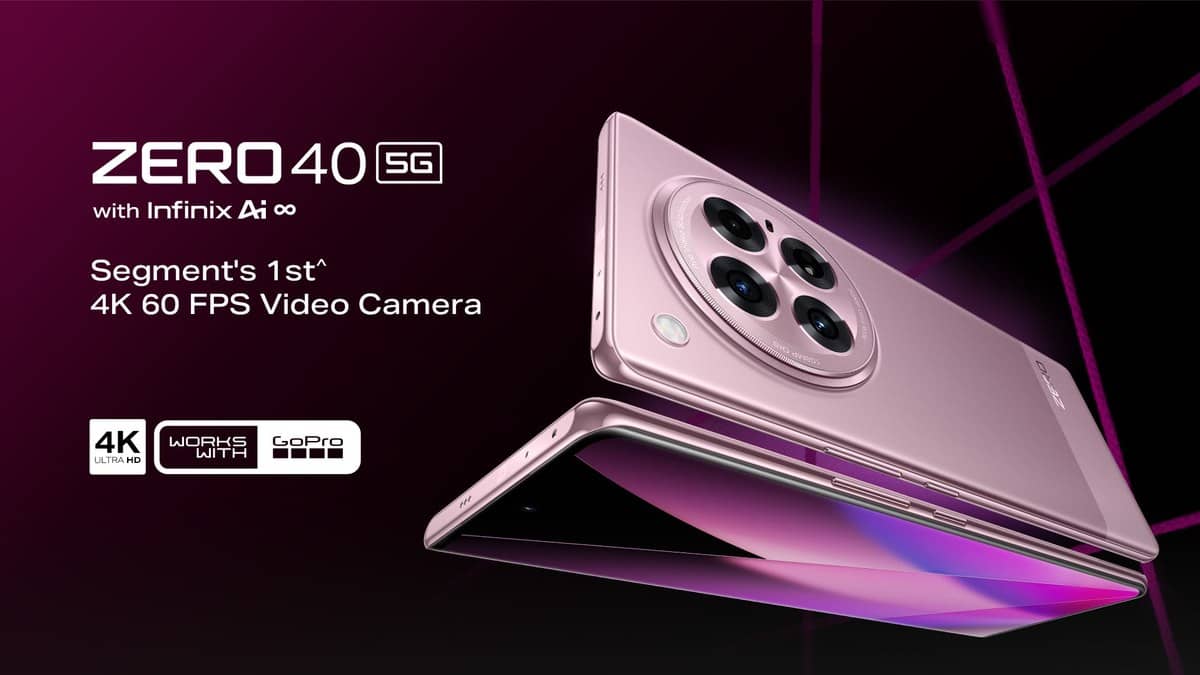
NEW DELHI: Infinix Zero 40 5G supports 4K video recording at 60 frames per second from its front and rear cameras, according to the brand's India product page. The practical benefit is the ability to use the same headline recording format when moving between a piece to camera and footage of the scene in front of you.
| Camera or option | Officially listed detail |
|---|---|
| Front camera | 50MP, with 4K 60FPS recording |
| Main rear camera | 108MP with optical image stabilisation |
| Recording claim | 4K 60FPS from front and rear cameras |
| Selected store version | 12GB RAM, 256GB storage, Rs 27,999 |
| Other listed storage | 12GB RAM, 512GB storage; price not exposed in the readable selection |
Price as of 1 November 2026, 00:28 IST. The verified figure applies to the selected Rock Black, 12GB and 256GB version. It is not a confirmed price for every storage option. This article explains the camera specification rather than supplying a replacement for the model's existing price list.
Why matching front and rear video matters
Imagine recording a short report from a college festival. The introduction uses the selfie camera, while the stage, crowd and exhibition use the rear camera. Matching the intended recording format before filming makes the editing plan clearer. The advertised capability means the front camera is part of that plan, rather than merely a fallback for a quick introduction.
It does not follow that both cameras produce identical pictures. The direction of the light, the subject's distance and the way the phone is held can change the result. A specification shared by both cameras is a useful starting point for a test clip, rather than proof that a change of camera will be invisible in the finished edit.
Nor is recording capability a guarantee about a video call. A calling service chooses its own quality according to its app, settings and connection. Treat the Zero 40's recording claim as a camera-file capability, not a promise that every meeting app will transmit the same format.
Separate still photographs from recording modes
The main camera's megapixel figure describes a different part of the specification from the video frame rate. A large still-photo number should not be read as the resolution of every video frame. For a project, decide the required recording mode directly instead of using the photograph specification as shorthand for video quality.
Optical image stabilisation is listed for the main rear camera. That detail belongs to that camera, and should not be extended to every camera or mode without checking. A sensible field test is to record a short stationary shot and a short walking shot, then inspect them before relying on the phone for an event that cannot be repeated.
For an interview, the framing decision also matters. Leaving space around the subject can make a later crop easier, while recording too tightly can limit the editor's choices. This is a production judgement, not a feature promised by Infinix, and it is worth settling before the actual interview begins.
Plan the files as well as the shoot
The official store offers two storage selections. If the phone is meant to hold unfinished projects, think about how footage will leave the handset after a shoot. A tidy transfer routine can be more useful than allowing recordings, exports and alternate edits to accumulate without knowing which copy is complete.
Make a short trial using the recording mode intended for the project, transfer that file and confirm it opens in the editing software. This checks the whole workflow. It also avoids discovering after an important recording that the chosen editor or sharing route needs a different export setting.
Who this camera feature is for
The front-and-rear recording claim is especially relevant to people who alternate between presenting and showing a location: students documenting an exhibition, a small shop explaining a product, or a family member narrating a trip. People mainly scanning receipts or taking occasional still photographs have a different priority.
For related model coverage, see the Infinix Zero 40 5G price list: Rs 27,999 to Rs 30,999, the Infinix Zero Flip price: Rs 49,999 in both colours and the Infinix GT 30 Pro vs GT 30 price: GT 30 starts lower at Rs 21,999. Compare their specific recording modes rather than assuming a common brand or resolution means the same camera system.
Official source: Infinix Zero 40 5G India product page.