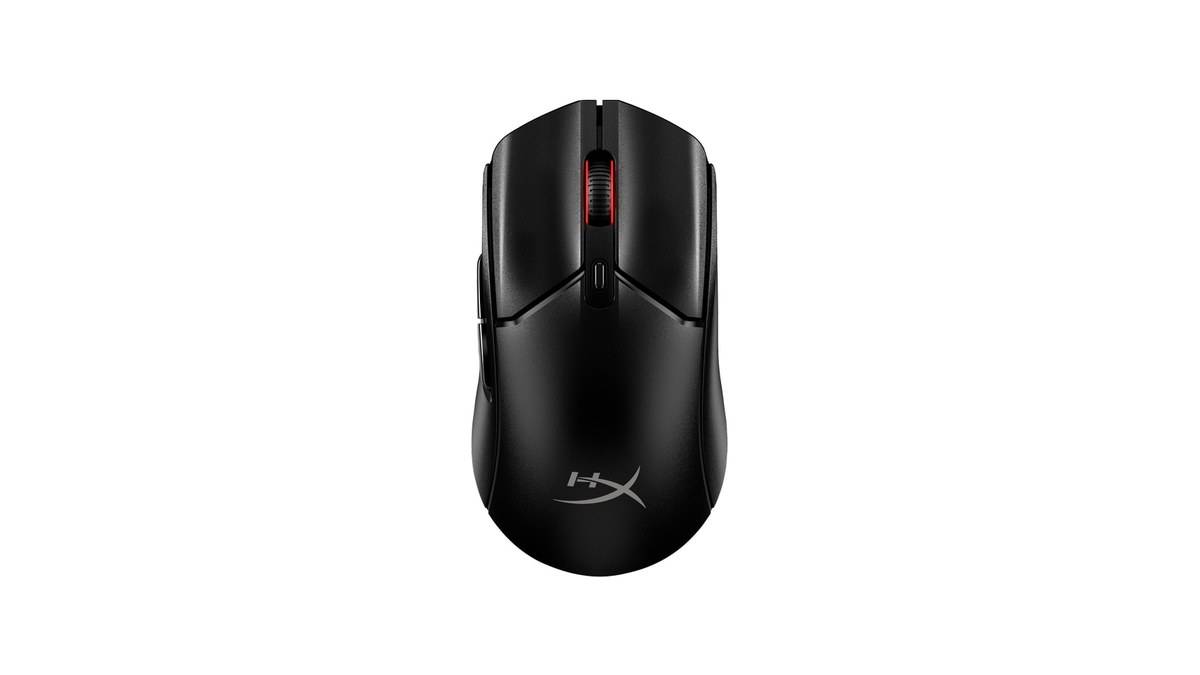
NEW DELHI: The HyperX Pulsefire Haste 2 Core Wireless claims up to 100 hours of use with its lights disabled, a AAA alkaline battery installed and the mouse connected over 2.4GHz at a 1,000Hz polling rate. HP's India store lists the Black/Black model, product code 8R2E6AA, at Rs 2,869.03 including taxes.
| Item | Verified detail |
|---|---|
| India configuration | Black/Black, 8R2E6AA |
| Listed selling price | Rs 2,869.03, tax inclusive |
| Power source | One user-replaceable AAA alkaline battery |
| Wireless modes | 2.4GHz and Bluetooth 5.2 |
| 100-hour test | Continuous use, lighting off, 2.4GHz, 1,000Hz |
| Sensor ceiling | Up to 12,000 DPI |
| Buttons | 6 |
Price as of 10 November 2026, 00:23 IST. This is the regular product-page selling figure read for the named India SKU, without applying a coupon. The complete Core Wireless name is important: a specification from another Pulsefire Haste version should not be carried across simply because the family name matches.
What the battery claim actually measures
The test is a continuous-use claim under a stated configuration. It is not a promise that every installed battery will last for the same period, nor a calendar interval between replacements. HyperX says usage and computing conditions affect the result. Lighting and connection settings therefore belong beside the headline runtime whenever it is quoted.
For an Indian laptop user who switches between work and games, that matters more than converting the claim into an invented number of days. The mouse may spend part of its time idle, part in ordinary desktop use and part in a game. Without a measured personal usage pattern, there is no sound basis for declaring an exact replacement schedule.
The replaceable battery also changes the practical routine. Power management here means keeping track of a removable cell, rather than assuming that a charging cable can refill an internal battery. HP's specification identifies the USB connection in the charging field as applying to the wireless adapter only. That should not be read as a rechargeable-mouse feature.
Bluetooth has a different performance setting
The mouse can also connect through Bluetooth. HyperX presents that mode as the option for longer battery life with a reduced polling rate. Its Bluetooth test conditions specify 250Hz, with lighting disabled and a AAA alkaline battery. The modes should therefore be compared with their settings attached, rather than as two runtime numbers describing identical operation.
Polling rate describes how often a mouse reports to the computer. HyperX's own explanation uses that distinction to separate reporting frequency from other mouse specifications. It is useful when understanding the battery trade-off, but it is not by itself a measurement of complete system latency or a guarantee of a particular result inside a game.
A practical desk arrangement might use the receiver for gaming and Bluetooth for another compatible device. That is an illustration of what dual wireless connectivity permits, rather than a claim that this mouse automatically selects the best mode for every application. The user still needs to know which connection is active.
Sensor settings and buttons have separate roles
The published sensor ceiling describes sensitivity capability. It should not be confused with polling rate or treated as a requirement to run at the maximum setting. For somebody moving between a game and ordinary desktop software, a usable sensitivity is the one that produces consistent control in the actual setup.
HyperX describes NGENUITY support for reassigning functions and macros, adjusting DPI and polling, and customising lighting. The India page's footnote requires the wireless adapter connection for that software. Bluetooth operation and access to the complete configuration workflow are consequently separate questions.
That creates a useful setup order: establish the intended connection, configure the controls and lighting, then assess battery behaviour under those settings. Changing several settings halfway through a personal runtime check makes it harder to understand what produced the result. Keep a note of the active mode and lighting choice so comparisons between batteries reflect a similar daily routine. This is a suggested way to interpret use, not an independent endurance test.
Who it is for
The Core Wireless specification fits a PC user who wants receiver and Bluetooth options and accepts a replaceable battery. Its appeal is the combination of those connection choices with customisable controls. Someone expecting internal USB charging should settle that requirement before treating it as interchangeable with another wireless Haste model.
Related reading: our Gadget and accessory price guide, HyperX Cloud III price list: Rs 7,299 to Rs 7,498.99 and HP 430 Multi-Device Wireless Mouse price: Rs 2,229 cover other parts of a PC desk.
Official sources: HP India price and test footnotes and HyperX product specifications.