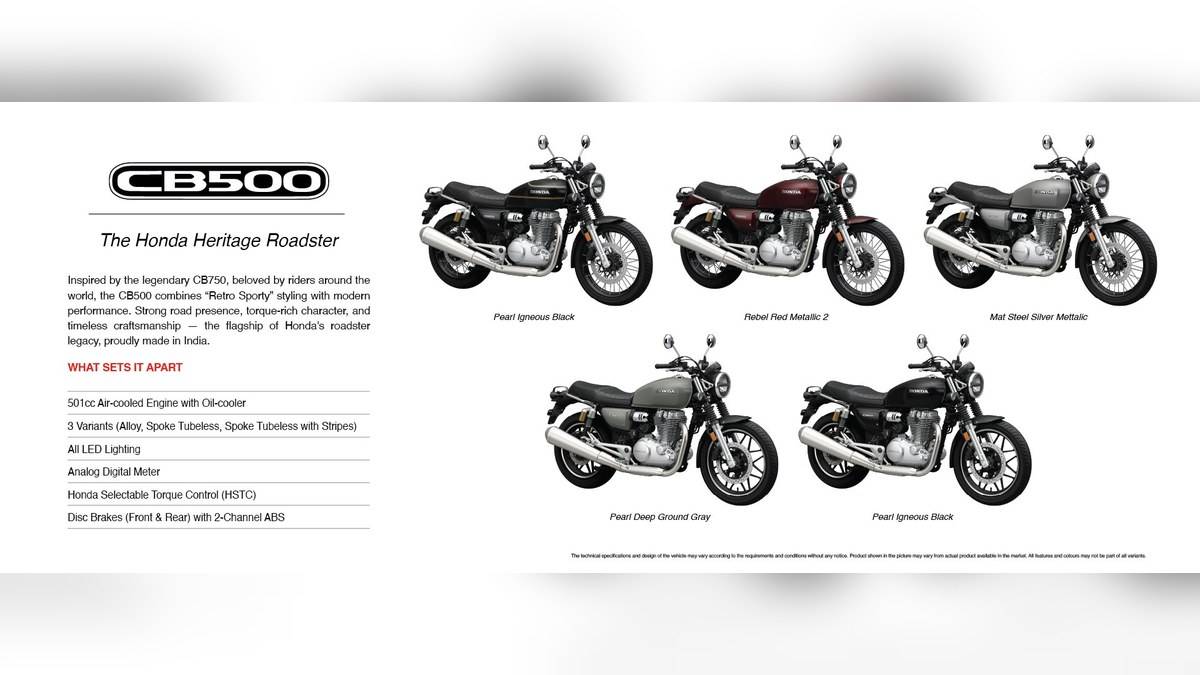
NEW DELHI: Honda's Rebel 300 starts at Rs 2,22,000, below the CB500 Alloy's Rs 2,75,000, according to their official India pages. Both figures are ex-showroom Bengaluru. The comparison is unusually close at the upper end of the Rebel range: its E-Clutch version is listed at Rs 2,62,000, putting a different kind of technology beside the CB500's larger engine.
| Official India listing | Rebel 300 | CB500 |
|---|---|---|
| Entry variant and price | Standard: Rs 2,22,000 | Alloy: Rs 2,75,000 |
| Other variants | E-Clutch: Rs 2,62,000 | Spoke: Rs 2,99,900; Spoke with Stripes: Rs 3,01,900 |
| Price basis | Ex-showroom Bengaluru | Ex-showroom Bengaluru |
| Engine described by Honda | 286cc, liquid-cooled | 501cc single-cylinder, air-cooled with oil cooler |
| Format | Bobber-inspired cruiser | Heritage roadster |
Price as of 7 November 2026, 23:52 IST. Honda says the amount applicable at delivery can vary with the model, variant and state. These are published ex-showroom figures, so they should not be read as a final registration-and-insurance-inclusive bill for another city.
Two different uses of the extra money
The Rebel's choice is about clutch operation within the same model family. Honda describes E-Clutch as a system that manages clutch operation while the rider changes gears. The CB500's choice runs through wheel and appearance variants. A higher-priced version therefore means something quite different in each showroom conversation.
This is why comparing only the cheapest badges misses the interesting part of the pairing. Someone discussing a Rebel E-Clutch and someone discussing a CB500 Alloy are looking at prices much closer together than the entry points suggest. The choice is between a rider-assistance feature and a different motorcycle layout, rather than a simple progression through one specification ladder.
The CB500's engine description also needs to be read carefully. Honda explicitly calls it a single-cylinder engine. The model name alone is not enough to infer cylinder count or import specifications from another Honda carrying a similar capacity badge in another market. The India announcement is the relevant reference for this comparison.
Cruiser equipment versus heritage presentation
Honda's India portfolio explanation gives the Rebel 300 an LED projector headlamp, a TFT display, RoadSync connectivity and turn-by-turn navigation. It also lists disc brakes at both ends and dual-channel ABS. Those are concrete equipment points supporting its lifestyle-cruiser positioning, beyond the low-slung visual treatment.
For the CB500, Honda lists all-LED lighting, an analogue-digital instrument arrangement, Honda Selectable Torque Control and disc brakes with dual-channel ABS. The roadster presentation therefore differs from the Rebel's screen-led cockpit. An instrument demonstration is more informative here than assuming the dearer motorcycle must use the same display format.
Neither engine capacity nor the presence of an electronic aid establishes how comfortable a particular rider will feel. This comparison has no independent ride-test results. It cannot award a handling, refinement or highway-performance winner from the published descriptions, and the official pages do not supply a common tested consumption figure for a running-cost comparison.
The availability caveat is model-specific
Both motorcycles were part of Honda's portfolio announcement on 24 July 2026. The current Rebel page still says detailed configurations and complete specifications will be unlocked in the third quarter of FY 2026-27, with deliveries shortly afterwards. That wording remains relevant even though an official price is already displayed.
The CB500 page makes a further distinction within its own range. It gives the third quarter of FY 2026-27 for the Alloy version, and the fourth quarter for Spoke and Spoke with Stripes, again with deliveries to follow. A price comparison can therefore be valid while the timing of the specific versions is different.
For a reader following these launches, the useful question is which exact variant the documentation describes. A CB500 price cannot, by itself, establish that every wheel version shares the same handover timetable. Likewise, the Rebel's published E-Clutch price should not be treated as confirmation of an immediate delivery slot.
Where this comparison leaves the two motorcycles
The Rebel 300 is the lower entry point and offers the separately priced E-Clutch route. The CB500 brings a larger single-cylinder engine and a heritage-roadster identity, with its own staggered variant schedule. These distinctions explain the pairing more accurately than treating capacity as a complete measure of equipment or suitability.
The comparison therefore keeps wheel versions, clutch technology and delivery timing visible alongside the amounts. Those are the distinctions most easily lost when the two model names are reduced to entry prices alone.
Related coverage includes Honda's XR300L and XR300 Rally announcement, our commuter motorcycle safety comparison and the explanation of E-Clutch on the CB750 Hornet. That last article concerns another model, so its specifications should remain separate.
Official sources: Rebel 300, CB500 and Honda's India portfolio explanation.