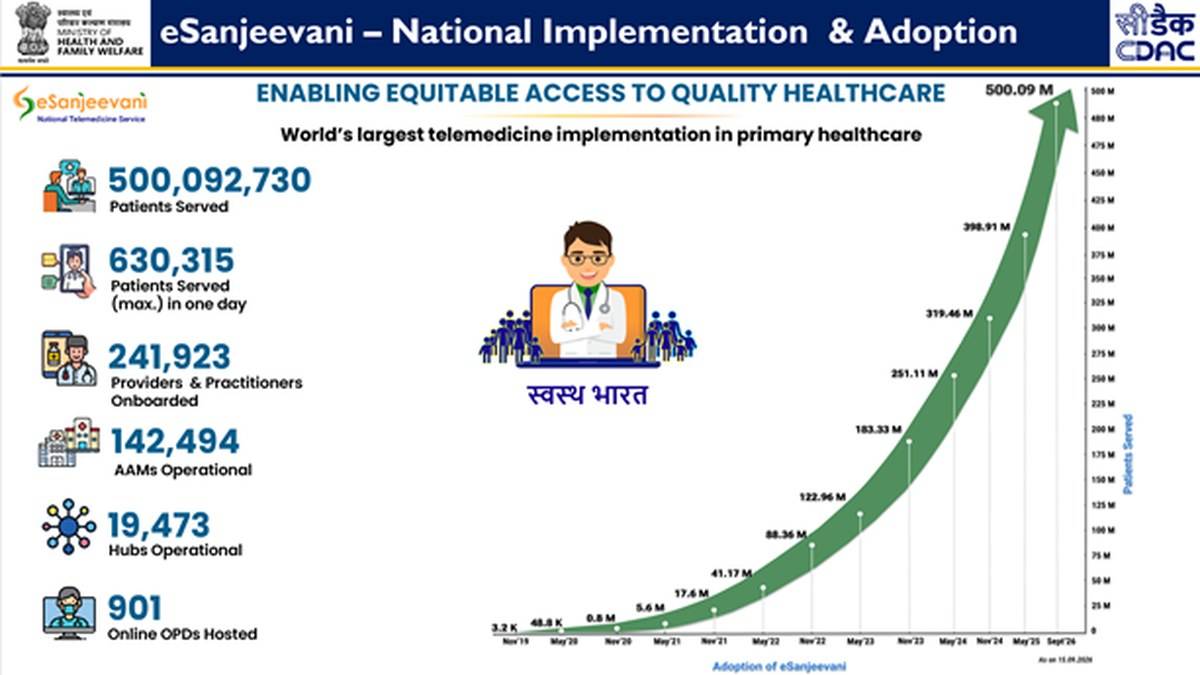
eSanjeevani OPD is India's government service for consulting doctors remotely, including from home. Its documented patient journey involves registration, a consultation token, a virtual queue, a video consultation and an electronic prescription. The consultation service is free, according to the government's published description. Start with the official eSanjeevani portal, and check the consultation options and timings available there before joining a queue.
| Point to check | What it means for a patient |
|---|---|
| Service | A remote consultation with a healthcare professional. |
| Home access | The OPD route connects a patient directly with a doctor. |
| Assisted access | Ayushman Arogya Mandirs can connect patients with medical hubs. |
| Consultation record | The documented process provides an electronic prescription after the consultation. |
How does eSanjeevani registration work?
The PIB patient instructions published on 20 August 2020 describe verification of a mobile number through a one time password, followed by patient details and generation of a patient ID and token. This explains the service's documented workflow. It should not be treated as a promise that every screen or button still has its original label; follow the instructions displayed on the official portal.
Keep the patient's details and relevant previous reports ready before beginning. The published instructions allow existing health records to be uploaded for the consultation. If you are helping a family member, make sure the information entered belongs to the person seeking care. A clear record of the patient's concern and previous consultation documents can help organise the conversation without requiring the patient to rely entirely on memory.
The token places the patient in a virtual consultation queue in the documented process. It is useful to distinguish registration from the consultation itself: creating a record does not mean a doctor has already reviewed the concern. The published process then brings the patient into a video interaction when a doctor becomes available, with permission required for camera and microphone access.
After the consultation, the documented workflow provides an electronic prescription and a link for viewing it through the registered number. Save the consultation document for future reference. Its contents are the clinician's record of that interaction; this guide does not recommend medicines, tests or a course of treatment.
Is eSanjeevani free, and is it the same as hospital insurance?
The government's April 2025 health services overview describes eSanjeevani as providing free remote medical consultations. The benefit described is access to a consultation. That statement should not be read as a guarantee that every later investigation, medicine or hospital service is included without charge.
There are also two different ways of reaching a doctor. The National Health Mission's telemedicine explanation distinguishes direct home consultations through OPD from the assisted model linking Ayushman Arogya Mandirs to medical hubs. Someone needing help with remote access can ask a local public health facility whether it provides the assisted service.
A hub is the medical team or facility supporting the remote consultation network, while a spoke is the connected local health facility. These terms describe how care is connected across locations. They do not mean a patient has been admitted to hospital, received insurance approval or been promised a particular specialist appointment.
Which doctors and specialist services are available?
In a release issued on 6 October 2026 at 9:53 am IST, the Health Ministry said patient to doctor consultations for selected specialties had been rolled out at AIIMS Jodhpur, AIIMS Jammu and AIIMS Patna. It described further expansion to other institutions as envisaged. That distinction matters: an announced direction of expansion does not confirm that every institution or specialty is already available to every user.
Check the options shown for the service you are using rather than assuming there is one nationwide timetable. A clinic name, a registration option and an available consultation are different things. This guide gives no fixed waiting time or assurance of an appointment with a named doctor. If a condition needs urgent assessment, seek urgent medical care rather than relying on an online queue.
What personal information does eSanjeevani collect?
The official privacy policy says registration information can include name, gender, age, address, mobile number, email and health records. It states that the platform assigns a patient ID associated with information uploaded to the service, and describes storage on a server managed by C-DAC Mohali. Registration therefore creates a health related record, rather than an anonymous video conversation.
The policy allows permitted profile corrections and describes a route for account deletion requests through the platform's contact page. It also says information can be retained while the account exists and in line with applicable telemedicine requirements. Readers with an existing condition should consult a qualified doctor about appropriate care and follow up.
For related public health explainers, see our articles on ABHA and consent for health records, India's government vaccination schedule and hand washing technique and timing.