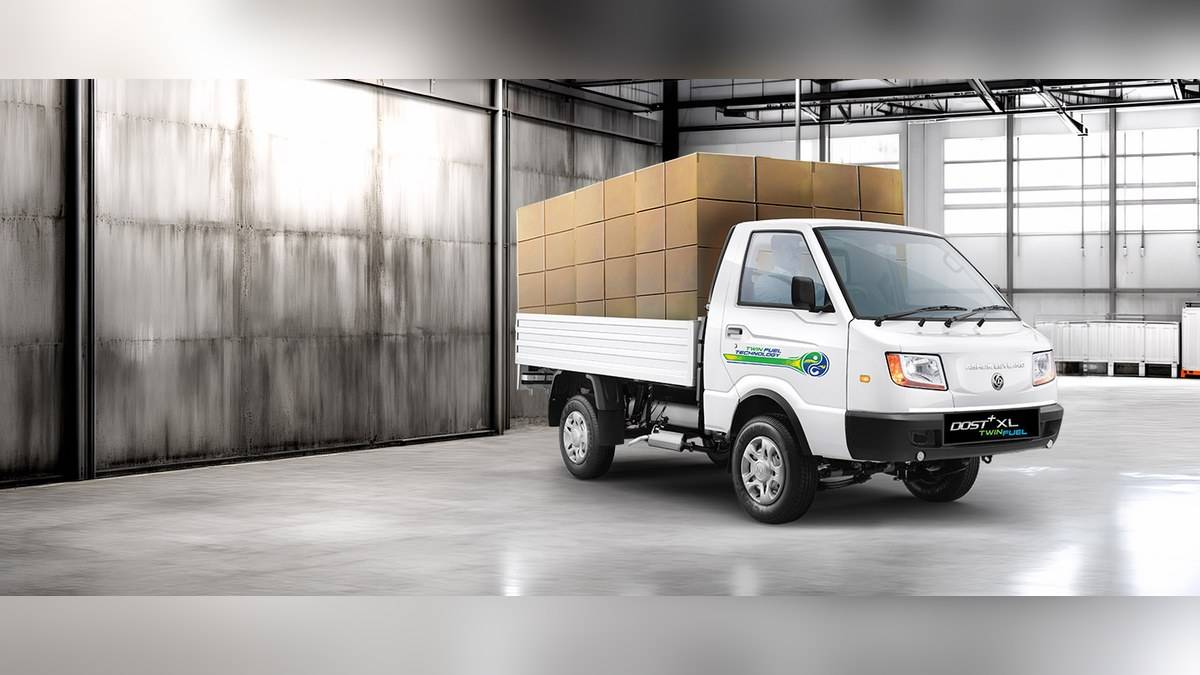
NEW DELHI: Ashok Leyland's Dost + XL Twin Fuel specification page lists a 1,410 kg payload for the FSD LS variant and 1,570 kg for CBC LS. These are separately labelled configurations. The larger figure should not be read as the carrying capacity of the finished FSD truck, or automatically carried over to a CBC vehicle after another body is fitted.
| Specification entry | Official figure |
|---|---|
| FSD LS payload | 1,410 kg |
| CBC LS payload | 1,570 kg |
| Gross vehicle weight | 2,915 kg |
| FSD load body, length x breadth x height | 2,805 x 1,620 x 440 mm |
| Loading platform height | 945 mm |
| Wheelbase | 2,510 mm |
Keep the body label beside the payload
The useful comparison is between the complete entries, including FSD or CBC and the LS designation. Do not reduce a quotation to a model name followed by a payload. Ask the representative to identify the precise configuration on the order and explain what body equipment is included when the vehicle is delivered.
In commercial-vehicle terminology, FSD describes a fixed-side deck and CBC a cabin-and-chassis configuration. For this particular truck, the official page explicitly attaches its load-body dimensions to FSD. That labelling matters: a chassis intended for subsequent bodywork should not be presented as though it already has the same working platform as the deck-bodied vehicle.
An operator planning a closed delivery body should ask for a completed-vehicle weight and carrying-capacity assessment. The proposed enclosure, floor, shelves and other equipment need to be part of that discussion. The CBC figure is a specification for the named configuration, not a promise about how much commercial cargo will remain available after any possible conversion.
Why a milk route and a parcel route read this differently
Consider a dairy distributor who needs to move cans between collection points and a local outlet. Its questions include access to the platform, the position of the load and the way the cans will be secured. The FSD measurements provide a starting point for checking the actual arrangement, but the operator still needs to assess the cans and restraints together.
A parcel operator looking for an enclosed body faces a different set of questions. It needs an opening suited to its packages, internal access and an orderly unloading sequence. Those requirements can add body equipment. Write them into the body proposal before accepting a claim that the CBC payload is the finished truck's usable consignment allowance.
Neither application can be settled by comparing the largest payload figures in isolation. The useful question is what the actual completed vehicle can carry in the form the business requires. Ask the dealer and body supplier to put their respective responsibilities on the same paperwork, so the operator can trace the final specification without relying on a verbal explanation.
Check the platform at the delivery location
Ashok Leyland gives a loading-platform height as well as the FSD dimensions. Take both to the loading point. A platform that fits the goods on paper still needs to work with the people, handling equipment and receiving area involved. Inspect the arrangement with the vehicle stationary, following the supplied operating instructions.
For a small shop supplied from the street, the last part of unloading can be more awkward than the journey itself. Establish where the truck can stand, how the load will be reached and whether the recipient has a suitable receiving arrangement. This is a site-planning exercise rather than a reason to assume that every vehicle with the same deck length will work identically.
Keep overall vehicle measurements separate from cargo dimensions when checking access. A gate or storage-yard turn concerns the complete truck; the length of an item concerns the usable body. Mark those as different checks on the delivery worksheet. If custom bodywork is proposed, obtain the completed vehicle's dimensions instead of carrying over an unmodified truck's measurements.
Confirm the Twin Fuel configuration at handover
The Twin Fuel specification distinguishes CNG and petrol operation. Request a demonstration of the actual supplied fuel controls and read the corresponding operating instructions. This article does not infer a switching procedure, fuel range or maintenance interval from the model name. Those details need the instructions that apply to the delivered version.
Our Car price guide concerns another specification question. For related body-label examples, see the Manual and power steering on the 70 hp Dost XL and How to read Maruti Super Carry's 4 petrol and CNG variants. Their figures should not be substituted for this Twin Fuel model's entries.
For the Twin Fuel truck, ask the body supplier to explain how the proposed equipment preserves access to the vehicle's fuel-system and service points. Request a demonstration on the completed vehicle before accepting the bodywork. A drawing that shows ample parcel space does not answer whether routine inspection remains practical. Keep the approved body description, completed dimensions and loading information together for workshop reference. That gives a later technician a clearer starting point than a generic Dost brochure when the operator brings in a vehicle with application-specific equipment.
Official source: Ashok Leyland Dost + XL Twin Fuel specifications.