Chowkaghat–Namo Ghat Power Lines to Go Underground in Varanasi
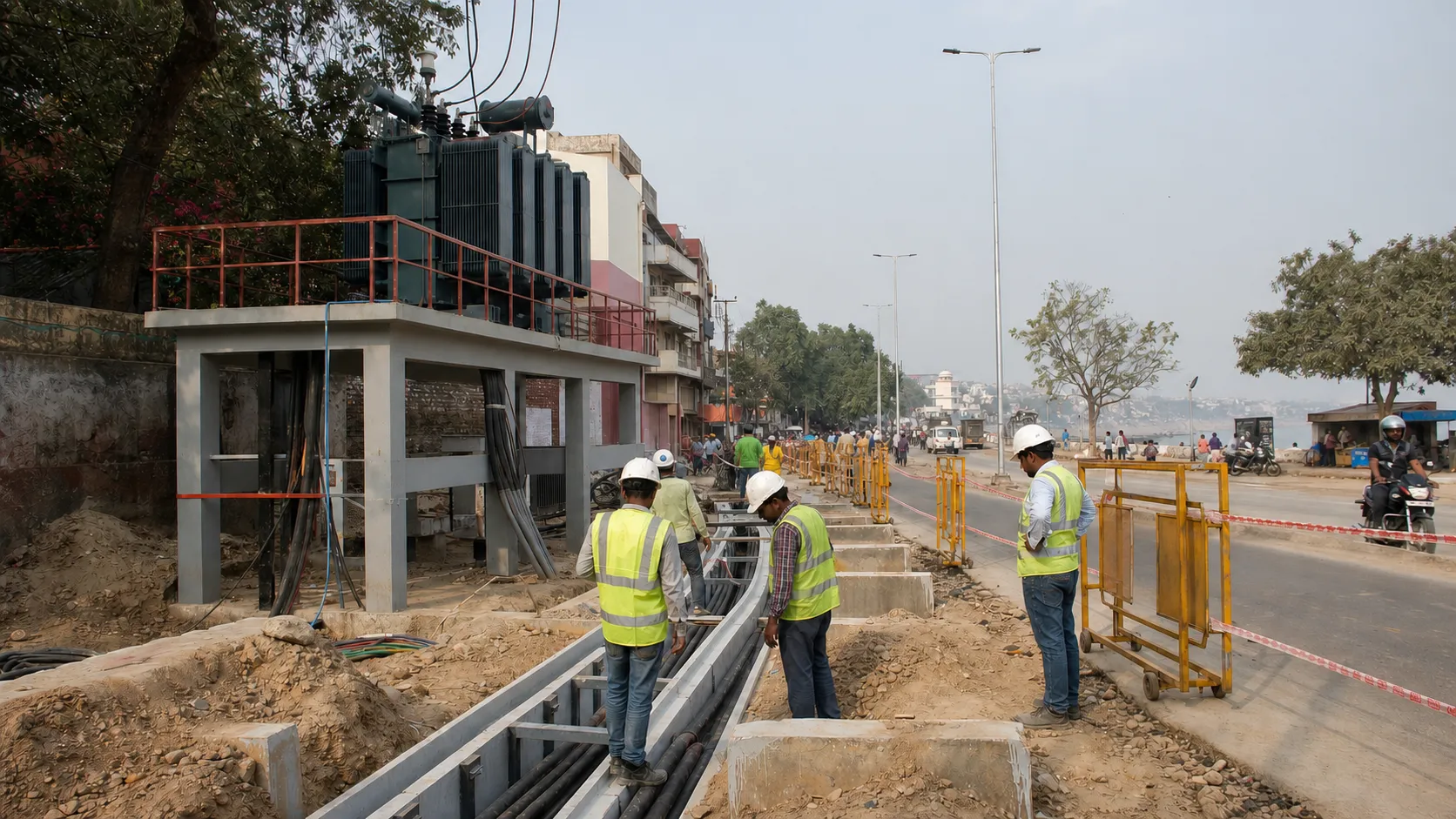
Varanasi’s electricity network is set for a visible and technical upgrade along the Chowkaghat–Namo Ghat corridor, where low-tension lines will be moved underground. The modernisation plan also includes 34 new transformer platforms and SCADA-based monitoring on 21 feeders, aimed at reducing fault-response time and improving supply reliability in the Rajghat distribution area.
The stretch is one of the city’s prominent movement routes towards the riverfront and carries a dense mix of local traffic, visitors, commercial activity and old utility infrastructure. Removing overhead LT lines would clear part of the wire clutter from the road while changing how faults are isolated and electricity is restored after a disruption.
Under the plan, 34 cemented elevated platforms are being prepared between Chowkaghat and Namo Ghat. Each platform is intended to carry a 400 kVA transformer. The transformers will be linked through an underground cable network, replacing the existing low-tension overhead arrangement along the corridor.
Ring Main Units, commonly called RMUs, are also planned below the transformers. The equipment allows sections of a distribution network to be isolated and supply to be routed through an alternative path where the system design permits. In practical terms, a fault at one point should not always force a prolonged shutdown across the entire connected stretch.
Executive Engineer Manoj Singh of Urban Electricity Distribution Division VIII, Rajghat, has said the work is being taken up under the department’s modernisation programme. No verified project cost or final completion date has been announced in the available information, so residents should treat those details as pending rather than rely on figures circulating informally.
The SCADA component is just as important as the undergrounding. Fault indicators are to be installed on 21 feeders in the division, allowing control teams to identify the likely location of a problem more quickly. Underground cables make a street cleaner and reduce exposure to some weather-related risks, but a damaged cable can be harder to locate than a snapped overhead line. Faster detection is what turns underground infrastructure into a more dependable system.
Execution will need careful street-level management. Cable routes have to account for water, sewer, telecom and other buried services. Open trenches, temporary diversions and planned outages should be communicated in advance, especially around markets and high-footfall sections. Restoration of the road surface matters too; a modern cable project should not leave behind broken edges or unsafe patches.
The upgrade also needs strong electrical-safety discipline. Transformer platforms must remain protected from unauthorised access, waterlogging and roadside dumping. Residents should report exposed equipment or damaged barricading instead of approaching it themselves.
For commuters, the most immediate change will eventually be visual: fewer low-hanging wires along a key city corridor. For consumers, the bigger test will be less visible—shorter interruptions, quicker fault isolation and stable voltage under load. If the underground network, RMUs and SCADA system are commissioned as one coordinated package, the Chowkaghat–Namo Ghat project could become a useful model for modernising other crowded routes in Varanasi.
Related Stories
Railways Orders Weekly Puja Special 09465 via Varanasi Through November
Hindi Diwas Marked Across BHU, Sanskrit University and Kashi Vidyapith

Lohta Police Register FIR After Bhitari Villager Alleges Hostage Beating
Baragaon Police Book Named Youths After Kazisaray Tea-Stall Assault and ₹1,900 Loot

Mayor Announces Stricter MCG Drive Against Stray Cattle