
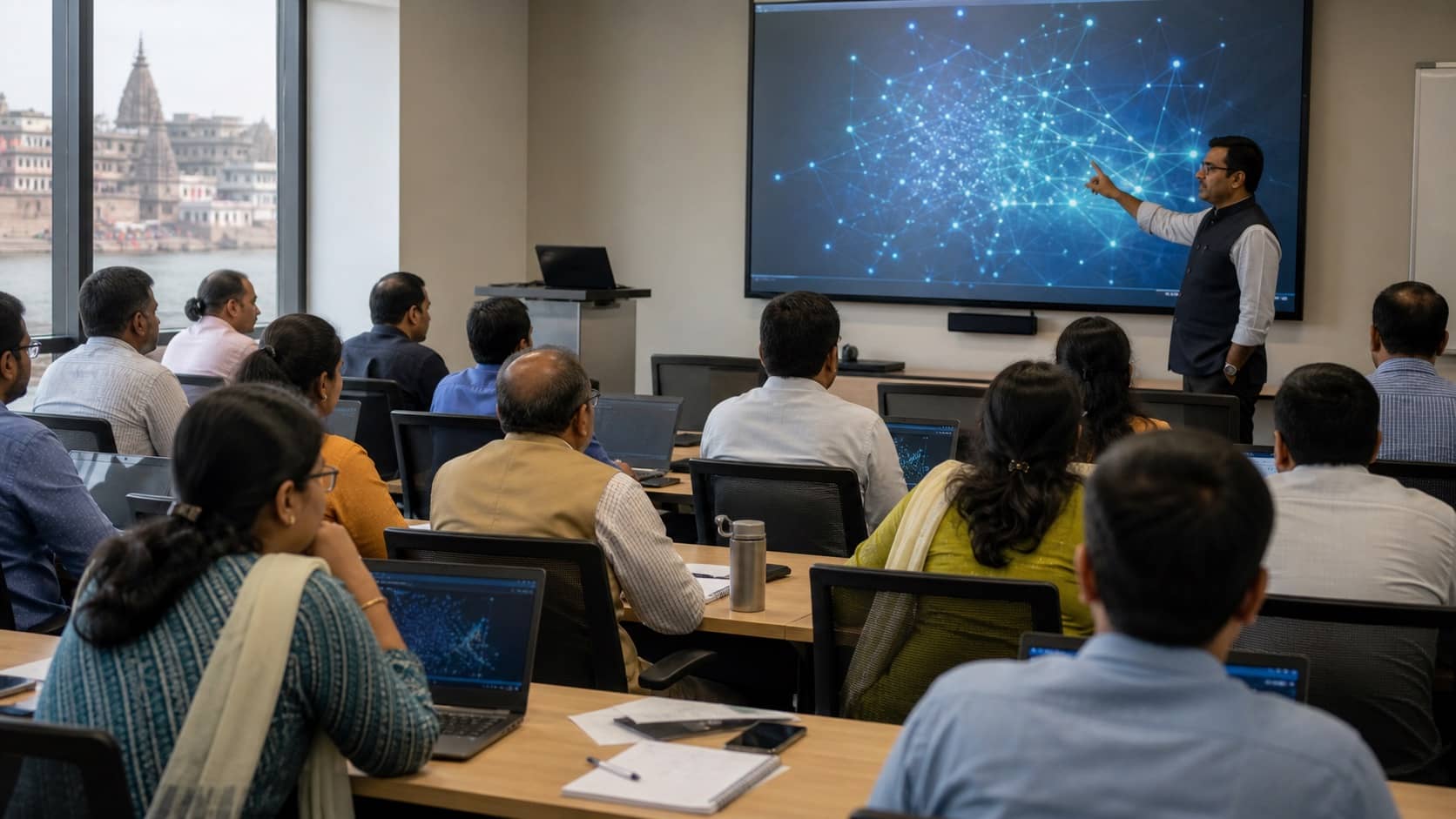
VARANASI: Banaras Hindu University has begun a six-day faculty course focused on artificial intelligence in higher education, bringing more than 50 participants from across India to its UGC-Malaviya Mission Teacher Training Centre. The programme runs through August 27 and is intended to move discussion beyond novelty towards practical classroom and research use.
Teachers from Maharashtra, Karnataka, Gujarat, Jharkhand and Kerala are among those attending. Vice-Chancellor Ajit Kumar Chaturvedi told the inaugural session that AI should be treated as an assistant rather than a replacement for teachers. The distinction set the tone for a course dealing with tools whose speed can be useful but whose output still requires expert judgment.
Prof Akhilesh Singh Raghuvanshi and Prof K Srinivas participated in the opening, while centre director Anand Vardhan Sharma outlined the institution’s training record. He said 1,248 participants had completed nine programmes out of 12 planned initiatives. Dr Awadhesh Kumar is coordinating the current course.
For teachers, the immediate uses of generative AI are easy to imagine: drafting quiz variations, translating instructions, building examples for different ability levels and summarising large sets of feedback. The risks are just as concrete. A fluent answer may contain invented citations, reproduce bias or expose confidential student information if material is uploaded without care.
The most valuable training will therefore be procedural. Participants need to learn how to verify claims, document tool use, protect personal data and design assignments that still reveal a student’s own reasoning. Simply demonstrating prompts would leave them unprepared for the disputes already emerging around authorship and assessment.
AI literacy also matters outside the classroom. Researchers are using machine learning for pattern detection, transcription and data cleaning, while administrative teams are exploring automated support. Each use needs a human accountable for the decision. A model can rank or suggest; it should not quietly determine admission, grading or discipline without explainable rules and review.
BHU’s national mix of participants can help because institutions face different constraints. A well-funded urban department and a small college with unreliable connectivity cannot adopt the same workflow. Sharing low-cost, multilingual approaches may be more useful than presenting a single technological ideal.
By the end of the six days, the test will not be how many tools teachers have tried, but whether they can decide when not to use one. Chaturvedi’s assistant-not-replacement formulation is a sensible starting point. Turning it into policy, assessment design and daily academic practice is the harder work this course has opened.